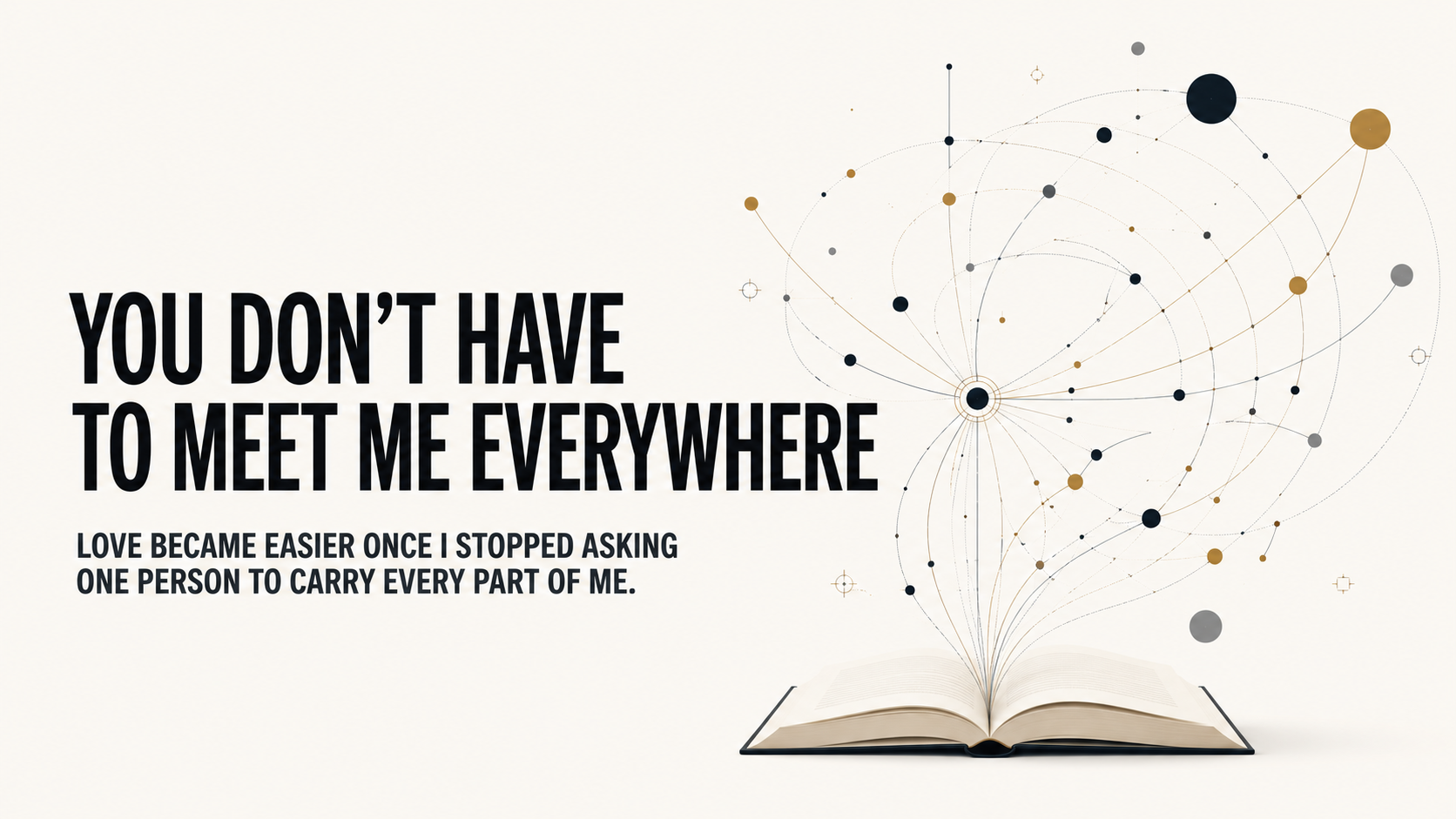
You Don’t Have to Meet Me Everywhere
Love became easier once I stopped asking one person to carry every part of me.
One of the strangest things I learned during my time at Muriel Wright had nothing to do with addiction.
At least not directly.
It had to do with expectation.
For most of my life, I expected the people closest to me to follow me everywhere mentally. I wanted partners who could move fluidly between subjects the same way I did. Artificial intelligence. Civic systems. Science fiction. Design theory. Obscure infrastructure problems. Theoretical propulsion systems. Potato soup recipes. The sociology of casinos at 03h00. Whatever strange hallway my brain decided to wander down that week.
I thought intimacy meant shared curiosity across almost everything.
When that didn’t happen, I often felt unseen.
Not immediately. Not dramatically.
Quietly.
Like there were entire rooms inside me nobody wanted to walk into.
Over time, that feeling could harden into resentment.
I didn’t fully understand how unfair that was until much later.
Because the truth is, most people are not generalists in that way. Most people have specific fascinations, specific tolerances, specific emotional bandwidth. Some people want to talk about gardening. Some people love baseball statistics. Some people care deeply about true crime or motorcycles or sourdough starters or neighborhood politics.
Very few people want to discuss transdimensional navigation theories from Star Trek over dinner.
That realization sounds obvious now.
At the time, it wasn’t.
I think part of me believed that if someone truly loved you, they would naturally become interested in almost everything that animated your mind. Not because they already cared, but because you cared.
There’s a certain arrogance hidden inside that expectation.
Not cruelty. Not narcissism.
Just a quiet assumption that emotional closeness should produce intellectual synchronization.
Life does not really work that way.
Then something unexpected happened.
I started writing again.
Not casually. Not privately.
Publicly.
I started throwing ideas into the world and discovered something I had been missing for years: distributed connection.
One person responded to the AI governance pieces. Another to the recovery writing. Another to a strange reflection about old diners, infrastructure decay, or Concorde. Someone else wanted to discuss speculative propulsion systems like we were standing in a Federation engine room.
The audience became the conversation I had spent years unsuccessfully trying to compress into individual relationships.
That changed me more than I expected.
The pressure came off.
My partner no longer needed to understand every curiosity I had ever developed. My friends no longer needed to mirror every intellectual obsession. My family no longer needed to occupy every emotional or philosophical space in my life.
People could simply be themselves.
Strangely enough, once that happened, I began appreciating them more.
I became less performative intellectually. Less disappointed. Less unconsciously demanding.
The ego started dissolving too.
Because underneath a lot of my frustration was a hidden belief that being misunderstood meant being undervalued. Writing exposed the flaw in that logic almost immediately.
Sometimes people love you deeply while having absolutely no interest in your theories about slipstream drives, orbital mechanics, or the operational failures of modern civic infrastructure.
That does not diminish the love.
It just means they are different from you.
I also began realizing something else.
No single person was ever supposed to carry all of me.
That is too much weight for a human being.
We talk constantly about romantic compatibility, but very little about intellectual distribution. The older I get, the more I suspect healthy adulthood involves building a wider ecosystem of connection instead of asking one relationship to satisfy every emotional, philosophical, creative, and intellectual need simultaneously.
Writers understand this instinctively.
So do artists. Musicians. Designers. Scientists. Comedians.
At some point, you stop trying to force every conversation into your immediate surroundings and instead begin contributing your thoughts to a broader commons.
You let the signal travel.
Some people will meet you there. Some won’t.
Both are fine.
Oddly enough, this realization made me more capable of intimacy, not less.
I became more interested in who people actually were instead of who I subconsciously needed them to become.
Love started feeling less like total comprehension and more like mutual goodwill. More patience. More curiosity. More room.
That may sound small.
For me, it changed everything.

Subscribe to Amid the Noise
Amid the Noise is an ongoing body of work on signal, systems, governance, AI, and the structures that shape human judgment under pressure.
Subscribe to receive new essays as they are published.