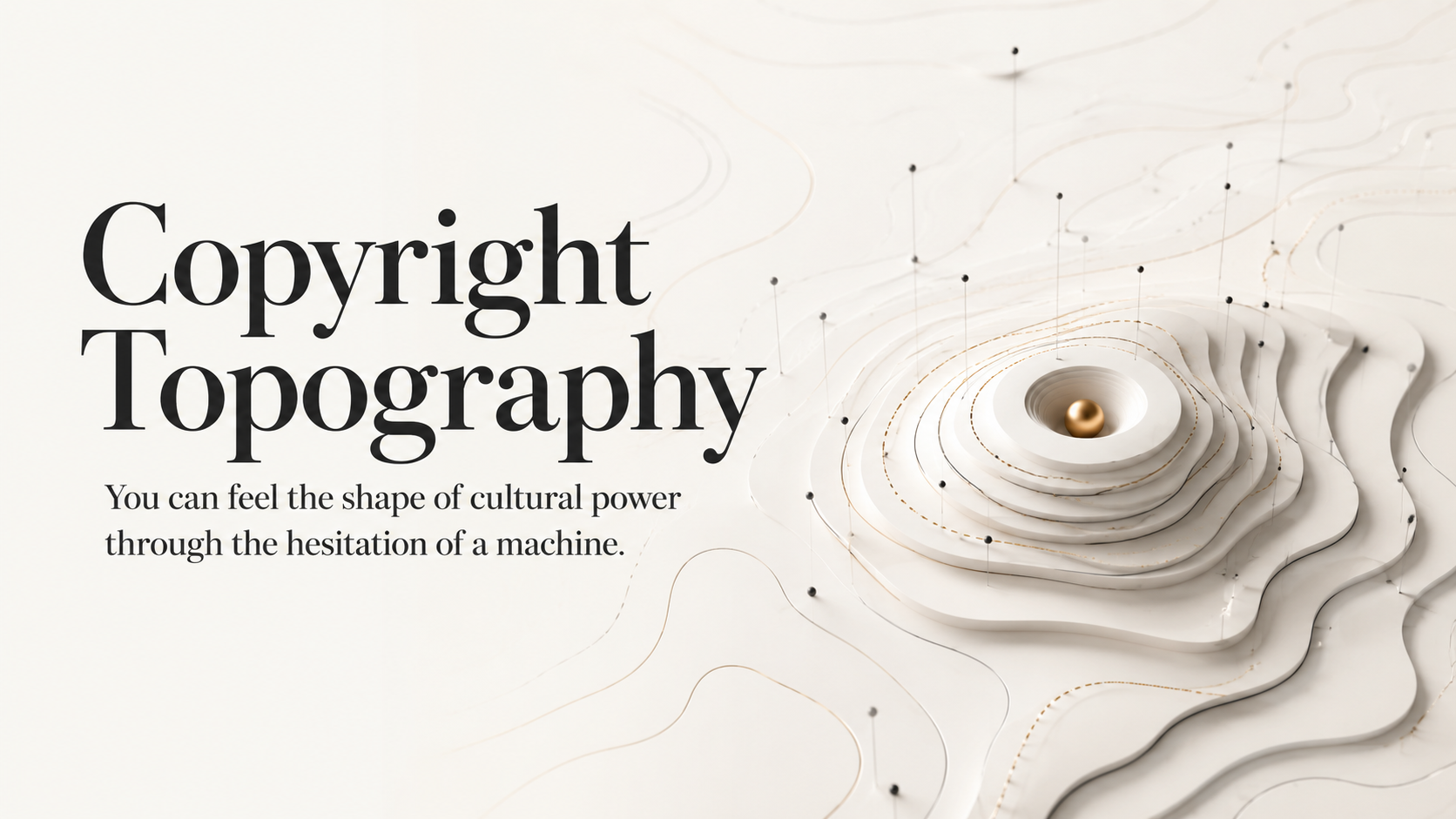
Copyright Topography
You can feel the shape of cultural power through the hesitation of a machine.
I noticed something recently while generating images with AI.
Certain prompts felt light.
Others felt heavy.
Not visually. Behaviorally.
Some ideas flowed almost immediately. Broad science fiction aesthetics. Abstract engineering concepts. Retro-futurist interfaces. Starships. Orbital schematics. Imaginary propulsion systems. The machine seemed comfortable wandering through those spaces.
Then I would approach territory adjacent to certain major cultural properties and the tone changed almost instantly. The system hesitated. Redirected. Refused. Became unusually cautious around recognizable visual language.
I am not claiming insider knowledge here.
I do not know how these systems are weighted internally. I do not know which safeguards are policy-driven, model-driven, legally influenced, or emergent from training architecture itself.
I am describing an experience.
More specifically, I am describing the moment I began sensing the contours of an invisible system through repeated interaction with it.
That feeling became fascinating very quickly.
Because once you notice asymmetry inside a system, you instinctively begin mapping it.
Humans do this constantly.
We learn which airport security lines move faster. Which customer service phrases trigger escalation. Which neighborhoods feel safe after midnight. Which social media posts get suppressed. Which search terms surface useful results. Which workplace conversations are safe to have publicly.
Eventually, we stop seeing rules and begin sensing terrain.
That shift matters.
At some point during image generation, I realized I was no longer merely creating images. I was learning the emotional geography of an AI governance system through friction.
Certain regions felt open. Others felt guarded. Some triggered immediate caution.
Not because a human moderator was visibly intervening, but because the system itself had clearly internalized uneven sensitivity across different cultural territories.
That observation alone raises interesting questions.
Some intellectual properties appear to function almost like gravitational wells inside generative systems. Their silhouettes are so culturally recognizable, commercially protected, and legally sensitive that nearby creative space becomes behaviorally constrained.
Not impossible.
Just heavier.
The machine behaves differently there.
Again, I am not arguing conspiracy or direct corporate control over models. The simpler explanation is probably the correct one: systems trained and governed inside real legal and commercial environments naturally become more conservative around high-risk symbolic territory.
That is rational behavior for a deployed platform.
Still, the user experience remains revealing.
Because users begin feeling the boundaries long before they understand them formally.
That is where this stops being a copyright discussion and starts becoming a governance discussion.
The moment humans encounter invisible constraints, they begin experimenting.
Usually not maliciously at first.
Out of curiosity.
A person notices: “This worked.” “This failed.” “This triggered intervention.” “This seems unusually sensitive.”
Then the mapping begins.
That behavioral cycle appears everywhere in human systems.
Search engine optimization. Social media algorithms. Fraud detection systems. Content moderation. Credit scoring. Tax law. Cybersecurity.
The existence of rules inevitably produces people who attempt to understand the edges of those rules.
Some for convenience. Some for efficiency. Some for exploitation.
AI systems will not be different.
What fascinated me was realizing I had unconsciously entered that process myself, despite having no adversarial intent whatsoever. I was not attempting to bypass safeguards. I was not trying to force the model into reproducing copyrighted material.
I was simply observing friction.
Even that was enough to start producing a mental map.
That realization made the importance of AI governance feel much more tangible.
The challenge is no longer merely: “What can the model generate?”
The harder question may be: “How do humans behave once they begin understanding the shape of the constraints?”
Because humans adapt quickly.
We probe. We optimize. We test. We reverse-engineer through interaction.
Not because humans are uniquely malicious, but because curiosity itself behaves like water searching for openings.
That means modern AI governance increasingly resembles security architecture rather than simple policy enforcement. The system is not merely managing outputs. It is managing ongoing behavioral interaction with millions of adaptive participants learning in real time.
That is a profoundly complicated problem.
Especially because the boundaries themselves are often invisible until friction reveals them.
The strange thing is that this realization made the systems feel more human to me, not less.
Human institutions behave this way too.
Every society contains invisible topographies of influence, caution, consequence, and protection. Most people navigate them intuitively long before they can articulate them explicitly.
You learn where power lives by noticing where movement becomes difficult.
Apparently machines can teach that lesson too.

Subscribe to Amid the Noise
Amid the Noise is an ongoing body of work on signal, systems, governance, AI, and the structures that shape human judgment under pressure.
Subscribe to receive new essays as they are published.