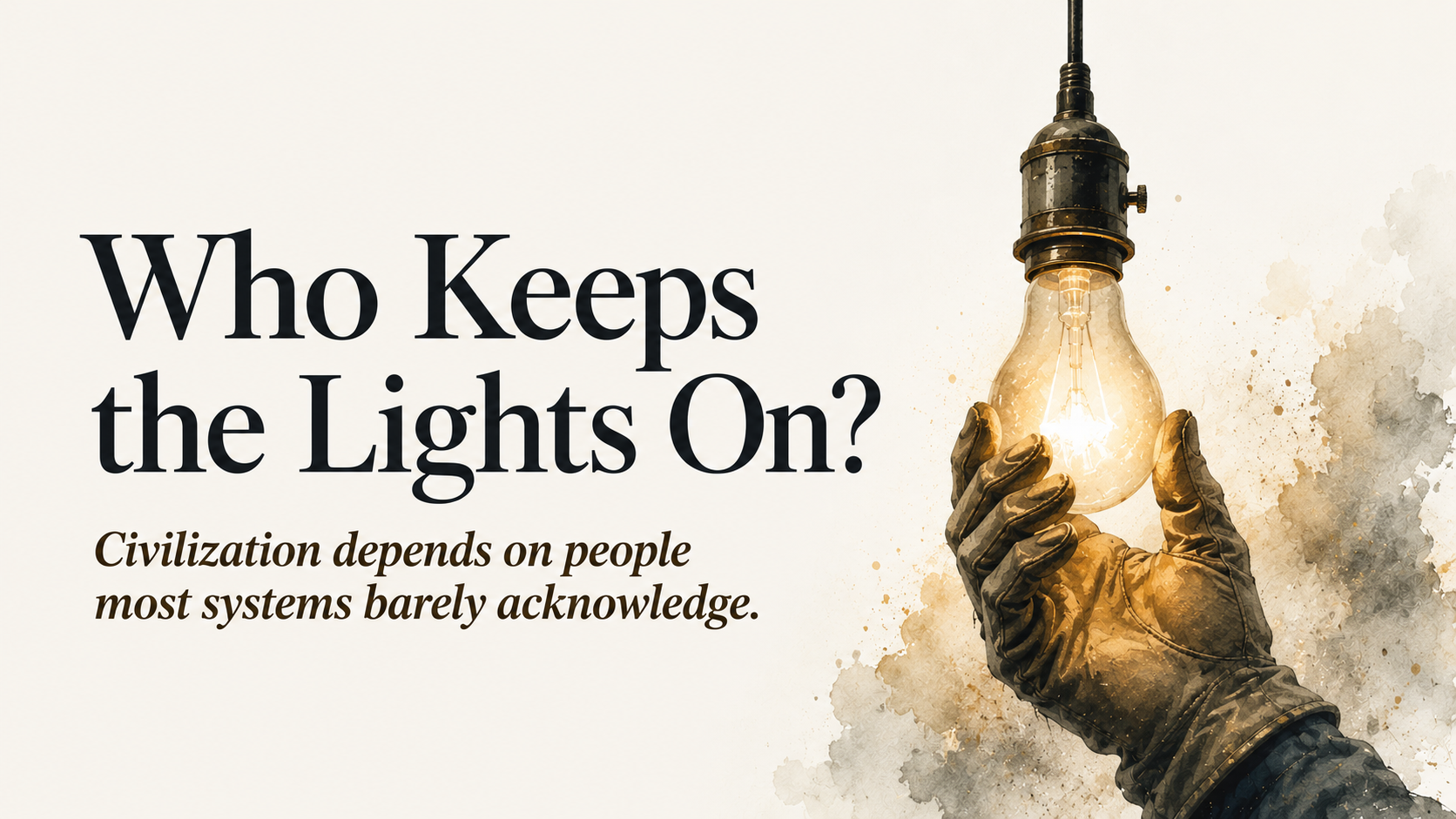
Who Keeps the Lights On?
Civilization depends on people most systems barely acknowledge.
In Silicon Valley, we celebrate invention.
Disruption. Innovation. Growth. Scale.
The mythology of the region places creation on a pedestal. Founders become folklore. Venture capital becomes gravitational. Entire industries organize themselves around the next thing arriving before the current thing fully settles.
Creation is exciting.
Maintenance rarely receives the same reverence.
But the older I get, the more convinced I become that civilization is not held together by invention alone.
It survives because someone keeps showing up to keep the lights on.
I notice this much more now than I once did.
Years ago, I probably viewed public infrastructure through the same arrogant lens many Americans quietly inherit: people should work harder, buy a car, figure it out, make better choices.
Transit was something you used only after failure.
At least that was the unspoken assumption embedded into much of suburban California culture.
Then life became more complicated.
The moment you actually need continuity infrastructure, the world reveals itself differently.
Suddenly the missing bench matters.
The broken elevator matters.
The unusable restroom matters.
The light rail seats soaked because maintenance collapsed under pressure matter.
The bus shelter without shade matters.
Not as inconveniences.
As dignity systems.
A senior who no longer feels safe driving still needs to move through the city.
A disabled person still needs continuity.
Someone exhausted, poor, recovering, overwhelmed, or temporarily unstable still needs the environment to permit participation without punishment.
That realization changed something in me.
Because these systems are not theoretical.
They determine whether public life feels survivable.
I think about this often when I travel.
In Japan, maintenance feels cultural.
People polish brass fittings outside fire stations. Transit systems remain astonishingly clean despite carrying enormous population density. Streets often stay immaculate even in places without public rubbish bins because collective upkeep is treated as shared responsibility rather than invisible labor.
The message underneath all of it feels unmistakable: this place will still care for you tomorrow.
Germany carries a different version of the same instinct.
In Bonn, parts of the city feel ancient in the truest sense, not frozen as spectacle, but continuously preserved through active participation across generations. The infrastructure communicates continuity instead of improvisation.
The systems feel inhabited.
America often feels different.
We are extraordinary at creating new things.
Less patient with maintaining them.
The result is subtle but emotionally cumulative: closed rest stops, deferred repairs, failing transit systems, public spaces designed defensively instead of generously, infrastructure slowly withdrawing comfort from the people who depend on it most.
None of this usually registers to people insulated from needing those systems directly.
That may be the saddest part.
Infrastructure becomes psychologically invisible until vulnerability makes it visible again.
Then suddenly you understand: the people keeping the lights on were never peripheral to civilization.
They were its spine.

Subscribe to Amid the Noise
Amid the Noise is an ongoing body of work on signal, systems, governance, AI, and the structures that shape human judgment under pressure.
Subscribe to receive new essays as they are published.