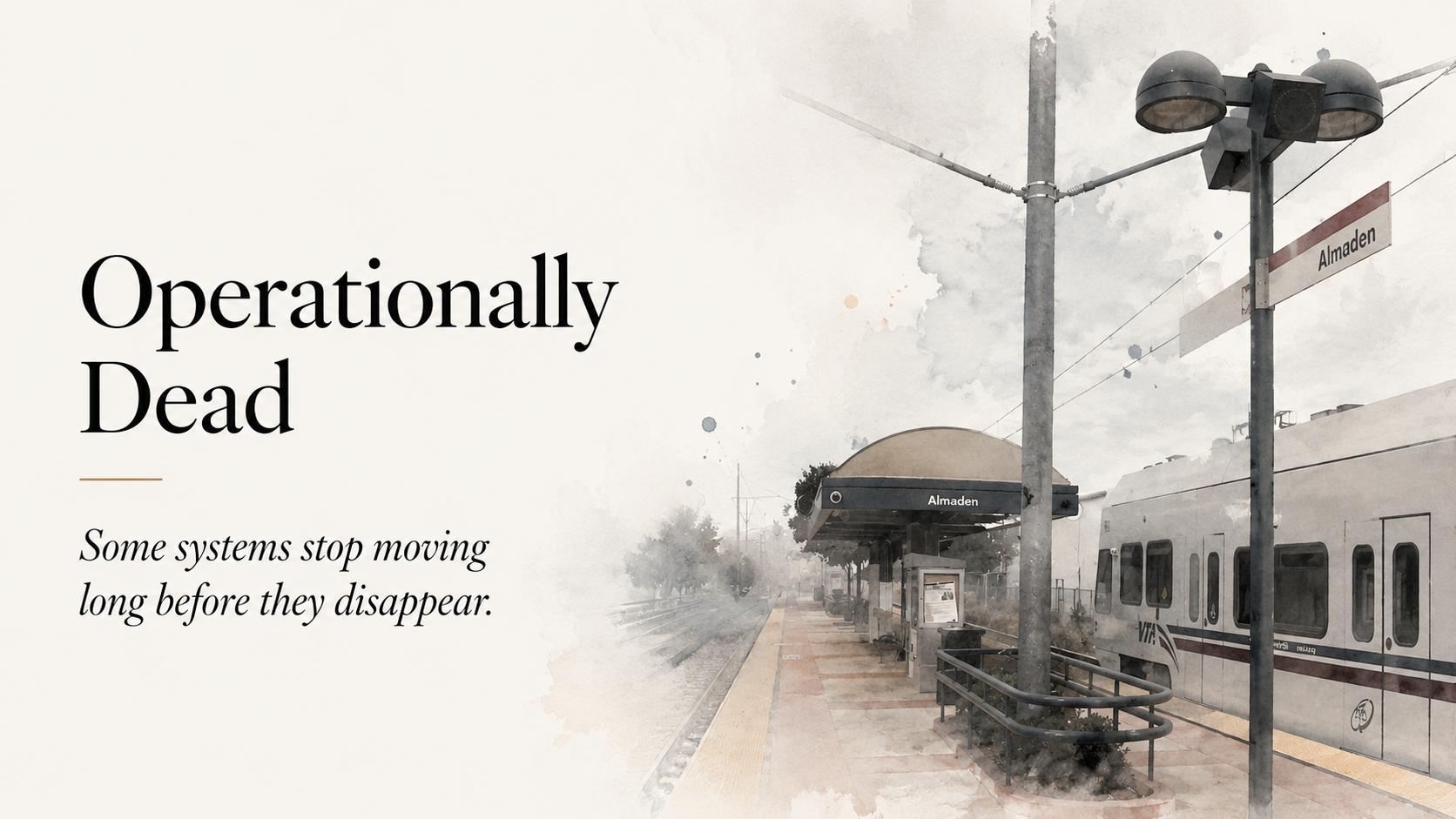
Operationally Dead
Some systems stop moving long before they disappear.
I have always been fascinated by infrastructure that still physically exists after the system around it has quietly stopped believing in it.
Closed subway platforms in New York.
Walled-up tunnels beneath San Francisco.
Unused corridors in transit stations where the signage still implies motion even though nobody has passed through in years.
There is something emotionally strange about spaces designed for movement that no longer move anyone at all.
Near where I live, VTA still carries remnants of the old Express Trains era. Some stations still have signs warning riders that trains may not stop there.
The warning survives.
The trains largely do not.
I think about that often.
There is also the old Almaden shuttle spur between Almaden Lake Park and Ohlone/Chynoweth, a rail line that still physically exists but has long since been replaced operationally by bus service.
The tracks remain. The platforms remain. The corridor remains.
But the future the line was built for appears to have quietly ended.
That may be the part I find hardest to shake.
Infrastructure is never just concrete, steel, or budget allocation. Infrastructure is institutional belief made physical. A rail line exists because someone once believed movement there would matter for decades.
When systems die cleanly, the emotional effect is different. Demolition creates closure.
But many systems do not disappear cleanly.
They linger.
Operationally dead.
Not fully abandoned. Not fully active. Not removed. Not acknowledged.
Just suspended in an uneasy state where the physical environment continues broadcasting assumptions the institution itself no longer supports.
That creates a subtle form of haunting.
Your brain still models movement there. You still imagine trains arriving. You still instinctively interpret the platform as part of a living system because infrastructure teaches expectation through repetition.
The same feeling exists in old subway systems.
New York is filled with sealed platforms and inaccessible corridors where tiled walls and directional signage continue implying a city that once moved differently. San Francisco has its own hidden remnants beneath the streets, fragments of earlier transit logic still embedded beneath the current system.
These places feel different from ordinary ruins.
Not ancient. Interrupted.
That distinction matters.
Most infrastructure is optimistic by nature. Transit systems especially are built around assumptions of continuity: future riders, future density, future coordination, future budgets, future civic alignment.
When those assumptions collapse while the infrastructure remains physically intact, the result feels less like history and more like suspended intention.
I suspect that is why these places linger in the imagination so powerfully.
They remind us that systems rarely fail all at once.
They drift out of coherence slowly enough that the architecture often continues remembering what the institution has already forgotten.

Subscribe to Amid the Noise
Amid the Noise is an ongoing body of work on signal, systems, governance, AI, and the structures that shape human judgment under pressure.
Subscribe to receive new essays as they are published.