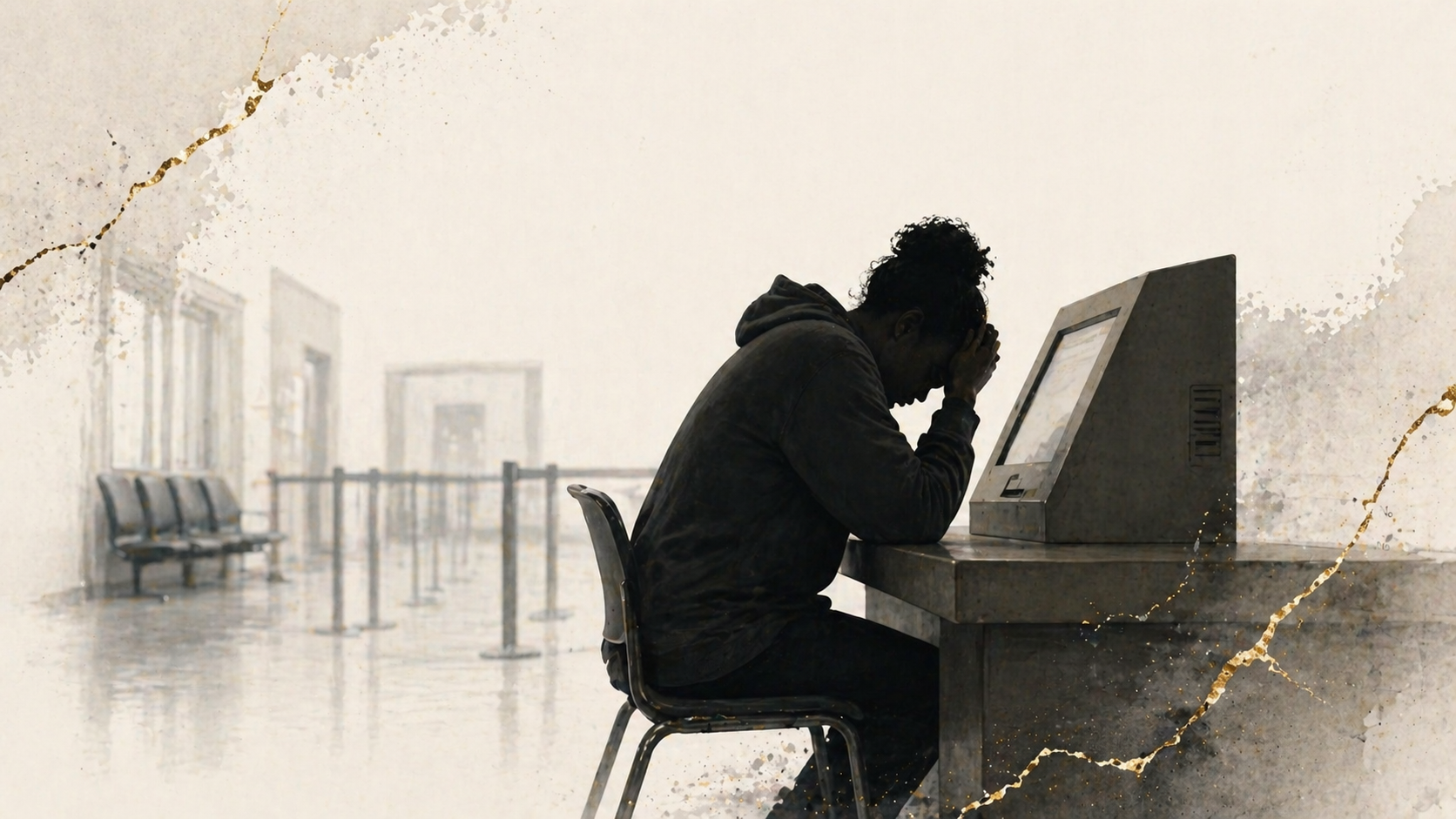
When Systems Break People
Hostility as design output
“The system isn’t broken. It was built this way.”
You hear that line enough, and it stops sounding cynical.
It starts sounding accurate.
It Isn’t Just Slow
There is something quietly violent about being made to wait three hours for a form, only to be told you’re in the wrong line.
Something dehumanizing about a housing portal crashing at 23h59.
Something disorienting about receiving a denial letter with no greeting, no explanation, no path forward.
These are not inconveniences.
They are interactions.
And interactions are designed.
The Myth of Neutral Design
Public systems like to present themselves as neutral.
Form-driven. Procedural. Impersonal.
That framing is convenient.
It hides intent.
Every dropdown that excludes your reality, every timeout that assumes uninterrupted time, every reset that discards your progress is making a decision about who the system is built for.
Neutral design does not exist.
There is only design that reflects power, and design that challenges it.
Friction Is Not Evenly Distributed
Friction in civic systems is often treated as inevitable.
It isn’t.
It is allocated.
When a form assumes stable housing, legal literacy, and consistent access to technology, it is calibrated against those who do not have those things.
When a system requires persistence under stress, it favors those who can afford to persist.
Everyone else gets filtered out.
Not explicitly.
Effectively.
The Interface Is the Policy
We tend to separate policy from experience.
In practice, they are the same.
If a benefit requires navigating a broken interface, the interface becomes part of the qualification process.
If the system times out, fails to save, or obscures next steps, that behavior is the policy.
It determines:
- Who completes the process
- Who understands the rules
- Who gives up
Design does not sit on top of policy.
It enforces it.
The Emotional Cost
Trauma is not always event-based.
Sometimes it accumulates.
Through repetition.
Through confusion.
Through being made to feel like you are the problem inside a system that cannot accommodate you.
Missed deadlines. Lost documents. Silent errors.
Each one small.
Together, structural.
This is not inefficiency.
It is erosion.
Toward Dignity-Centered Design
You cannot audit your way out of this.
You have to change what you value.
Design that centers dignity looks different:
- Plain language instead of legal abstraction
- Mobile-first access instead of desktop assumptions
- Error-tolerant systems that expect disruption
- Flows that acknowledge fear, stress, and limited time
It also means something more fundamental.
Including the people these systems fail in designing them.
Not as feedback.
As authors.
What If UX Came First
We invest heavily in making commerce seamless.
We optimize onboarding, conversion, retention.
We remove friction where it affects revenue.
What if we applied that same rigor to access?
To housing. To benefits. To reunification.
What if applying for help didn’t feel like punishment?
The Work
You cannot talk about justice without talking about experience.
Experience is how systems are felt.
And what people feel determines whether they engage, persist, or disappear.
If a system consistently breaks people, that is not a user problem.
It is a design decision.
One that can be changed.

Subscribe to Amid the Noise
Amid the Noise is an ongoing body of work on signal, systems, governance, AI, and the structures that shape human judgment under pressure.
Subscribe to receive new essays as they are published.