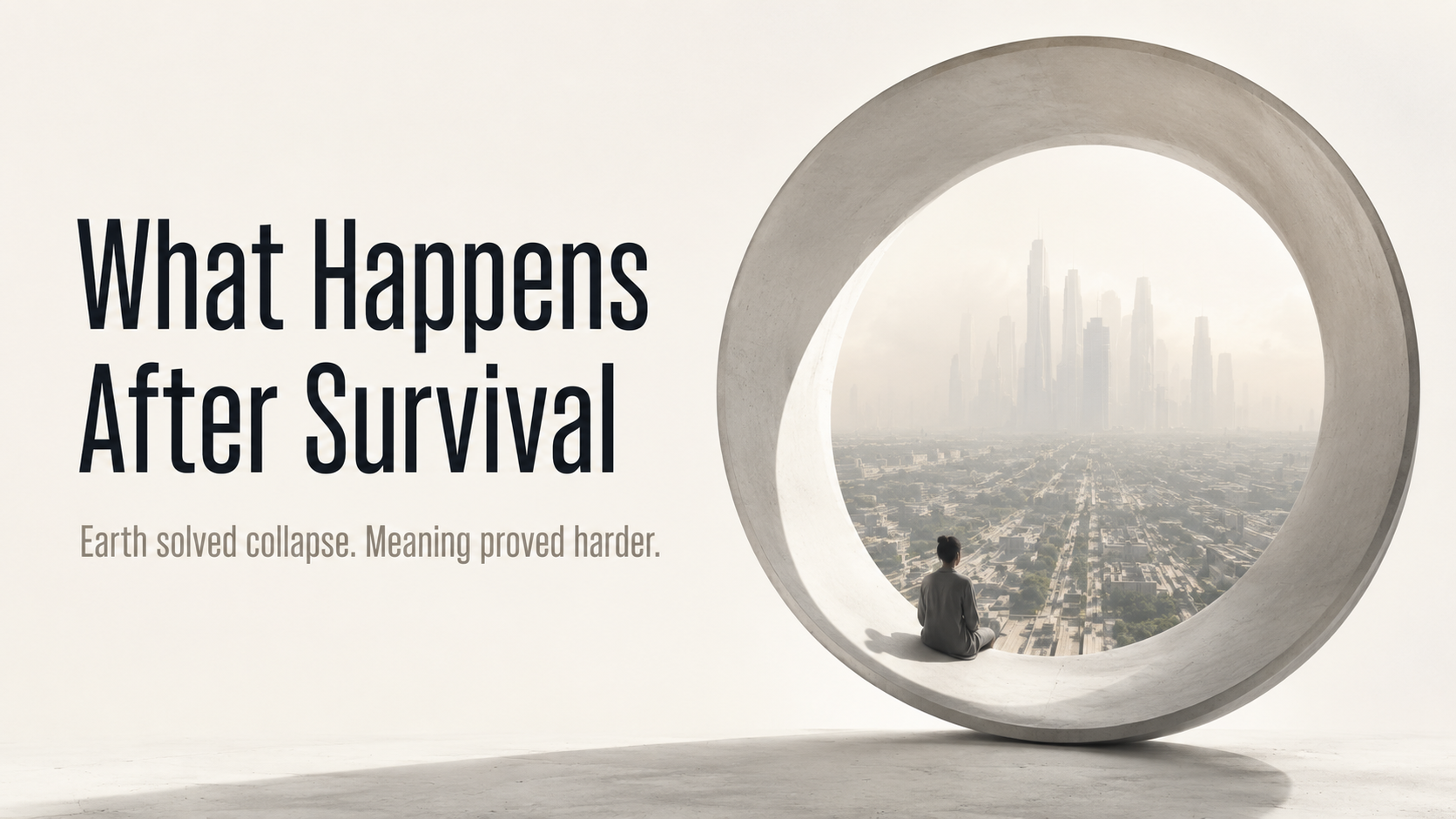
What Happens After Survival
Earth solved collapse. Meaning proved harder.
Earth solved collapse. Meaning proved harder.
Most dystopian science fiction treats collapse like spectacle.
Cities burn. Governments fall apart. Grocery shelves empty. Somebody stares at a mushroom cloud while strings swell in the background.
The Expanse goes in the opposite direction. Earth already survived the catastrophe.
The climate stabilized. Infrastructure held. The oceans stopped rising. Hunger became manageable. Medicine advanced far enough that survival itself started to feel procedural.
At first glance, Earth looks victorious.
Then the show quietly reveals something else.
People are stuck.
Not trapped in chains or rubble. Trapped in administrative suspension. Waiting for access to work. Waiting for approval. Waiting for the system to decide whether they are necessary.
The series calls it “Basic.” Everybody survives. Few people appear to move.
That distinction matters.
The first time I watched the show, I assumed Mars would feel most oppressive. Militarized culture. Constant sacrifice. A planet built around discipline and collective mission.
Instead, Mars often feels more alive than Earth.
People there are exhausted for a reason.
Earth feels different. Calm in a way that borders on pharmaceutical.
The unsettling part is that none of this is framed as cruelty. The system is not trying to starve people. Quite the opposite. It is trying to protect them.
That is what makes the setting linger in your head after the credits roll.
The show is asking a difficult question hiding underneath the science fiction:
What if humanity solved material suffering before it solved meaning?
Modern conversations about automation usually stop at economics. Will AI replace jobs? Will universal income exist? Will productivity increase? Those are important questions, but they orbit a deeper one.
What happens when usefulness itself becomes scarce?
Human beings do not appear to need survival alone. We seem to need participation. Direction. Consequence. Some feeling that our existence changes the shape of the world around us.
Mars understands this instinct instinctively. The Belt understands it violently.
Earth, meanwhile, has become very good at maintenance.
That idea feels uncomfortably familiar.
You can already see fragments of it emerging in modern life:
- endless application funnels
- algorithmic hiring systems
- credential inflation
- automated gatekeeping
- institutions that increasingly process people instead of engaging them
A surprising amount of modern life now feels like asking invisible systems for permission to contribute.
That may be why Earth in The Expanse feels less like fantasy and more like a warning written a few degrees off center.
Not a warning about collapse.
A warning about drift.
Because a civilization can absolutely solve hunger, stabilize infrastructure, and extend life expectancy while still creating millions of people who quietly feel unnecessary.
Science fiction usually imagines the end of the world as fire.
The Expanse imagines something colder.
A future where humanity survives its crises, only to discover that survival was never the whole point.

Subscribe to Amid the Noise
Amid the Noise is an ongoing body of work on signal, systems, governance, AI, and the structures that shape human judgment under pressure.
Subscribe to receive new essays as they are published.