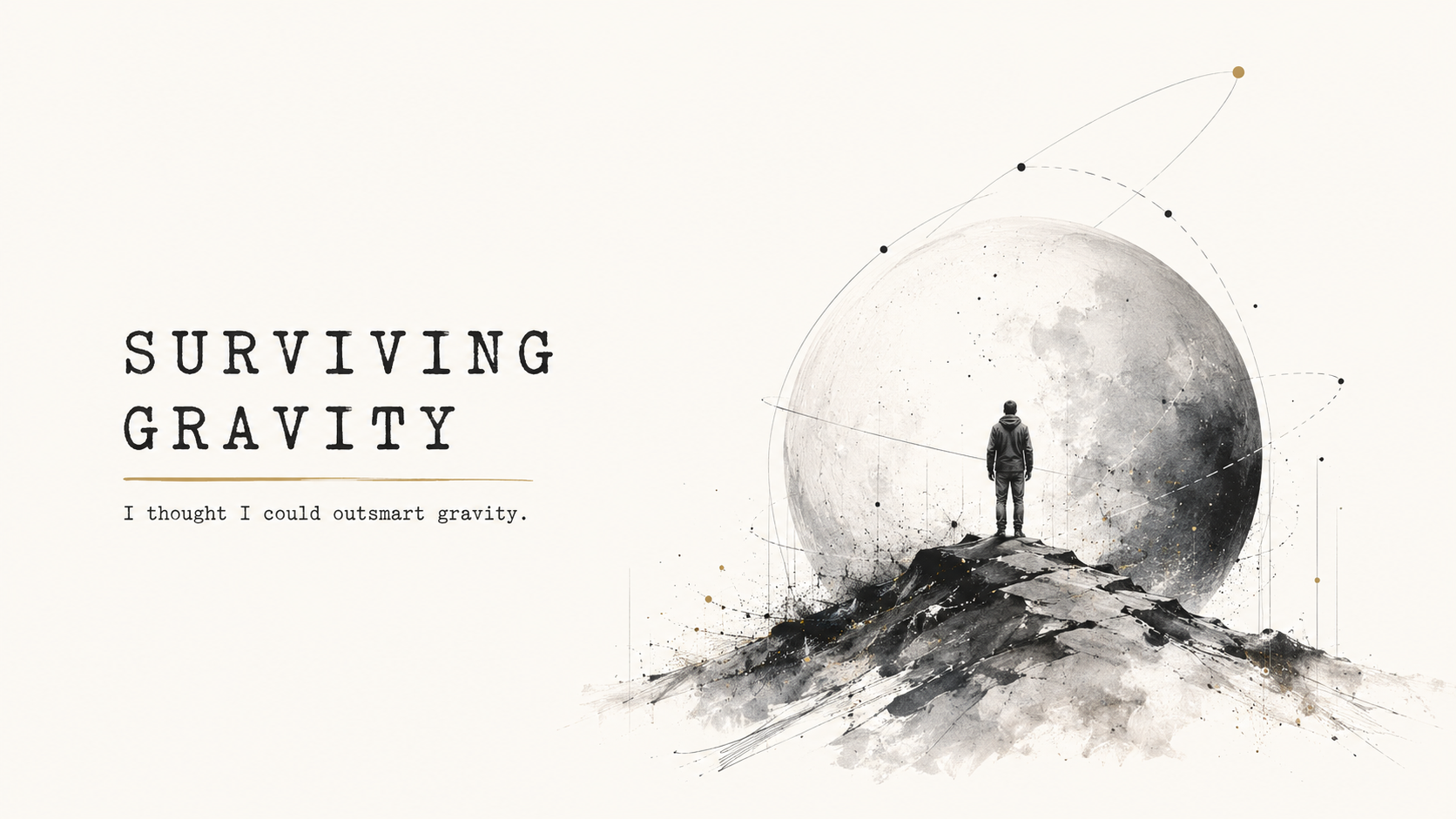
Surviving Gravity
I thought I could outsmart gravity.
For a long time, I believed exhaustion was something you could negotiate with.
Sleep less. Push harder. Recover later.
I treated limits like design flaws instead of realities. Hunger, grief, stress, loneliness, fear. Everything became something to optimize around, chemically suppress, or temporarily outrun.
Addiction thrives in that mindset because it whispers exactly what exhausted people want to hear: you can borrow energy from tomorrow.
At first, it feels like acceleration.
Then slowly, almost invisibly, your life begins narrowing around the substance itself. Relationships become logistics. Time becomes fragmented. Money evaporates without memory attached to it. Entire weeks disappear into survival math and rationalization.
You stop building a future and start managing impact velocity.
The strange thing is that active addiction rarely feels dramatic from the inside. Most of the time it feels administrative. Small compromises stacked on top of each other until collapse starts masquerading as routine.
I told myself I was functioning.
I told myself I was adapting.
Really, I thought I could outsmart gravity.
Eventually, I ran out of explanations and checked into Muriel Wright.
There was no cinematic clarity waiting on the other side of those doors. No sudden rebirth. No orchestral revelation. I arrived exhausted, emotionally fractured, financially unstable, and deeply aware that my life had become unsustainable in ways I could no longer explain away.
Recovery turned out to be less about transformation and more about reentry.
Your senses come back first.
Food tastes sharper. Music sounds dimensional again. Morning light stops feeling hostile.
Then your sense of time returns. Then your memory. Then the terrifying realization that the world kept moving while you were chemically disconnected from it.
Sobriety does not magically solve grief, loneliness, regret, financial instability, or uncertainty. If anything, it removes the anesthetic protecting you from fully experiencing them.
That is the difficult part.
That is also the honest part.
Over time, I rebuilt routines that once felt impossible. I started writing consistently again. I began thinking in years instead of weekends. I repaired parts of myself I had quietly abandoned long before anyone else noticed they were gone.
Not perfectly. Not elegantly. Not all at once.
Just steadily.
I also stopped chasing reinvention.
That surprised me.
For a while, I thought recovery meant becoming an entirely new person. Someone cleaner. More disciplined. More impressive. Some polished redemption-story version of myself assembled neatly from the wreckage.
Instead, recovery felt more like regaining signal.
A return to clarity. A return to proportion. A return to emotional gravity.
I became reachable again.
Reachable by other people. Reachable by responsibility. Reachable by the future.
That may be the quietest and most important thing sobriety gave me.
Not perfection.
Reachability.
For years, I mistook momentum for flight. I thought constant movement meant escape velocity. Looking back now, much of it was simply falling sideways with style.
Gravity does not negotiate. Eventually every unsustainable orbit collapses.
The miracle is not avoiding the ground forever.
The miracle is surviving impact with enough self left to begin again.

Subscribe to Amid the Noise
Amid the Noise is an ongoing body of work on signal, systems, governance, AI, and the structures that shape human judgment under pressure.
Subscribe to receive new essays as they are published.