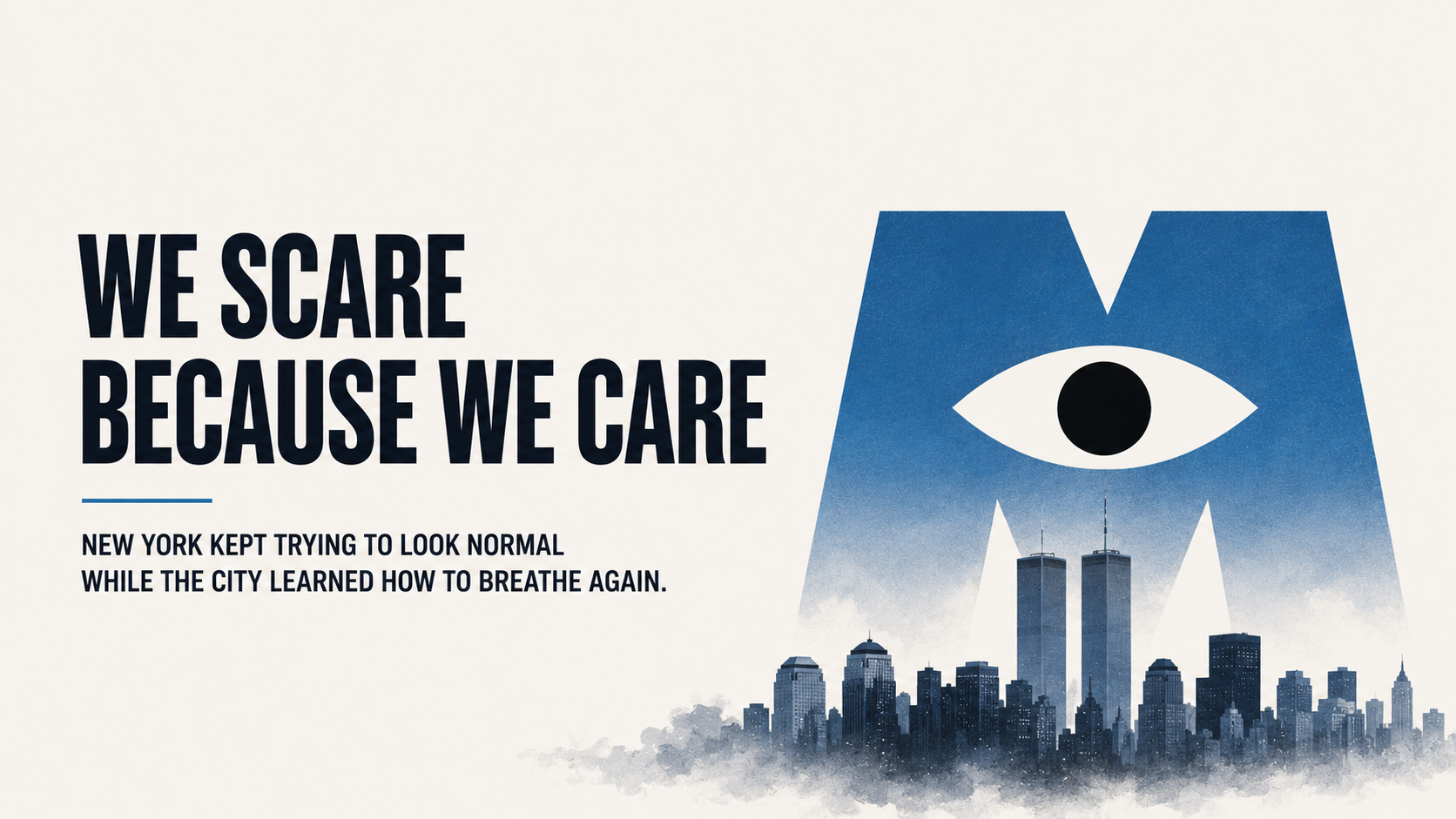
We Scare Because We Care
New York kept trying to look normal while the city learned how to breathe again.
In the months after September 11th, I remember one slogan being everywhere in New York City:
We Scare Because We Care.
Monsters, Inc. advertisements covered subway walls, bus shelters, storefronts, and taxi tops. Bright blues and greens stretched across a city whose emotional temperature had changed almost overnight.
At the time, it barely registered.
Years later, the memory feels surreal.
Advertising operates on a simple assumption: tomorrow will resemble today closely enough for the campaign to remain relevant. Posters get printed months ahead of release. Billboards go up. Media buys lock into place. Entire commercial systems move forward expecting continuity.
Then history interrupts the atmosphere without asking permission.
The strange thing about collective trauma is how visually uneven it can feel at first. The emotional reality changes immediately. The physical environment lags behind. Movie posters remain standing. Department store windows stay illuminated. Coffee shops continue serving espresso beneath conversations nobody knows how to finish.
For a while, New York felt suspended between realities.
Part of the city was grieving. Part of the city was in shock. Part of the city was trying desperately to continue functioning because functioning itself felt necessary.
Meanwhile cheerful animated monsters kept smiling down from advertisements repeating:
We Scare Because We Care.
The slogan had originally been harmless corporate wordplay. Cute. Clever. Disposable in the way most movie marketing is disposable.
After September 11th, it started feeling strangely loaded.
Not sinister.
Just unintentionally reflective of the emotional atmosphere surrounding it.
Fear and protection had suddenly become intertwined concepts in American life. Safety announcements multiplied. Security posture changed. Public reassurance itself started carrying the language of threat prevention. The country entered an era where fear and care increasingly occupied the same psychological space.
The slogan survived long enough inside that new atmosphere to accidentally absorb some of its meaning.
That is what stayed with me.
Not the movie itself. Not even the advertisements.
The feeling of watching ordinary commercial life continue running alongside historical rupture as though both realities had to coexist temporarily until the city decided which one would become permanent.
Then Christmas arrived.
Oddly enough, that was the first moment New York began feeling alive again.
Not healed. Not normal.
Just willing to participate in itself again.
The lights stopped feeling inappropriate. Crowds returned to familiar rituals. Restaurants filled slowly. Store windows regained some of their warmth. The city seemed exhausted by grief and finally ready to allow small pieces of ordinary life back into the room.
I think that is why those posters remained lodged in my memory all these years later.
Because they became accidental witnesses to the moment one version of America ended while another was still trying to introduce itself.

Subscribe to Amid the Noise
Amid the Noise is an ongoing body of work on signal, systems, governance, AI, and the structures that shape human judgment under pressure.
Subscribe to receive new essays as they are published.