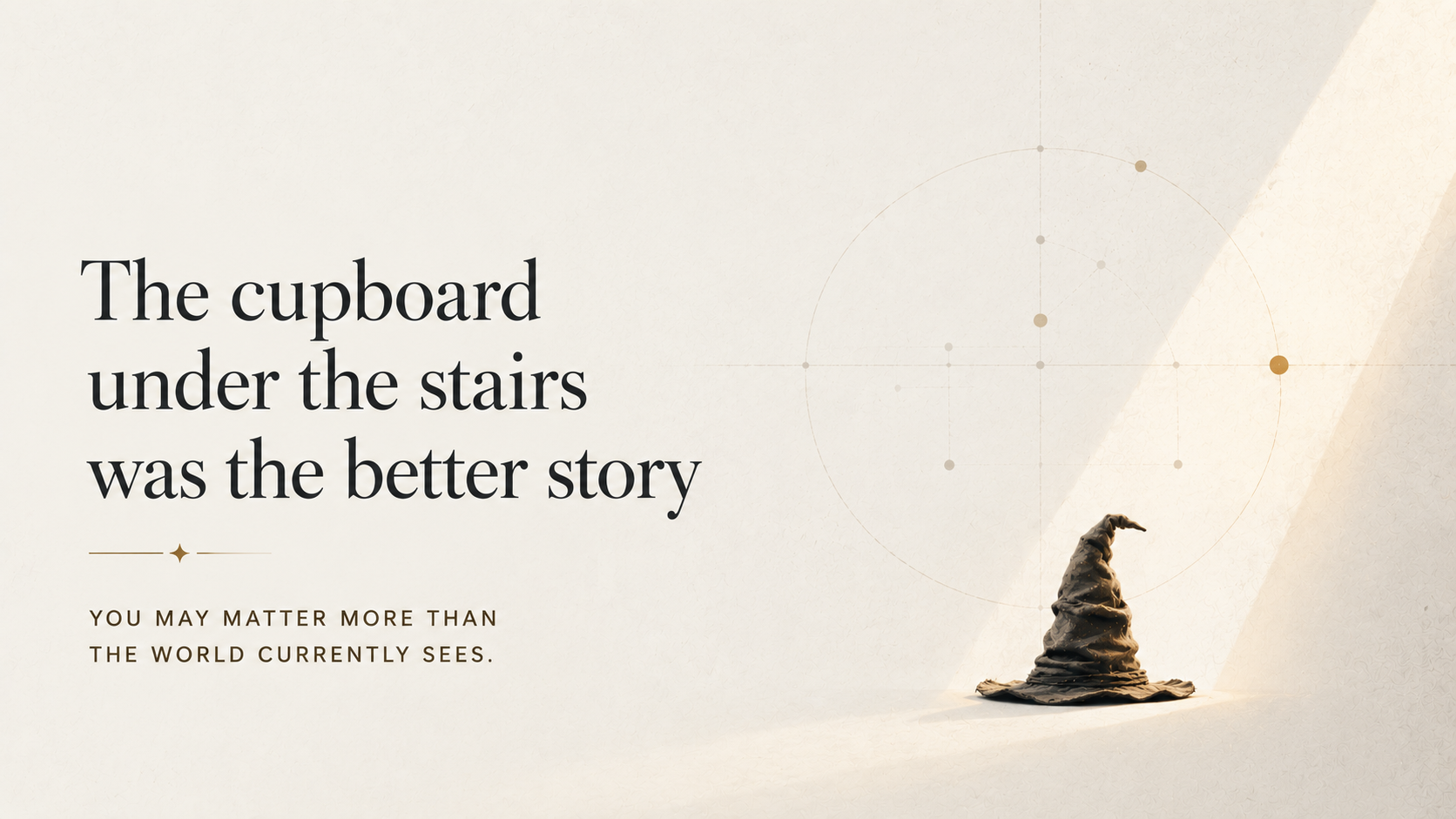
The Cupboard Under the Stairs Was the Better Story
You may matter more than the world currently sees.
The most powerful version of Harry Potter lasted only a few chapters.
Before the prophecies. Before the vault of gold. Before the whispers about destiny and greatness and chosen bloodlines.
Back when Harry lived under the stairs.
That was the better story.
Not because it involved magic, but because it understood something painfully ordinary: the experience of being unseen. Not awkward. Not unpopular. Structurally invisible. Fed last. Spoken over. Treated like excess inventory in someone else’s life.
The cupboard under the stairs was not fantasy. It was emotional realism wearing fantasy clothing.
That is why the invitation to Hogwarts worked.
The letter was not merely admission into a magical school. It was recognition. A signal that the assumptions surrounding Harry were incomplete. That neglect was not proof of worthlessness. That hidden capability could exist beneath humiliation.
For one brief stretch, the story carried a genuinely radical possibility:
You may matter more than the world currently sees.
Then the architecture changes.
Harry does not arrive at Hogwarts as an ordinary child discovering capability. He arrives as inherited importance waiting to be unveiled.
He is wealthy beyond comprehension. Famous before introduction. Connected to prophecy. Protected by destiny. Special by bloodline. Immediately sorted into the institutionally celebrated house.
The emotional gravity shifts from discovery to confirmation.
The story initially asks: Who are you really?
Then it quietly answers: Someone important by birth.
Those are not the same story.
I suspect this lands differently depending on where you came from.
A kid from rural Oklahoma is often assigned a character before he has written one himself. Yokel. Redneck. High-school football. Small-town ceiling. The social sorting happens early and usually without consent.
People decide whether you are sophisticated before you speak. Whether you are intelligent before you think aloud. Whether your future is expansion or repetition.
That is why stories about hidden identity resonate so deeply with people from constrained environments. Not because they believe they are secretly wizards, but because they understand what it feels like to be miscategorized by geography.
The opening chapters of Harry Potter briefly reject deterministic identity. They suggest that circumstance is not destiny. That neglect is not definition. That where you begin does not fully determine where you belong.
Then the series pivots toward inherited exceptionalism.
The irony is that the original premise was more powerful than the mythology that replaced it.
A genuinely subversive version of Harry Potter might have kept Harry ordinary the entire way through. No prophecy. No aristocratic lineage. No cosmic destiny. Just a neglected child slowly becoming capable through friendship, courage, education, discipline, and exposure to a larger world.
That story would have preserved uncertainty.
Hogwarts itself would remain the miracle instead of Harry becoming the miracle.
The cupboard under the stairs mattered because it mirrored something real: the fear that the world has already decided what you are allowed to become.
The letter mattered because it challenged that verdict.
Everything after that was spectacle. The beginning was truth.

Subscribe to Amid the Noise
Amid the Noise is an ongoing body of work on signal, systems, governance, AI, and the structures that shape human judgment under pressure.
Subscribe to receive new essays as they are published.