We Replaced Meaning with Explanation
What gets lost when everything has to make sense
The window frames were always blue.
Not painted perfectly. Not consistent from house to house. Just… blue. Set into adobe like they belonged there.
Porches held small imprints in the stucco. Sun symbols. Not centered. Not polished. Pressed in like someone marked time with their hands.
A kokopelli leaned into a wall nearby, mid-step, mid-song. A gecko clung to the surface like it had always been there, watching heat settle into the day.
None of it asked to be explained.
Somewhere along the way, we decided everything should be.
Blue frames became insect repellent.
Turquoise became material science.
Symbols became decoration.
The story shifted from meaning to mechanism.
That shift feels harmless. Even helpful. Explanation gives us confidence. It lets us point to a reason and say, this is why.
Still, something gets lost in the translation.
The original system wasn’t built for explanation.
It was built for orientation.
The blue at the threshold wasn’t just color. It marked a boundary. A transition from outside to inside. From exposure to shelter. In many traditions across the Southwest, that blue traces back to turquoise. Not as ornament, but as protection. A material believed to hold balance between sky and earth.
The sun symbols weren’t branding. They were anchors. Four directions. Four phases. A way to locate yourself without needing a clock or a map.
Kokopelli wasn’t a mascot. He carried movement. Fertility. Continuity. A reminder that life doesn’t stay still, even if the walls do.
Even the gecko, decorative as it looks, signals something simpler. Adaptation. Survival in heat. The ability to hold position when everything else feels exposed.
The vigas tell the same story in a different language.
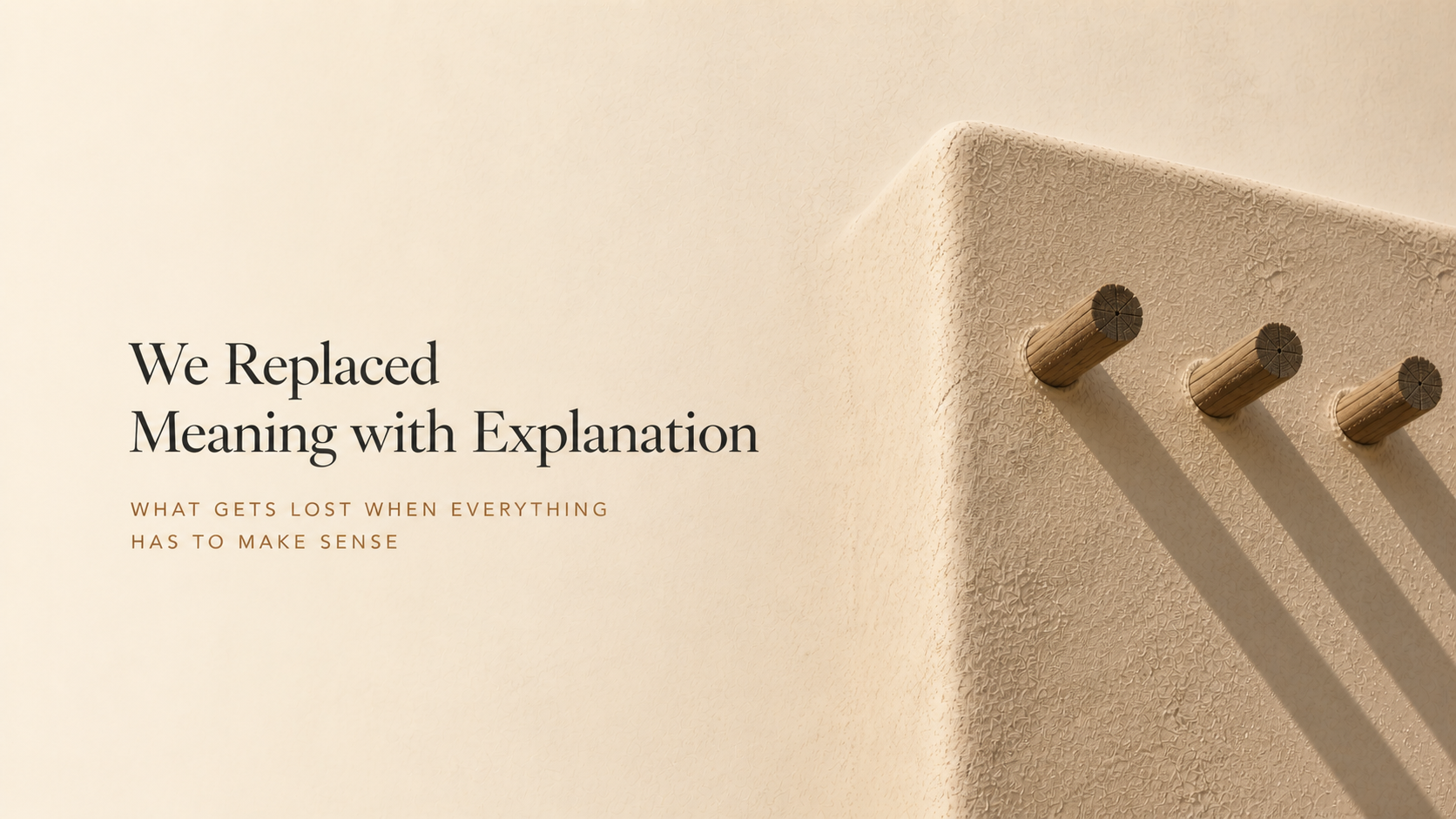
They were never meant to be seen. They held the roof. They carried weight. Over time, they became rhythm across the wall. Structure made visible.
Taken together, these weren’t aesthetic choices.
They were a system.
Modern systems don’t just lack meaning.
They’re designed without it.
They prioritize output over orientation. Action over understanding. Speed over placement. The assumption is simple: if the system can tell you what to do next, it has done its job.
It hasn’t.
A system that drives action without orientation produces compliance, not clarity. It creates users who move quickly and understand nothing about where they are, what changed, or why the outcome mattered.
It reduces the user to an executor.
So we compensate.
We add dashboards to explain what just happened.
We add notifications to prompt the next step.
We add summaries to reconstruct context after the fact.
Layer on layer, trying to rebuild orientation as a feature.
It never works.
Because orientation isn’t something you append.
It’s something you design in from the beginning.
There’s a case to be made for this flattening.
Not every inherited system deserves preservation. Some carry exclusion. Some encode power in ways that should be challenged or dismantled. Explanation can expose those faults. It can make the invisible visible.
That matters.
Still, removal isn’t the same as replacement.
We’ve been efficient at tearing down meaning.
We’ve been less effective at building anything that carries the same weight.
New Mexico never made that trade.
The houses don’t explain themselves.
They hold their logic in plain sight and let you live into it.
You cross a threshold marked in blue.
You sit beneath a symbol that tracks the day.
You notice movement where you expected stillness.
Over time, you begin to understand where you are.
Not because something told you.
Because something held you there long enough to see it.

Subscribe to Amid the Noise
Amid the Noise is an ongoing body of work on signal, systems, governance, AI, and the structures that shape human judgment under pressure.
Subscribe to receive new essays as they are published.