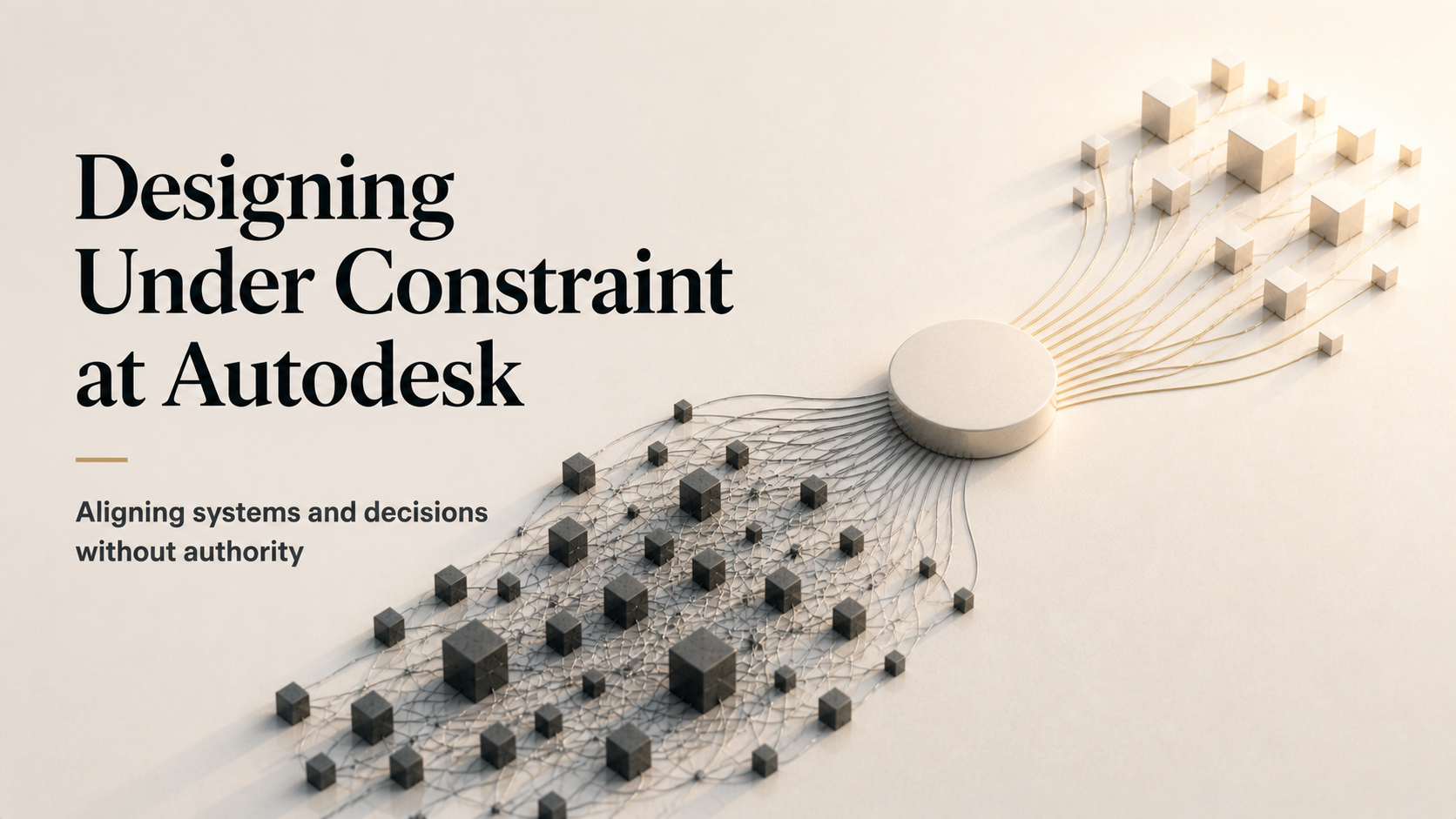
Designing Under Constraint at Autodesk
Aligning systems and decisions without authority
The situation
Autodesk did not have a single system for licensing.
It had many.
Different products. Different teams. Different models of ownership. Each system carried part of the truth. None carried all of it.
Customers experienced this as friction.
Internally, it showed up as delays, rework, and uncertainty around who could actually make a decision.
At the same time, Autodesk was moving toward cloud-based licensing and subscription models. The direction was clear.
The system was not.
Where the work actually started
I did not start with design.
I started with ownership.
Who owned each system.
Who could change it.
Who blocked it.
Where decisions were made versus where they were merely recorded.
I audited the landscape organizationally as much as technically. What emerged was not a clean architecture diagram. It was a network of influence.
That network determined what was possible.
Operating without authority
I did not have formal authority over most of the systems involved.
Progress depended on alignment.
That meant building relationships across product, engineering, support, and operations. It meant making the system legible to the people inside it, not through abstraction, but through shared visibility into how work actually moved.
In some cases, teams believed they owned a licensing decision because their system stored the record. Other teams believed they owned it because they handled the customer escalation. Neither could fully resolve the issue without the other.
The system produced fragmentation because ownership itself was fragmented.
Transparency became the first tool.
When people could see the full path of a licensing decision, including where it stalled or fractured, alignment stopped being theoretical. It became operational.
Converging the system
The goal was not to replace everything.
It was to create a point of convergence.
I led the design and development of a back office portal that became the convergence layer for Autodesk licensing. It unified how customers managed licenses, credits, and subscriptions without forcing every underlying system to disappear first.
For the first time, there was a place where:
- licensing could be managed, not just recorded
- subscription models could operate alongside legacy structures
- internal teams and customers could act from a shared view of the system
The interface was visible.
The real work was in how decisions flowed beneath it.
What changed
Licensing moved from fragmented ownership to coordinated behavior.
Teams that had previously operated in isolation began working from shared context. Support friction dropped because fewer issues required translation across systems. Decisions that once stalled across organizational boundaries could now resolve within a single operational flow.
Efficiency improved, but not because of optimization in isolation.
It improved because the system became coherent.
As the platform stabilized, the effects became visible beyond the teams directly involved. Licensing moved faster. Ownership became clearer. The organization began to trust the system to carry real work.
I was later named to Autodesk’s CEO Top 5 Up-and-Coming list.
The recognition mattered less than what it reflected: the system had started to hold.
The throughline
This work took place in 2012.
The tools were different. The constraints were not.
I have since seen the same structural pattern repeat across finance, automation, civic systems, and AI platforms:
multiple sources of truth
unclear ownership
decisions resolving across disconnected systems
The interface is rarely the hard part.
Alignment is.
I design systems where decisions have to hold under real-world conditions.
Not in theory.
In organizations.
With constraints.

Subscribe to Amid the Noise
Amid the Noise is an ongoing body of work on signal, systems, governance, AI, and the structures that shape human judgment under pressure.
Subscribe to receive new essays as they are published.