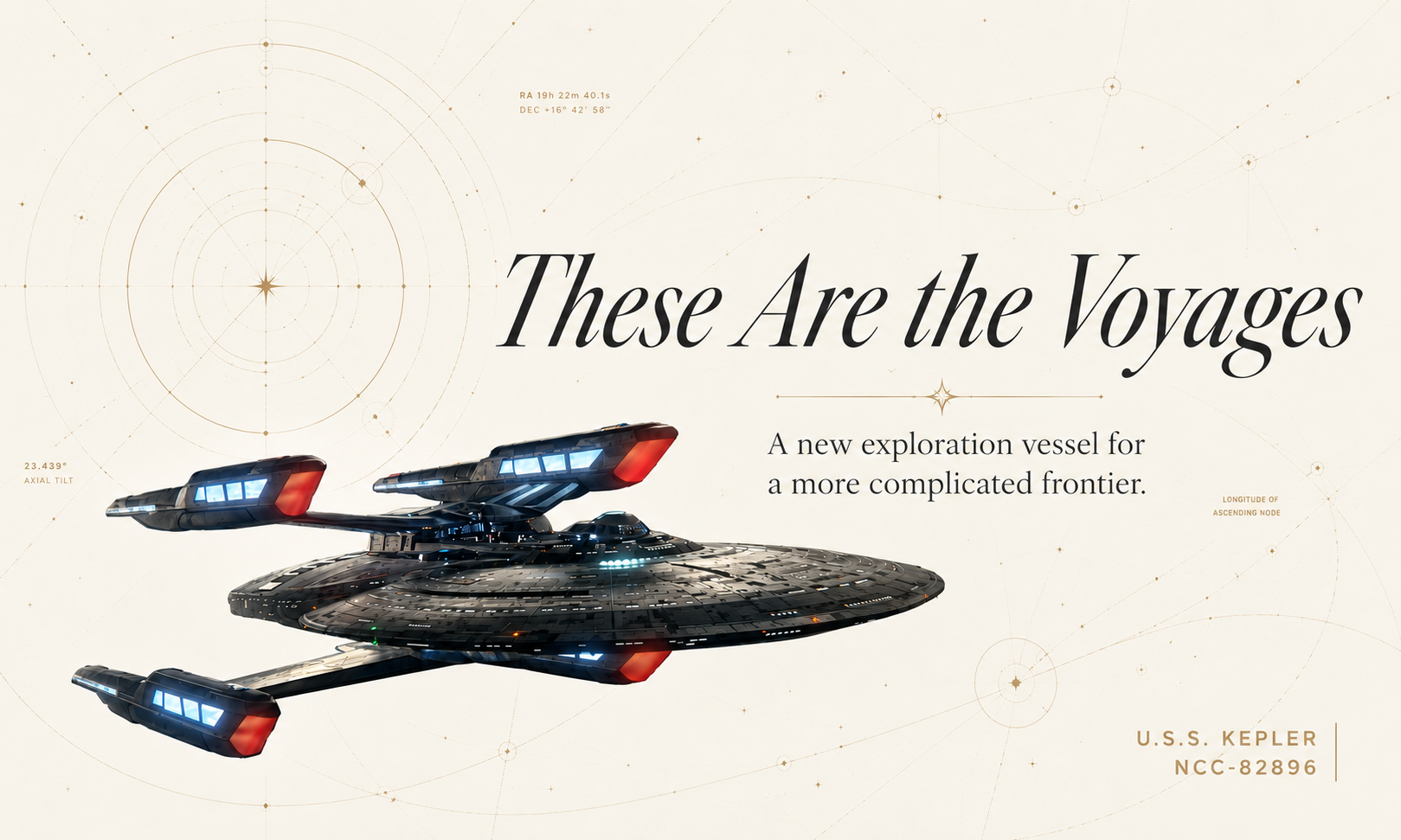
These Are the Voyages
A new exploration vessel for a more complicated frontier
Not everyone in Starfleet wants to serve on the Enterprise.
That realization quietly changed the way I think about science fiction.
For years, Star Trek trained viewers to believe the flagship was the center of gravity. The biggest ship. The best crew. The highest stakes. History happened there.
Then something shifted.
The ships started feeling inhabited again.
The Titan in Star Trek: Picard felt calm in a way Starfleet vessels rarely do. Competent. Capable. Respected. Important, even. Still, it did not feel mythological. The crew felt like people who had learned each other’s rhythms over long deployments rather than symbols standing beneath dramatic lighting.
Lower Decks pushed this even further by acknowledging something large institutions eventually discover: not everybody wants the prestige assignment.
Some officers want exploration. Some want engineering. Some want scientific ambiguity. Some want stability. Some want a ship where the captain still knows everyone’s name.
That distinction matters because ships in Star Trek are not just vehicles. They are governance models.
The Galaxy-class represented institutional confidence at its peak. Massive crews. Families aboard. Diplomatic infrastructure. Floating cities carrying the Federation’s self-image into deep space.
The newer ships feel different.
The Sagan-class, particularly the USS Stargazer, feels post-Borg and post-Dominion War in subtle ways. Less triumphant. More adaptive. More systems-oriented. It feels like a vessel designed by a civilization that learned complexity cannot always be centralized.
That makes it fertile ground for storytelling.
A capital ship naturally bends every narrative toward existential consequence. The Enterprise arrives and history pivots around it. That works beautifully in moderation, but smaller exploratory ships create room for something else: culture.
Routine. Ritual. Operational drift. Scientific obsession. Departmental folklore.
A mid-sized exploratory vessel spends enormous stretches doing work that would never make a trailer:
- recalibrating communications relays
- validating stellar cartography
- monitoring ecological systems
- mapping navigation corridors
- repairing infrastructure
- updating long-range sensor networks
That sounds mundane until you place highly intelligent people inside those conditions for years at a time.
People like that do not stay idle.
They investigate things. They optimize systems nobody asked them to optimize. They rerun simulations after shift change because a mathematical inconsistency bothered them during dinner. They accidentally discover entirely new branches of physics because somebody in engineering got curious about field harmonics during a maintenance cycle.
That is where the USS Kepler started for me.
Not as a hero ship, but as a thought experiment: What kinds of ships create the most believable long-term cultures?
The answer, I think, is ships with enough autonomy to evolve.
The Kepler is built around the idea that exploration is no longer purely geographic. Starfleet already crossed most of the obvious frontiers centuries ago. The more interesting frontier now is infrastructural and systemic.
How does a civilization maintain trust across interstellar distance? How do crews adapt doctrine faster than institutions can update policy? What happens when scientific curiosity quietly outruns bureaucracy? How do intelligent systems evolve through thousands of small decisions rather than singular historical moments?
Those questions feel more relevant to modern life than another superweapon arc.
One of the most interesting developments in recent Trek lore is how casually transwarp infrastructure is beginning to appear. What once felt unknowable now feels industrialized. Navigable. Operational. Almost normalized.
That shift fascinates me because civilizations rarely understand the consequences of technologies at the same speed they operationalize them.
The Kepler’s crew lives inside that tension.
Not because the ship is secretly evil or powered by forbidden magic, but because exploration has always involved people pushing systems slightly further than they were intended to go.
A chief engineer tweaks a relay optimization. A science officer notices a repeating anomaly in subspace telemetry. A maintenance cycle reveals behavior nobody fully understands yet.
Then the frontier moves again.
That feels deeply Star Trek to me.
Not the frontier as conquest. The frontier as sustained curiosity.
In many ways, the most interesting ships in Star Trek history are the ones that leave room for people to remain people. Voyager worked because an already capable crew was forced to evolve faster than the situation around them. Deep Space Nine worked because institutions collided with ordinary life every single day. Lower Decks works because somebody finally admitted the Federation probably runs on thousands of competent crews history never celebrates.
The Kepler exists somewhere inside that lineage.
Less flagship. More living system.
Today marks the official christening of the USS Kepler and the beginning of a larger collaborative storytelling experiment exploring governance, systems evolution, scientific curiosity, and life aboard a Federation vessel designed to adapt rather than dominate.
If any of this sounds interesting, you can follow the project as it develops at:
Because the future of science fiction may not belong to the ships at the center of history.
It may belong to the ships quietly learning how to live with the future before everyone else arrives.

Subscribe to Amid the Noise
Amid the Noise is an ongoing body of work on signal, systems, governance, AI, and the structures that shape human judgment under pressure.
Subscribe to receive new essays as they are published.