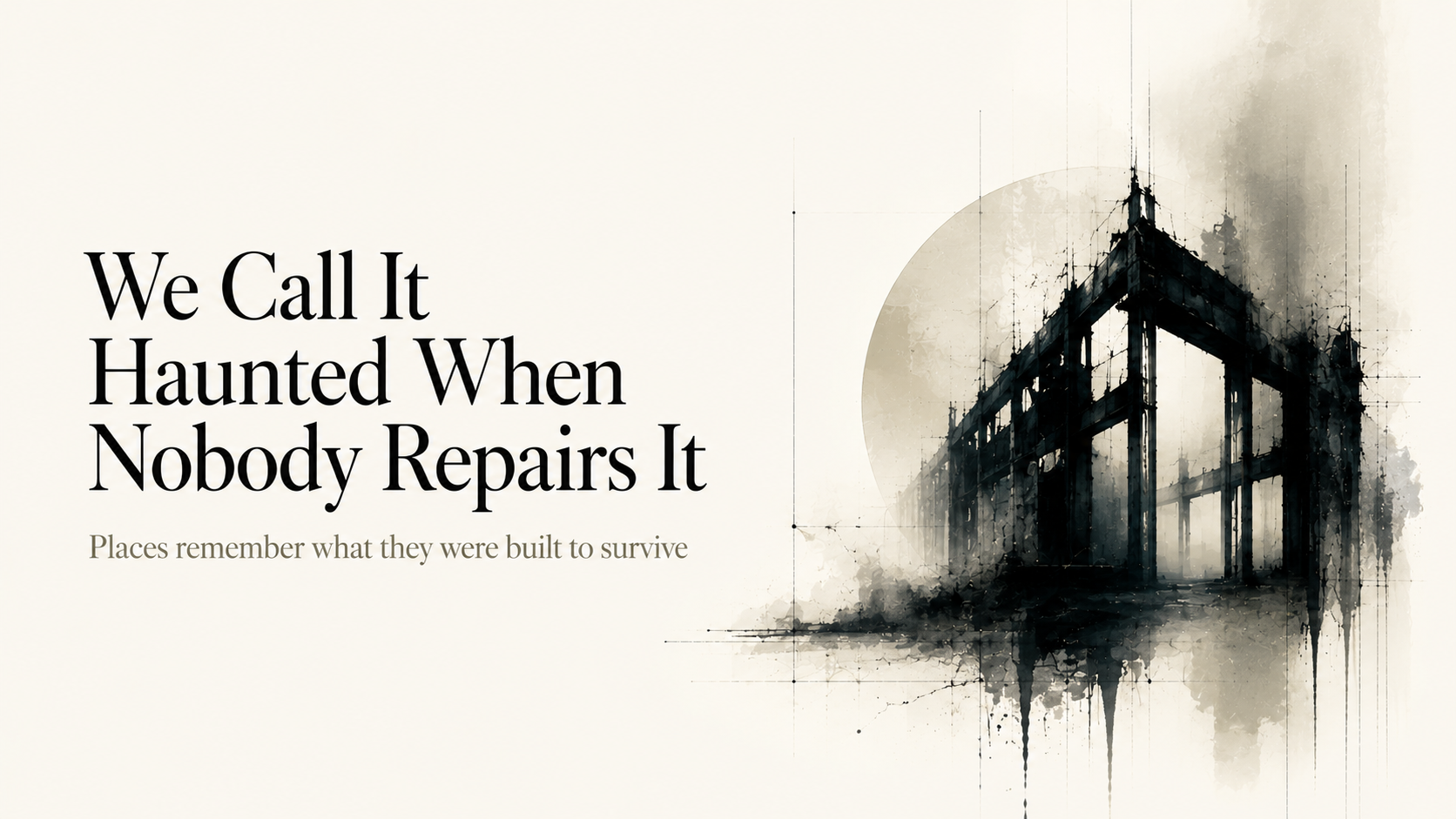
We Call It Haunted When Nobody Repairs It
Places remember what they were built to survive
A place becomes haunted when people stop understanding it but continue moving through it anyway.
Not metaphorically.
Operationally.
Most of the truly unsettling places in America are not abandoned. They are still functioning. The lights remain on. The doors still open. People continue reporting to work every morning inside systems nobody fully trusts anymore.
That feeling has stayed with me for years.
Driving past Rancho Seco does it to me every time.
The cooling towers are gone now, but the memory of the structure remains embedded in the landscape. Even after decommissioning, the site still radiates a strange psychological gravity. People remember what it was built to do. The absence almost feels louder than the facility itself once did.
That is the thing about infrastructure.
Even after systems stop operating, they continue shaping behavior.
Sometimes entire communities organize themselves around the memory of risk.
The longer I work around large institutions and complex systems, the less I think people are reacting to present conditions alone. More often, they are reacting to accumulated operational memory.
A catastrophic outage ten years ago still influences deployment behavior today.
A financial collapse reshapes consumer trust for a generation.
A violent household changes how someone interprets silence for the rest of their life.
The original event passes.
The adaptation remains.
That adaptation eventually becomes culture.
You can watch this happen almost everywhere.
The employee who keeps redundant backups because one failure permanently altered the organization’s tolerance for uncertainty.
The engineer afraid to touch legacy infrastructure because nobody fully understands the downstream dependencies anymore.
The citizen carrying extra documentation because unpredictability trained them to expect friction.
The family member who instinctively changes tone when a certain person enters the room.
Human beings adapt remarkably fast to unstable architecture.
What starts as temporary survival behavior slowly hardens into inherited ritual.
Then nobody remembers where the ritual came from.
Only that violating it feels dangerous.
That may be the clearest definition of a haunted system.
Not a system containing ghosts.
A system still exerting force long after the original conditions disappeared.
Legacy software behaves this way.
Governments behave this way.
Religious institutions behave this way.
Families behave this way.
Entire cities behave this way.
People inherit navigation patterns before they inherit understanding.
They learn which doors stick. Which intersections feel unsafe. Which forms require extra paperwork. Which topics change the atmosphere of a room. Which systems punish unpredictability.
Then eventually those navigation patterns become normalized.
At some point, adaptation starts masquerading as stability.
That is where things become dangerous.
Because familiarity and stability are not the same thing.
One of the defining features of a haunted house is not the presence of a monster. It is the collapse of trust in the environment itself. Doors stop leading where expected. Sound arrives disconnected from source. Orientation becomes unreliable.
The structure behaves incorrectly.
Broken institutions produce the same psychological effect.
People can survive hardship surprisingly well when systems remain legible. What destabilizes people is inconsistency. The sense that outcomes depend less on fairness than on learning invisible behavioral rules.
Once that happens, people stop moving confidently through systems.
They move defensively.
They overprepare.
They memorize workarounds.
They warn newcomers where the floorboards collapse.
Eventually entire populations begin organizing themselves around instability instead of repairing it.
That is how neglect becomes architecture.
Modern society often feels suspended in this condition.
We patch over exhaustion instead of resolving it. We normalize institutional drift because rebuilding feels politically impossible. We decorate failing systems with better branding while the underlying structure continues deteriorating underneath.
The shell remains operational enough to survive another quarter.
Nobody wants to shut the building down long enough to repair the foundation.
That may be why certain abandoned places feel emotionally charged even when they are objectively harmless.
The emotional residue is real.
Not supernatural residue.
Behavioral residue.
Operational residue.
Places remember what they were designed to survive.
So do people.
So do institutions.
The harder question is whether modern systems still remember how to repair themselves, or whether we have become so accustomed to adaptation that instability now feels normal.
Because eventually every unresolved system produces ghosts.
Not supernatural ones.
Operational ones.
And they continue shaping human behavior long after the original architects disappear.

Subscribe to Amid the Noise
Amid the Noise is an ongoing body of work on signal, systems, governance, AI, and the structures that shape human judgment under pressure.
Subscribe to receive new essays as they are published.