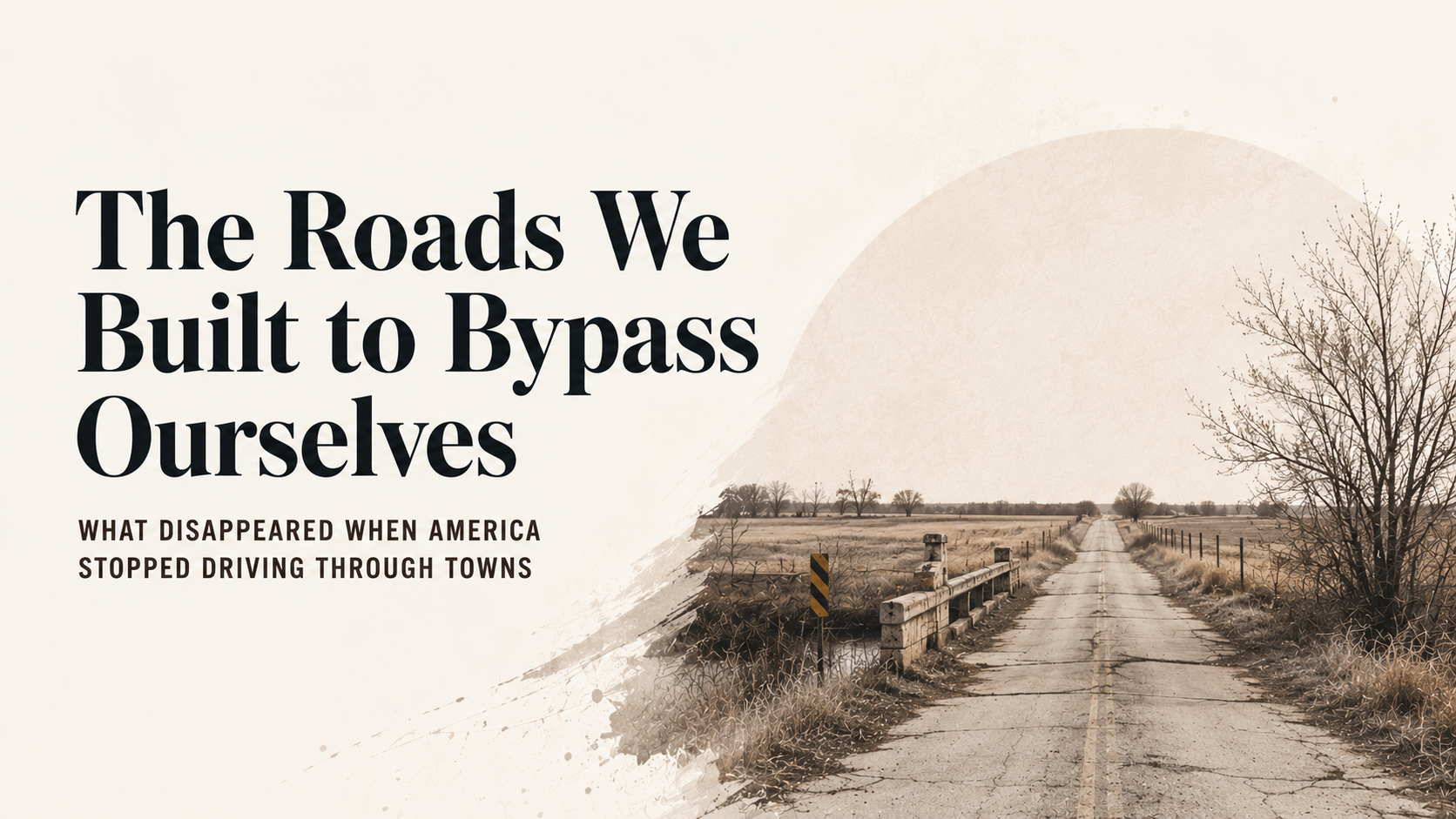
The Roads We Built to Bypass Ourselves
What disappeared when America stopped driving through towns
I grew up acutely aware that Interstate 40 was not the original road.
The real road was still there beside it.
Sometimes it ran parallel for miles. Sometimes it vanished into weeds or dead-ended into gravel. Sometimes it cut directly through small Oklahoma towns the interstate no longer acknowledged. Old concrete alignments. Faded center stripes. WPA bridges with rusted railings and plaques bolted into stone.
The old roads connected places.
The interstate connected destinations.
That distinction matters more than most people realize.
In western Oklahoma, you could physically see the transition between two versions of America layered on top of each other. One curved naturally through towns, rivers, and geography. The other arrived later as a four-lane ribbon of asphalt engineered for speed, freight, and efficiency.
One asked you to encounter the country.
The other asked you to traverse it.
As a kid, I spent a lot of time on an old bridge outside Headrick over the Red River between Altus and Snyder. Steel truss construction. Narrow lanes. Endless arches repeating toward the horizon.
It hummed.
I had forgotten that detail until recently.
Not loudly. More like the bridge resonating with itself through wind, steel tension, and tires crossing expansion joints. Older bridges felt alive in a way modern overpasses rarely do. You felt the structure carrying you. Every arch framed the next section of sky and riverbed like a sequence of industrial cathedral windows.
Crossing it never felt passive.
You were aware you were above something.
The bridge has been closed since the late 1990s, left to slowly surrender to weather and gravity. Last I heard, it still stands there fenced off over the river, no longer part of the active system but not fully gone either.
That feels strangely emblematic of the country itself.
America did not erase its older infrastructure cleanly. It bypassed it.
You see this all over Oklahoma. Old motels sitting beside newer exits. Empty service stations stranded along forgotten alignments. Concrete roads that once carried families westward now reduced to frontage access and memory.
Route 66 became Interstate 40 in fragments, but the replacement changed more than travel times.
The old highways forced interaction with local life. You drove through downtowns. You slowed for school zones. You stopped for gas in towns you had never heard of. Businesses survived because the road passed directly in front of them.
Then the interstate arrived and rerouted economic gravity overnight.
Some towns adapted.
Some faded almost immediately.
Some still exist in a strange suspended state where the old signs remain but the momentum left decades ago.
The logic behind the interstate system was not wrong. Faster freight movement reshaped the American economy. Long-distance travel became dramatically more efficient. Entire regions became more accessible.
But optimization always extracts something.
When systems prioritize speed above all else, they often remove the accidental human encounters that gave the earlier system meaning.
That pattern extends far beyond highways.
Modern airports are optimized to reduce friction. Social media platforms optimize engagement. Cities optimize real estate yield. Algorithms optimize throughput. Enterprise software optimizes operational efficiency.
Increasingly, American systems are designed to minimize interruption rather than encourage encounter.
The old roads interrupted you constantly.
You noticed towns. You noticed geography. You noticed people.
The interstate lets you cross entire states without remembering much of anything.
I think about that bridge often now.
Not because I believe the past was simpler or better. It wasn’t. Many of those same roads carried segregation, economic hardship, and Dust Bowl migration westward under desperate circumstances. Nostalgia has a way of airbrushing suffering into aesthetic texture.
Still, something valuable existed in infrastructure designed at human scale.
The old roads acknowledged that movement itself was part of civic life.
The newer systems increasingly treat movement as a problem to solve.
Maybe that is why abandoned bridges feel strangely emotional to people who grew up around them. They represent a version of America that believed connection and efficiency were the same thing.
Then one day the traffic stopped.
The hum disappeared.
And the arches remained, waiting above the river for a world that no longer needed to slow down long enough to cross them.

Subscribe to Amid the Noise
Amid the Noise is an ongoing body of work on signal, systems, governance, AI, and the structures that shape human judgment under pressure.
Subscribe to receive new essays as they are published.