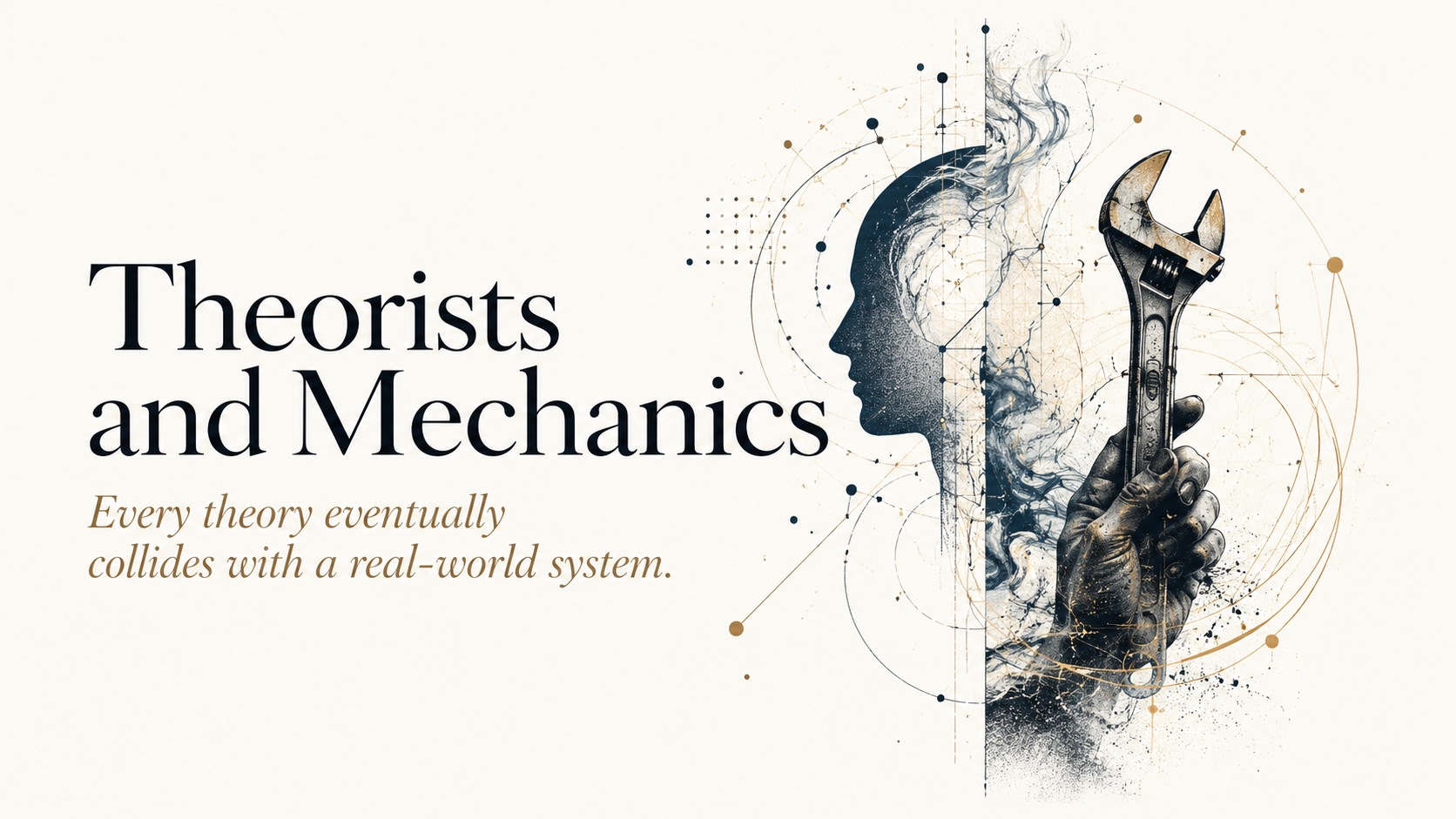
Theorists and Mechanics
Every theory eventually collides with a real-world system.
For a long time, science fiction treated engineers like two entirely different species.
One type lived in equations.
The other lived inside the machine.
You can see it all over Star Trek.
Scotty pulling apart a warp conduit because he trusts instinct as much as documentation. Jett Reno solving problems sideways with improvised brutality and sarcasm. Rutherford in Lower Decks enthusiastically elbow-deep inside systems because he genuinely loves the machinery itself.
Then there’s the other archetype.
The theorists.
The people who can hold impossible abstractions in their heads long enough to bend reality around them. Stamets navigating a spore drive no one fully understands. The scientist who writes the paper everyone else eventually depends on. The architect who understands the math before the world understands the implications.
Different personalities. Different rhythms. Different relationships with failure.
One asks:
“How does this behave under pressure?”
The other asks:
“What becomes possible if this works?”
The interesting thing is that neither group survives very long without the other.
Theory without practice becomes elegant nonsense.
Practice without theory becomes maintenance.
The systems that actually change civilization emerge when the two begin speaking the same language.
That tension matters far beyond science fiction.
It may be one of the defining problems in artificial intelligence right now.
A great deal of modern AI governance exists at the altitude of white papers, conference panels, and policy frameworks. Important work happens there. Necessary work. Theorists help civilizations think ahead of impact instead of merely reacting to damage.
Still, many governance conversations feel strangely detached from operational reality.
They discuss alignment without deployment. Accountability without interfaces. Safety without workflow. Human oversight without understanding what human beings actually do at 16h47 on a Thursday when five systems fail simultaneously and a supervisor is trying not to make a catastrophic decision under pressure.
That gap matters.
Because systems are never governed solely by intentions.
They are governed by implementation.
A beautifully written AI principle means very little if the production environment rewards speed over verification. An ethics board changes nothing if escalation pathways are unusable. A “human in the loop” becomes theater if the human lacks authority, context, or time.
Eventually, every theory collides with a keyboard, a dashboard, a budget meeting, or an exhausted operator.
That collision point is where governance becomes real.
This is partly why engineering culture fascinates me.
Not engineering as branding. Engineering as temperament.
The best practitioners develop a relationship with systems that is almost conversational. They know where things fail. They know which metrics lie. They know what breaks first during scale. They understand that operational complexity has texture.
A seasoned infrastructure engineer often trusts behavior more than documentation.
That instinct matters.
In AI, we are beginning to discover that the distance between conceptual governance and operational governance is enormous. The people building models are not always the people integrating them into hospitals, underwriting systems, public services, logistics chains, or intelligence workflows.
Those worlds speak different dialects.
One optimizes for possibility. The other optimizes for survivability.
The future probably belongs to people who can move between both.
Not pure theorists. Not pure mechanics.
Translators.
People capable of understanding abstraction deeply enough to imagine new systems, while remaining grounded enough to understand how those systems behave once real human beings touch them.
That bridge matters professionally too.
For years, much of my own work has appeared heavily theoretical from the outside. Essays about signal integrity. Governance. Decision systems. Trust architectures. Civic systems. Human-centered intelligence infrastructure.
Thought work.
At least that’s how it can appear at first glance.
The reality is less glamorous and more practical.
Most of those ideas emerged from watching real systems fail in real environments with real consequences attached. Enterprise software. Financial systems. Operational workflows. Public-facing systems where ambiguity, pressure, and incentives collide.
Theory came afterward.
Not before.
That distinction matters more than people realize.
The strongest strategic thinking is often produced by practitioners who stayed close enough to implementation to understand where the abstractions break apart.
The mechanic eventually learns architecture. The architect eventually learns respect for the machine shop.
The dangerous people, in the best sense of the word, are the ones who can do both.
In science fiction, the theorist and the engineer usually end up in the same room eventually, trying to stop the ship from tearing itself apart.
That may be more realistic than it first appears.

Subscribe to Amid the Noise
Amid the Noise is an ongoing body of work on signal, systems, governance, AI, and the structures that shape human judgment under pressure.
Subscribe to receive new essays as they are published.