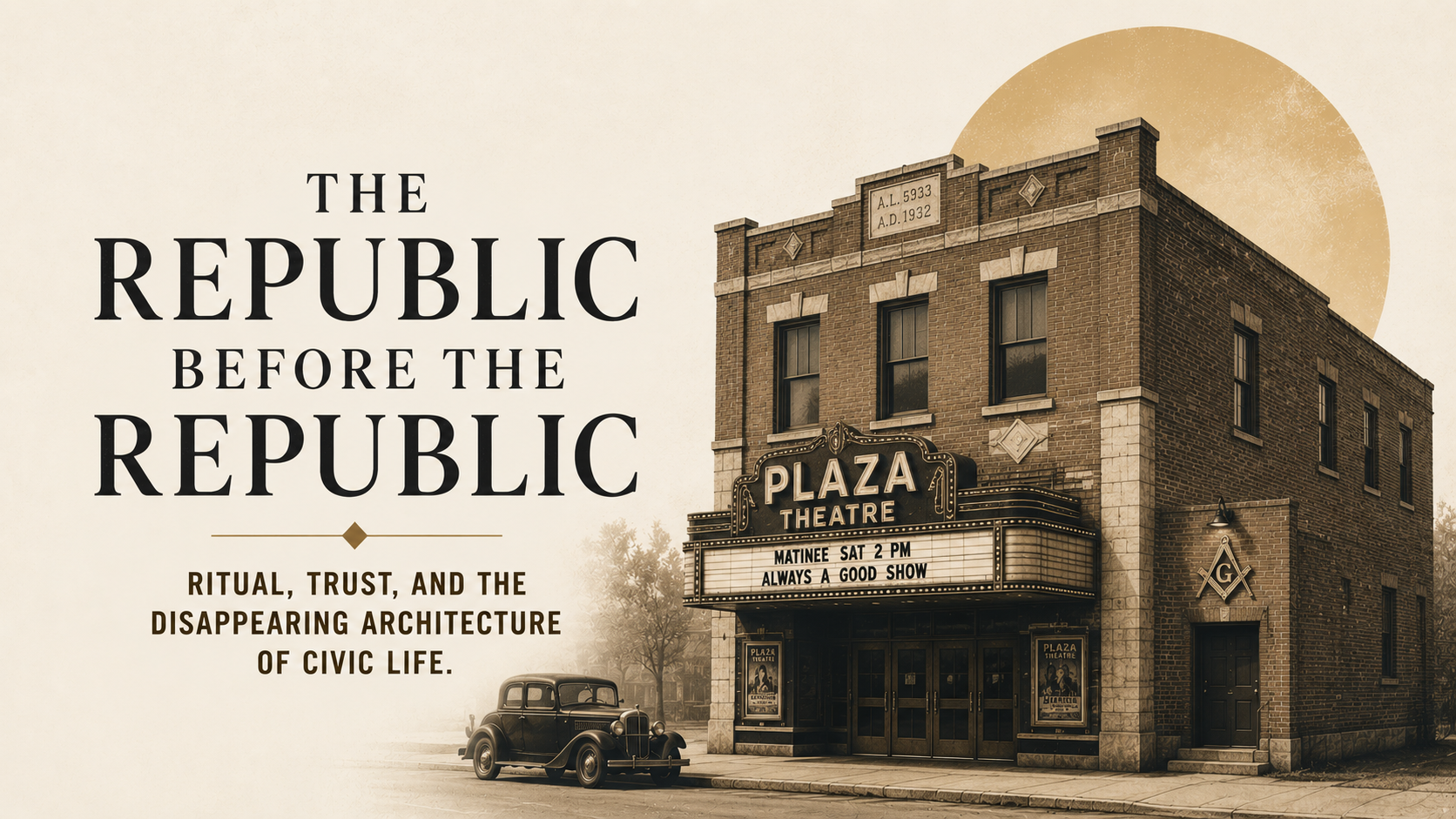
The Republic Before the Republic
Ritual, trust, and the disappearing architecture of civic life.
Long before I understood Freemasonry philosophically, I understood it atmospherically.
I understood it through small pauses in conversation.
A ring noticed across a counter.
A subtle nod during a traffic stop.
My parents dressing for Eastern Star meetings.
Quiet references to lodges, dinners, charities, obligations, funerals, rituals, and people I had never met but somehow already belonged to.
Freemasonry was never presented to me as a conspiracy.
It felt more like inherited civic weather.
As a child, I understood the visible layer first: the symbols, the formality, the strange titles, the buildings with no windows downtown. The practical benefits revealed themselves later. A little more trust here. A little more patience there. A slight softening between strangers who recognized the same symbolic language.
People often interpret those moments cynically now.
Modern culture increasingly treats trust as something quantified publicly rather than earned slowly over time.
The older fraternal world operated differently.
Imperfectly, certainly. Sometimes unfairly. Sometimes exclusionary. Yet it also created forms of social continuity that modern America increasingly struggles to reproduce.
A Masonic ring did not merely signal affiliation. It implied inheritance. Conduct. Obligation. Someone had vouched for you over time.
That distinction matters.
We used to drive past the lodge just to see whose trucks were parked outside.
That was often enough to know who was still in town, who was doing alright, who might already be upstairs drinking coffee and arguing about something that had been argued about for forty years.
From the outside, the buildings rarely looked important.
Some dated back to the 1930s and 1940s, with fading brick facades and narrow second-floor windows overlooking downtown streets that once carried far more life than they do now. Others reflected a different confidence entirely. The “new” lodge in Altus carried that unmistakable atomic-age optimism: clean lines, geometric masonry, bright stone, mid-century confidence that institutions and progress would continue expanding forever.
Even the architecture told a story about the America that built it.
Inside was cigarette smoke, old wood, burnt coffee, ritual books, worn carpet, folding chairs, and giant pots of pinto beans or red beans simmering in the kitchen downstairs before a fundraiser or fish fry.
The public mostly saw the harmless surface layer: pancake breakfasts, scholarship checks, fish fries, raffles, charity drives, glaucoma screenings.
Nothing about it looked powerful.
That may be why people misunderstand Freemasonry now.
Modern Americans are conditioned to assume real influence must look sleek, centralized, technologically sophisticated, or deliberately hidden.
Yet much of the old fraternal world functioned through something quieter:
repetition.
Men showing up repeatedly for decades.
Shared ritual repeated until memory became instinct.
Widows invited back every year after funerals.
Teenagers receiving scholarships from men who once received them themselves.
Neighbors checking whose truck was parked outside the lodge on a Tuesday night.
It was not glamorous.
It was infrastructure.
Like all infrastructure, it depended upon maintenance.
Meetings people did not feel like attending.
Coffee that still had to be brewed.
Rituals repeated until they became memory instead of novelty.
A man who spends forty years arguing about repairing the lodge roof is participating in a form of civic rehearsal whether he realizes it or not.
Small procedural disagreements. Budget votes. Committee frustrations. Rotating leadership. Losing arguments without leaving the room afterward.
Those behaviors scale outward.
School boards. City councils. Volunteer organizations. Democratic governance depends less upon ideological agreement than upon a population willing to remain inside shared processes long after novelty disappears.
The republic was never designed to run on autopilot.
Even in southwest Oklahoma, the story was more complicated than nostalgia sometimes allows.
Altus had both white lodges and a Prince Hall lodge because American Masonry reflected many of the same contradictions as America itself. The fraternity spoke the language of symbolic equality while often remaining segregated in practice.
Yet there is something revealing in the fact that Black Masonic traditions endured anyway.
In many Black communities, the lodge became one of the few places where procedural equality could be rehearsed before it existed reliably outside the building.
The promise of symbolic equality proved powerful enough that excluded communities rebuilt the structure for themselves rather than abandoning it altogether.
In southwest Oklahoma, the consolidations came slowly enough that people could pretend they were temporary.
One small town folded into another.
Then another.
Then another.
The lodges retreated inward the same way the towns themselves did.
Each merger probably made practical sense: fewer members, older members, shrinking populations, maintenance costs, longer drives between communities that once sustained themselves independently.
The men who built those mid-century lodges assumed they were expanding a permanent civic future. The generations that followed increasingly learned to manage contraction instead.
Yet something larger was disappearing underneath the administrative logic.
The deeper loss was not simply membership.
It was cultural patience.
Modern America increasingly prefers identity over obligation, visibility over participation, and personal expression over repetitive institutional maintenance. The older fraternal world asked something less glamorous from people: show up again next week.
That kind of continuity once trained citizens to tolerate procedure, disagreement, boredom, succession, and compromise without interpreting every inconvenience as betrayal.
Even Mangum eventually dimmed, and for people who grew up there, that felt almost impossible. Some lodges carried the emotional weight of permanence. Their buildings, rituals, and cornerstones projected the confidence of institutions that expected to outlive everyone inside them.
The men who laid those cornerstones genuinely believed they were constructing part of the civic skeleton of America itself.
Then one day the lights go out upstairs.
The theater downstairs closes too.
The windows darken.
The pancake breakfasts stop.
And eventually nobody remembers which Tuesday night was the last one.
Over time, I became less interested in the mythology surrounding Freemasonry and more interested in the historical conditions that made it so culturally pervasive during the colonial period and the earliest decades of the United States.
The modern imagination often reverses the causality.
People assume Freemasonry secretly infiltrated the founding of America.
The more plausible interpretation is far more interesting:
many of the kinds of men capable of building a republic were already predisposed toward the same Enlightenment-era values Freemasonry reinforced.
Rational inquiry.
Procedural order.
Self-governance.
Moral accountability.
Structured debate.
Civic obligation.
Symbolic equality within the lodge despite inequality outside it.
Freemasonry did not invent those ideas alone. The Enlightenment was already reshaping Europe and the colonies intellectually. Yet the Blue Lodge provided something uniquely important:
a recurring social theater where those values could be practiced behaviorally before they were attempted politically on a national scale.
That is the part many modern discussions miss.
A republic is not sustained by documents alone.
The Constitution is paper.
Self-government is behavioral.
It depends upon citizens capable of restraint, deliberation, succession, disagreement within structure, and symbolic commitment to systems larger than themselves. Those are trained behaviors, not automatic human defaults.
Inside the lodge, men rehearsed many of those behaviors repeatedly: rotating authority, formal procedure, democratic voting, ritualized equality, codified conduct, intergenerational mentorship, and the subordination of ego to shared symbolic process.
Not perfectly. Human institutions never are.
Yet it is difficult to ignore how naturally these fraternal structures aligned with the psychological and civic demands of the American founding.
Freemasonry did not secretly create the republic.
Yet it helped cultivate many of the habits, relationships, symbolic frameworks, and systems of trust upon which republican governance depends.
The old lodges understood something modern America increasingly forgets: self-government requires rehearsal.
Not because democracy is natural.
Because it is not.
The buildings themselves understood this once.
That is why they were built to feel permanent.
Cornerstones set deep into the ground. Theaters downstairs. Lodge rooms upstairs. Heavy doors. Long staircases. Institutions constructed with the assumption that future generations would continue climbing them.
Then one day the lights go out upstairs.
The theater downstairs closes too.
The windows darken.
Eventually nobody remembers which Tuesday night was the last one.
When the rehearsal stops, the republic does not collapse all at once.
It simply forgets how to perform itself.

Subscribe to Amid the Noise
Amid the Noise is an ongoing body of work on signal, systems, governance, AI, and the structures that shape human judgment under pressure.
Subscribe to receive new essays as they are published.