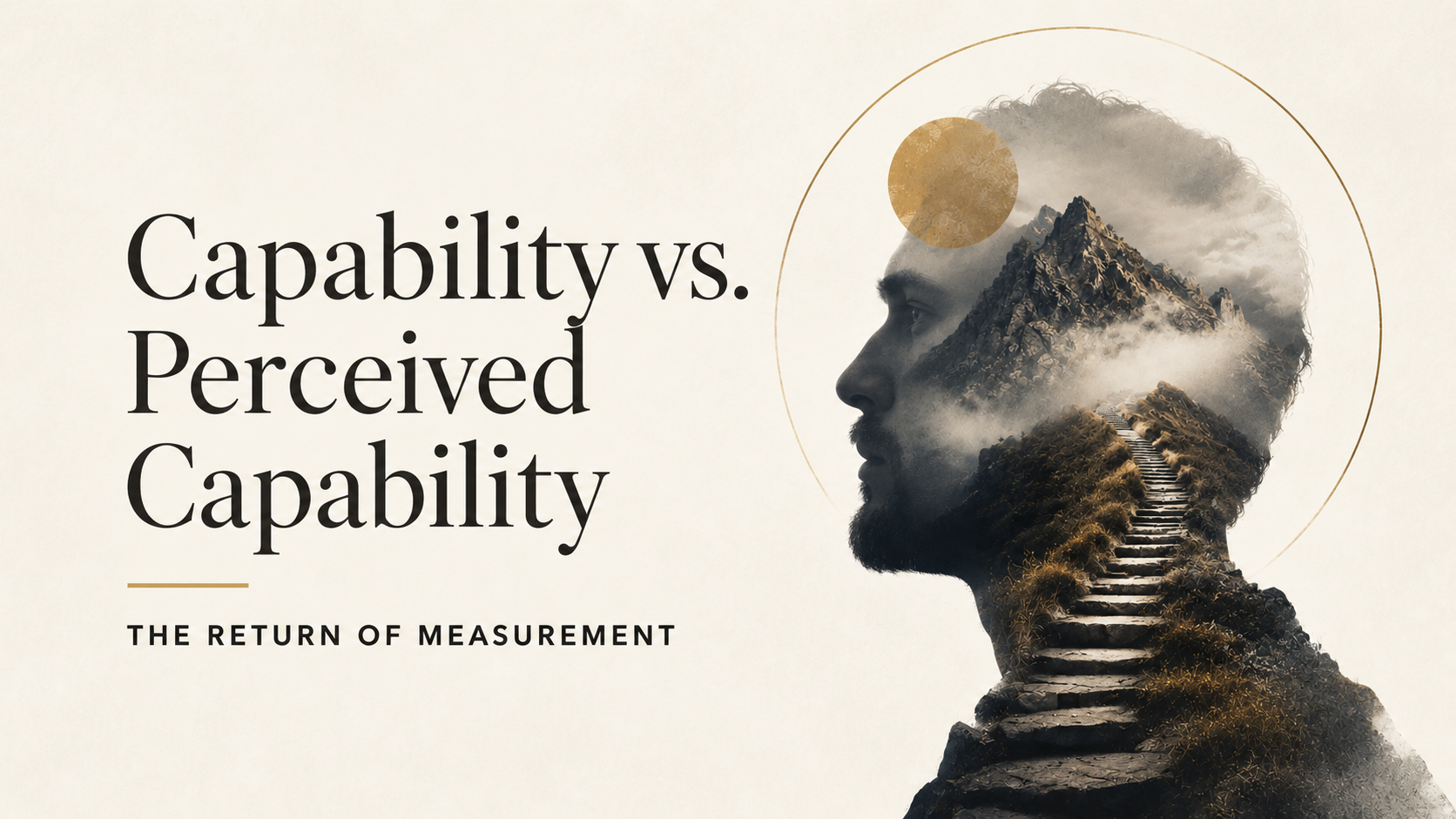
Capability vs. Perceived Capability
The difference between feeling strong and being strong
By the end of my shift at the vote center, my feet hurt.
That should not have surprised me.
Somehow it did.
The work itself is not difficult. Most of it involves helping people register to vote, answering questions, solving small problems, and making sure things run smoothly. It is important work, but it is hardly strenuous.
Yet after a full day on my feet, I came home tired in a way I had not expected.
The surprise lingered.
Not because I was exhausted.
Because I had forgotten what ordinary effort feels like.
For years, I lived inside a distorted relationship with energy.
Many people think addiction changes behavior.
It does.
What it also changes is perception.
The body continues reporting information.
The mind stops interpreting it accurately.
The substance is not the only thing capable of doing this.
Stress can do it.
Burnout can do it.
Grief can do it.
Anything that creates enough noise can eventually drown out the signal.
Fatigue becomes optional.
Recovery becomes negotiable.
Limits become invisible.
The dashboard remains lit while warning lights quietly disappear.
Looking back, I can see countless moments where capability and the perception of capability drifted apart.
At the time, I would have insisted they were the same thing.
If I could work, I was fine.
If I could stay awake, I was productive.
If I could keep moving, everything must still be functioning.
The body was saying one thing.
The mind was hearing another.
Sobriety has a way of exposing that gap.
One of the stranger experiences in recovery is discovering that reality often feels worse before it feels better.
Not because life is deteriorating.
Because measurement is returning.
The signals become clearer.
You notice the lack of sleep and the accumulated stress.
You notice tension that has been quietly riding in your shoulders.
You notice that standing all day actually requires stamina.
You notice that concentration consumes energy.
You notice that work has weight.
The temptation is to interpret these discoveries as weakness.
I think they may represent something else.
Accuracy.
Every system depends on feedback.
Bodies do.
Relationships do.
Organizations do.
Governments do.
The scale changes.
The principle does not.
When feedback becomes distorted, strange things happen.
Companies convince themselves customers are happy while users quietly leave.
Institutions celebrate improving metrics while trust erodes underneath them.
People insist they are doing fine while important parts of their lives slowly collapse.
The problem is rarely the absence of information.
The information is often present.
The problem is our ability to perceive it.
That realization has changed the way I think about recovery.
Recovery is often described as regaining strength.
Sometimes it is.
Sometimes it is regaining honesty.
Sometimes it is regaining perspective.
Sometimes it is learning to trust signals that were always there but could no longer be heard clearly.
My feet hurt after work.
My body was tired.
For the first time in a long time, I trusted those signals.
They were not evidence of failure.
They were information.
For a long time, I confused feeling capable with being capable.
The distinction matters more than I realized.
Capability is what exists.
Perceived capability is what we believe exists.
The distance between those two things can become surprisingly large.
Wisdom begins when we learn to measure that distance honestly.
The most dangerous failures often occur long before a system stops functioning.
They begin when it loses the ability to accurately perceive itself.
The same may be true of people.

Subscribe to Amid the Noise
Amid the Noise is an ongoing body of work on signal, systems, governance, AI, and the structures that shape human judgment under pressure.
Subscribe to receive new essays as they are published.