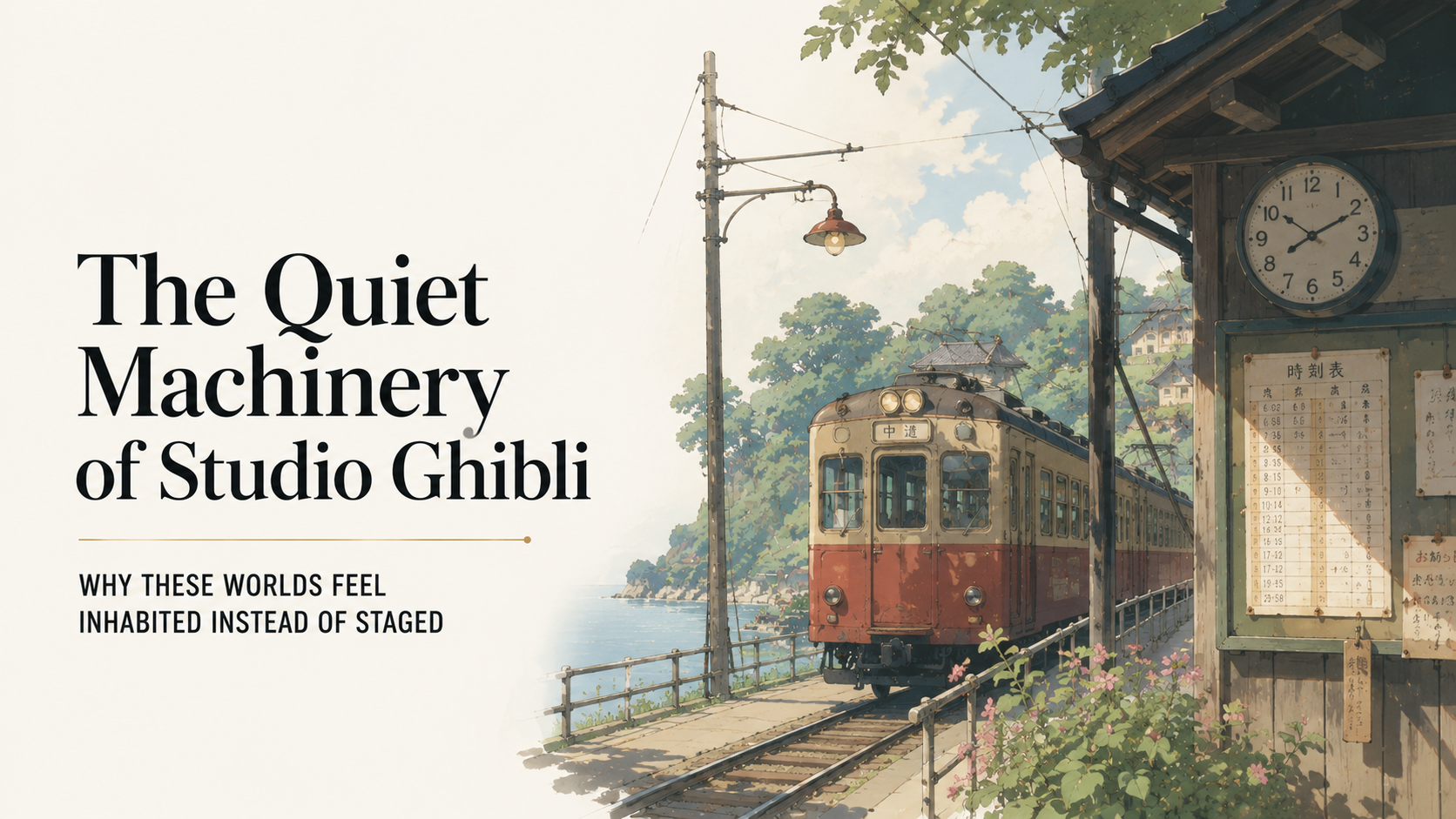
The Quiet Machinery of Studio Ghibli
Why these worlds feel inhabited instead of staged
There is a reason the worlds of Studio Ghibli feel believable long before they feel fantastical.
It is not merely the animation. It is not nostalgia. It is not even the storytelling itself.
It is the maintenance.
Most fictional worlds are built around spectacle. Grand conflicts. Ancient prophecies. Endless lore. Entire franchises now operate like expandable databases, constantly explaining themselves in greater detail while somehow feeling less inhabited with every installment.
Studio Ghibli does something quieter.
Its worlds feel operational.
Train schedules are pinned to station walls. Soot stains collect around machinery. Lanterns require maintenance. Bread cools in windows. Work aprons hang beside doorways after long shifts. Handwritten menus curl slightly at the edges from steam and time.
Even silence feels employed.
The environments communicate that people live there beyond the needs of the plot. Someone swept the hallway before dawn. Someone repaired the boiler last winter. Someone stocked the pantry before the rain arrived.
That continuity matters.
The genius of films like Spirited Away, Kiki’s Delivery Service, and Princess Mononoke is not simply their visual imagination. It is the sense that life continues at the edges of the frame.
The train still runs when the protagonist falls asleep. The bakery still opens before sunrise. The bathhouse still needs towels washed, floors cleaned, pipes repaired, and accounts balanced.
The fantasy arrives inside functioning systems rather than replacing them.
That distinction changes everything.
Many modern fictional universes confuse explanation with depth. They build encyclopedias instead of environments. Every historical event receives documentation. Every character receives backstory. Entire timelines unfold across companion media, streaming spin-offs, games, and online wikis.
Yet the worlds themselves often feel strangely vacant.
Nobody appears to buy groceries. Nobody waits for buses. Nobody wipes down counters at closing time. Nobody maintains the infrastructure required for civilization to feel alive.
Studio Ghibli obsesses over exactly those details.
A tiled corridor in a bathhouse carries emotional weight because the environment reflects use. A weathered toolbox on a shelf tells the audience more about a world than pages of exposition ever could. Utility poles disappearing into fog communicate scale, weather, isolation, and continuity all at once.
The worlds feel inhabited because they contain operational texture.
That phrase matters to me.
Good systems often reveal themselves indirectly through accumulated evidence of care. Cities. Software. Transit systems. Restaurants. Institutions. The environments people trust most are rarely frictionless. They simply bear signs that someone thoughtful remains present behind the scenes.
Maintenance is emotional architecture.
Studio Ghibli understands this intuitively.
Even food operates as infrastructure in those films. Meals are not decorative props placed into scenes for aesthetic effect. They communicate geography, labor, seasonality, class, comfort, and emotional safety. A bowl of ramen or a loaf of fresh bread often explains more about the state of a world than dialogue does.
The magic is rarely the spectacle itself.
It is the operational continuity beneath it.
That may be why these films linger so differently in memory. Their worlds do not feel staged for an audience. They feel observed mid-function, as though the camera simply happened to arrive while life was already underway.
The worlds feel alive because someone stayed behind to keep them running.

Subscribe to Amid the Noise
Amid the Noise is an ongoing body of work on signal, systems, governance, AI, and the structures that shape human judgment under pressure.
Subscribe to receive new essays as they are published.