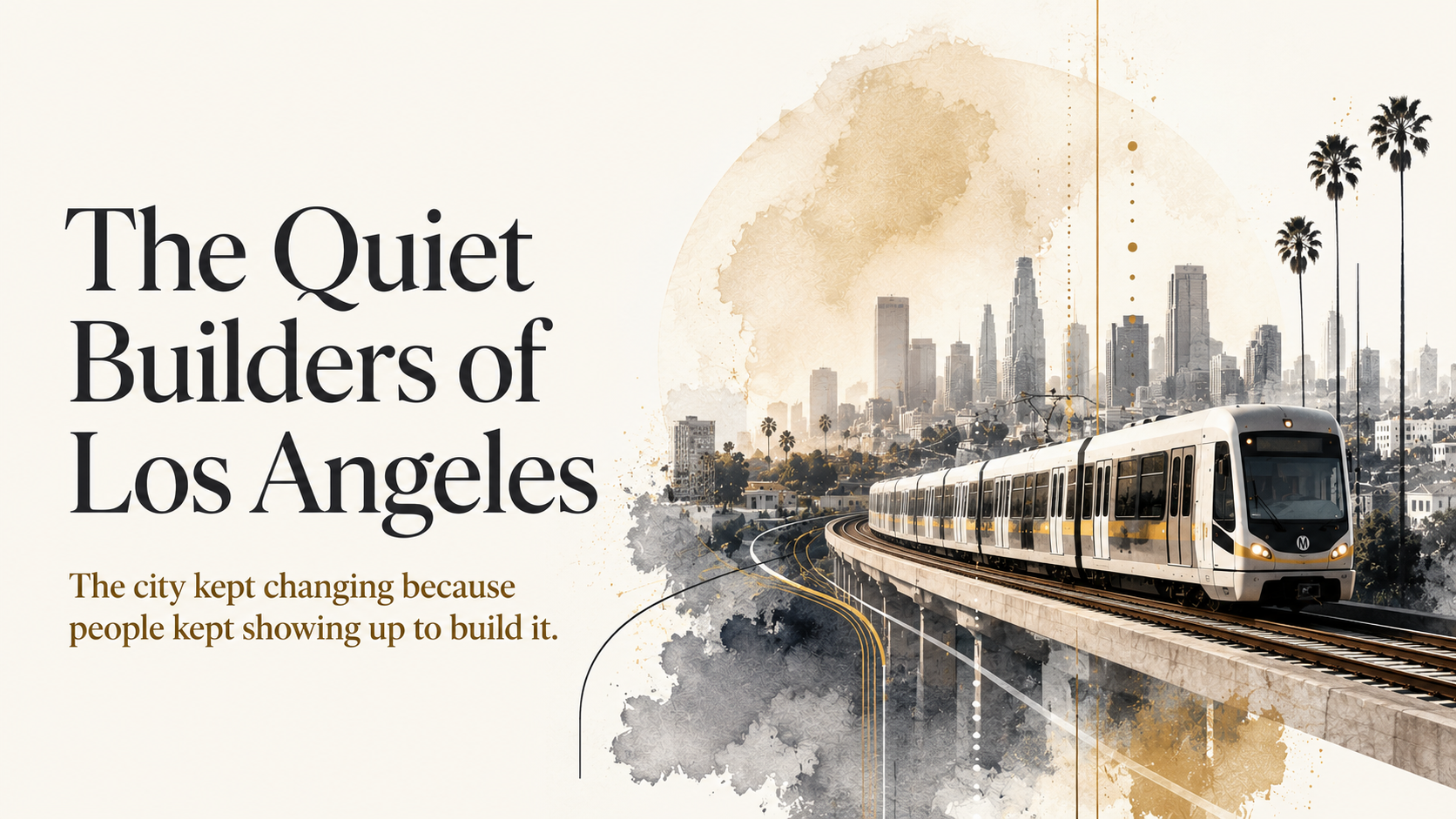
The Quiet Builders of Los Angeles
The city kept changing because people kept showing up to build it.
I used to stay at a hotel near the entrance to the Santa Monica Pier.
By then, the Metro line terminated almost at the edge of the Pacific, near where the old Santa Monica mall once stood. I never actually rode the train during those trips, but I watched it constantly.
Trains arrived. Doors opened. People disappeared inside. The line left again toward downtown Los Angeles.
I studied the maps. Bought a TAP card. Imagined routes across the city.
This was still before I would fully do such a thing myself, but something about it fascinated me.
Part of that fascination honestly traced all the way back to Volcano in the 1990s.
For people of a certain age, Los Angeles rail almost felt fictional back then. The city was culturally synonymous with freeways, traffic, and endless automotive sprawl. The subway existed more as curiosity than identity.
So when I found myself in Santa Monica in 2018, I was stunned by how much had quietly changed.
The system had expanded dramatically.
And it never stopped.
Fast forward to today and the announcements seem nearly constant: new extensions, new funding, new stations, new corridors, new connections.
The opening of the Metro D Line extension felt especially symbolic to me. Not because Los Angeles had suddenly solved transit, but because the city appeared willing to continue attempting something extraordinarily difficult: reconnecting itself physically after generations of designing around separation.
That matters more than people realize.
Most conversations about Los Angeles flatten the city into mythology.
Celebrity. Traffic. Performance. Freeways. Sprawl.
But beneath all of that exists an enormous coordination system carried by people most visitors never think about: planners, signal engineers, maintenance crews, electricians, construction workers, cleaning staff, operators, facilities teams, overnight repair crews.
The quiet builders of Los Angeles.
The older I get, the more convinced I become that infrastructure is one of the clearest expressions of what a society believes people deserve collective access to.
Transit is not simply transportation.
It is participation infrastructure.
A train line determines whether someone can reach work without owning a car. Whether a senior can remain mobile after driving no longer feels safe. Whether a veteran can access the VA. Whether students can move across a city without isolation becoming permanent. Whether economic participation remains possible when life becomes unstable.
That is why Los Angeles fascinates me so deeply.
The city still feels unfinished in a way I find strangely hopeful.
You can see the negotiation happening in real time between older assumptions and newer possibilities. Freeways still dominate the landscape, but beneath them another system continues threading itself slowly through the region.
Not glamorous. Not complete. Not universally loved.
Just persistent.
I think that persistence is what I respond to emotionally.
The city appears willing to keep trying despite the complexity.
There is something profoundly human about that.
Especially now, when so many systems seem designed primarily to optimize, extract, or fragment.
Los Angeles still appears interested in the difficult work of connection.
And honestly, I think that may be why the city increasingly feels like somewhere I could belong.

Subscribe to Amid the Noise
Amid the Noise is an ongoing body of work on signal, systems, governance, AI, and the structures that shape human judgment under pressure.
Subscribe to receive new essays as they are published.