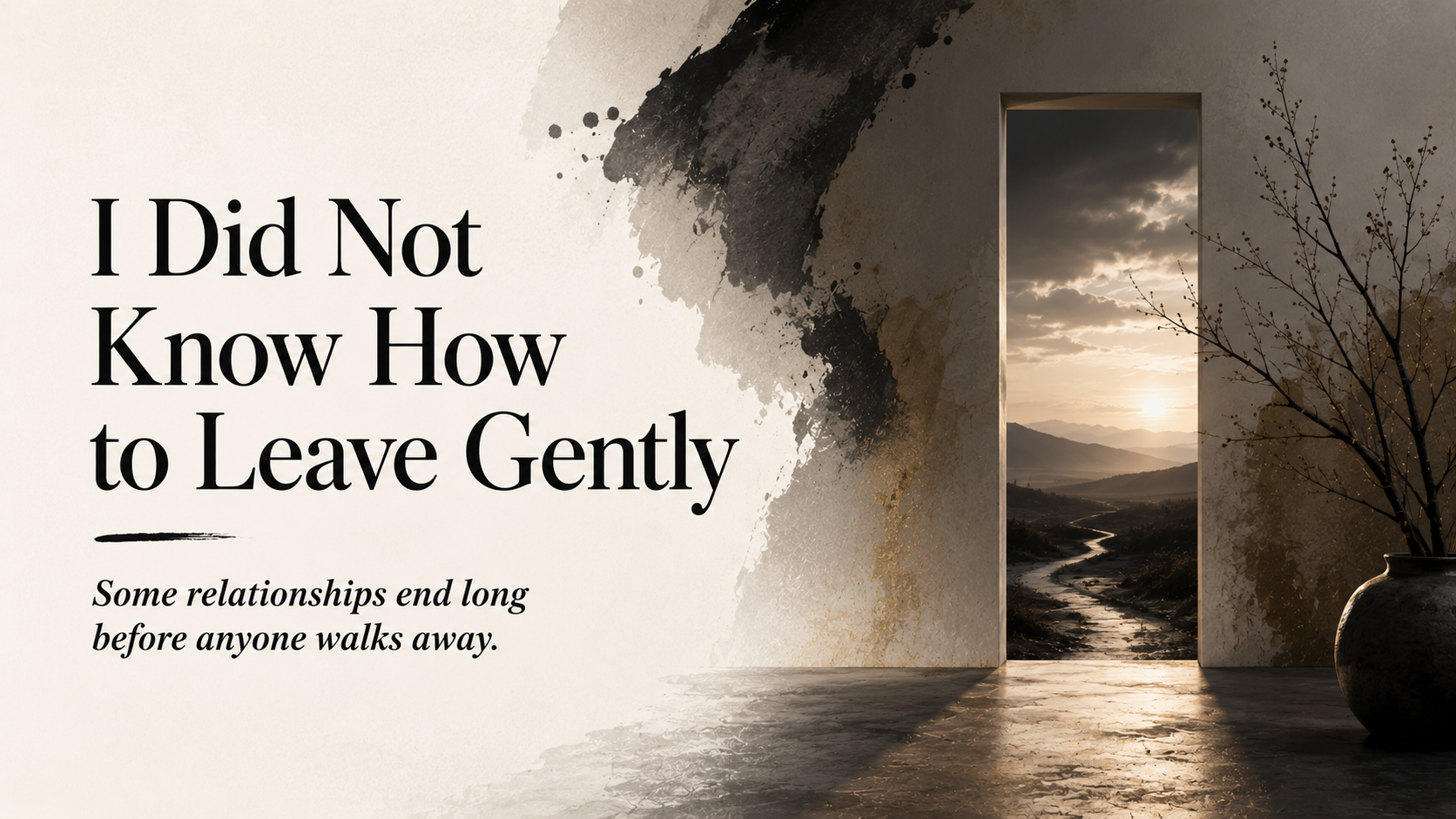
I Did Not Know How to Leave Gently
Some relationships end long before anyone walks away.
I am happier with my life now than I once believed possible.
Not because everything became perfect.
Because I finally became more intentional about what and who I allow to shape it.
That sounds obvious until you realize how many years survival was the primary organizing force behind my decisions. Addiction narrows life aggressively. Relationships formed inside that environment can become less about compatibility and more about mutual orbit. You survive together long enough that eventually the structure itself starts feeling inevitable.
My longest relationship lasted ten years.
We met early in substance abuse. I eventually got sober for a period, though the relationship itself never really stabilized. I tried ending things more than once over the years. Sometimes directly. Sometimes emotionally. Sometimes through distance. None of it fully worked.
There were always leases. Living situations. Families. Financial realities. History. Guilt. Momentum.
The relationship kept continuing even when parts of it had already stopped functioning.
At the time, I interpreted endurance as commitment. I thought refusing to give up automatically made me a better partner. I convinced myself enough time and enough effort could eventually transform incompatibility into stability.
Now I think I was confusing persistence with avoidance.
The difficult truth is that some relationships become structurally hard to leave long before they become emotionally healthy to stay in.
That does not mean nobody loved each other.
It means entanglement can outlive compatibility.
Over time our lives organized themselves around instability. Relapse cycles. Recovery attempts. Temporary resets followed by collapse. Long periods where neither of us was fully emotionally present. We were not building a future so much as repeatedly trying to survive the present.
Looking back, I think part of me understood the relationship was already ending years before the official breakup happened.
I just did not know how to leave gently.
That realization has become uncomfortable to sit with because I no longer believe all self-destruction is purely accidental. Sometimes chaos becomes a doorway people use when they cannot emotionally access a cleaner exit.
I am not proud of that.
I also no longer think honesty is served by pretending I did not understand what I was doing.
The strange thing about recovery is that clarity often arrives slowly and out of order. During the first year sober, survival itself becomes the full-time job. Stay clean. Stabilize emotionally. Rebuild structure. Do not burn your life down impulsively trying to reinvent yourself overnight.
That advice exists for a reason.
Only later do quieter questions begin surfacing.
Do we actually work together?
Would we have chosen each other outside the conditions that created us?
Are we building peace together, or merely familiarity?
Those questions are much harder than relapse itself sometimes.
Especially when history, loyalty, guilt, and shared survival all become tangled together.
I do not regret loving people who were struggling.
I do regret how long I believed struggle itself was proof of compatibility.
There is a difference between helping carry someone through darkness and building a life permanently organized around surviving it.
I understand that distinction more clearly now than I once did.
That understanding arrived late.
Still, late is better than never.

Subscribe to Amid the Noise
Amid the Noise is an ongoing body of work on signal, systems, governance, AI, and the structures that shape human judgment under pressure.
Subscribe to receive new essays as they are published.