The Pool & the Fence
Belonging and Babel
The pool smells of chlorine and desperation. Ten feet away, the water sparkles with curated joy. Somewhere between the two, I am still trying to translate.
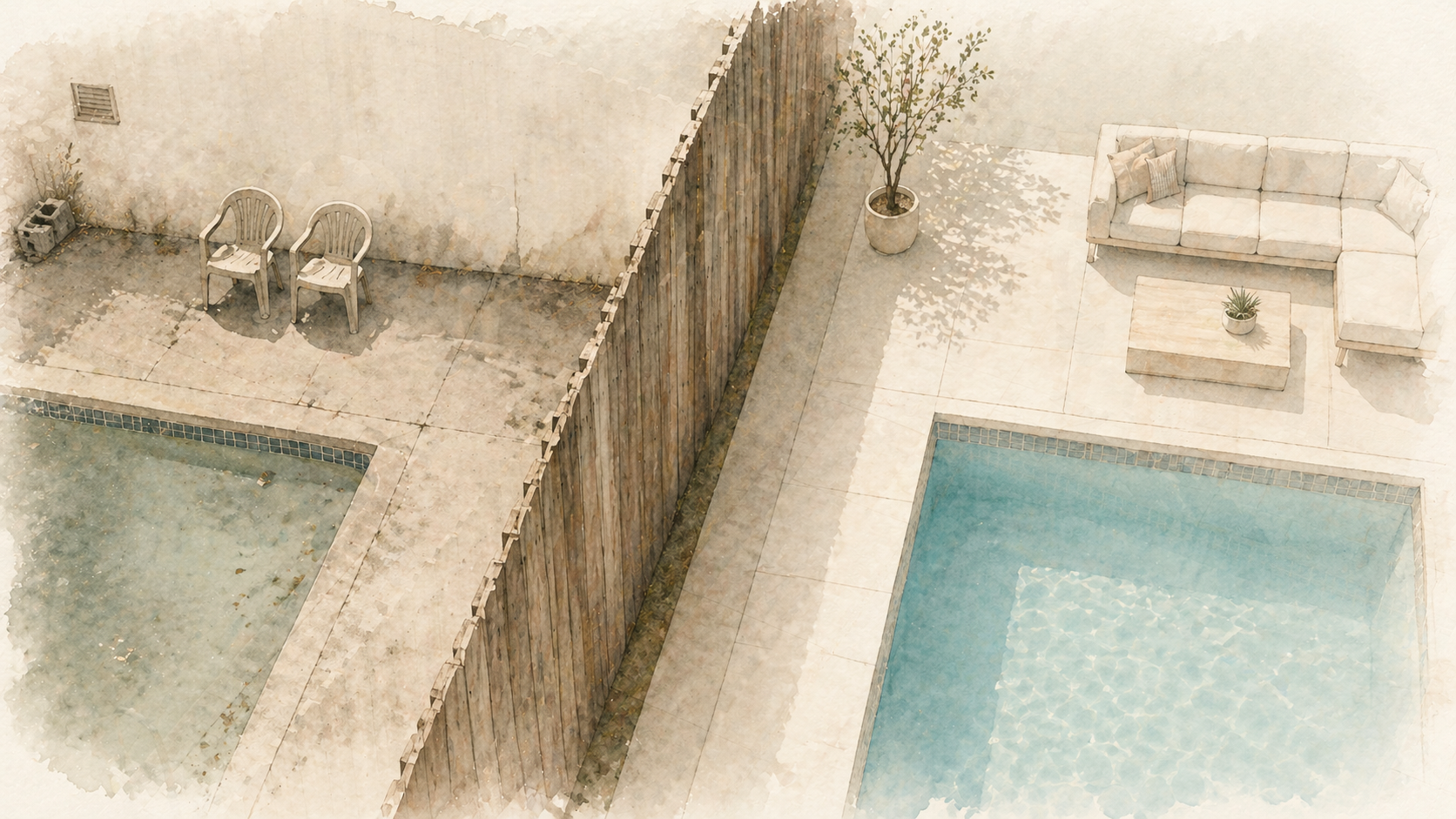
There’s a pool somewhere in Milpitas, hidden behind a beige two-story house where the neighbors’ roofs are so close they could gossip over the gutters. The pool smells of chlorine and desperation.
On one side of a sunburned wooden fence, the conversation drifts toward who just got out, who got put back in, which judge has it in for whom, and the child someone just lost to the system. The hustle went wrong. The sack that never showed up. The language of survival.
Ten feet away, in the neighbor’s yard, people chat about baby showers, gender reveals, job promotions, and Tesla’s latest model. Someone chuckles about wine pairings while others scroll through a registry. The same sun gleams off both pools, yet one hides broken promises beneath the ripples, while the other reflects curated happiness.
It is not the fences that divide people most.
It is the language.
When Words Build Walls
On one side, the conversation is all lived experience—no polish, no metaphor, only survival. People talk about what happened, not how it felt. The sentences land hard, clipped, transactional.
“She’s back inside.”
“Lost custody last week.”
“Court date Monday.”
There is a kind of raw honesty in that cadence—no need for translation, no room for pretense.
In the other yard, the vocabulary stretches itself like a yoga instructor. It is full of new opportunities, mindful transitions, and moments to pause and realign priorities. Words that sound like personal growth but serve as self-promotion with better lighting.
Language is meant to bring us together; it often shows who belongs and who doesn’t.
Fluent in Exile
I have spent most of my adult life as a translator—a person fluent in multiple dialects of belonging. I can speak recovery and recursion, trauma and tech. I can shift from the cadence of the halfway house to the shorthand of the boardroom without missing a beat. The older I get, the more I realize that fluency is not always a gift. Sometimes it is exile with a better vocabulary.
My career has been centered on making language accessible—creating systems that people can easily use, removing the jargon that makes them feel small. The irony is that I still find comfort in the simplicity of exclusion. It feels good to sound like you belong. It feels powerful to be understood only by a select few.
My partner used to do that. He would tell me he worked in “zone three today” or that his route was five or seven. He could have said First Street or Bassett by the freeway. The jargon gave him a sense of control—a world where everything had a number, a map, a code. When I asked where that was, he would sigh and say, “I told you before.”
That’s what happens when language ceases to be communication and turns into currency. The words no longer clarify; they credential.
The San Francisco Mirror
Maybe that’s why I keep returning to San Francisco. It’s one of the few cities that speaks my language. Complexity is seen as a virtue, and acronyms act as social currency. Every sentence feels like half prayer, half password.
The tragedy is that I love it. I find comfort in the hum of data, the clear logic of systems, the poetry of code. I belong to the world that builds fences, yet I have never forgotten what it feels like to live on the side that cannot afford one.
Even our humor reveals us. A MUNI bus once displayed an ad that read, “Don’t SOC-block your best engineer.” I laughed out loud, delighted by the pun, knowing that almost no one outside of cybersecurity would get it. That is the paradox of belonging in this city—our cleverness unites us while quietly ensuring most people will never be in on the joke.

Subscribe to Amid the Noise
Amid the Noise is an ongoing body of work on signal, systems, governance, AI, and the structures that shape human judgment under pressure.
Subscribe to receive new essays as they are published.