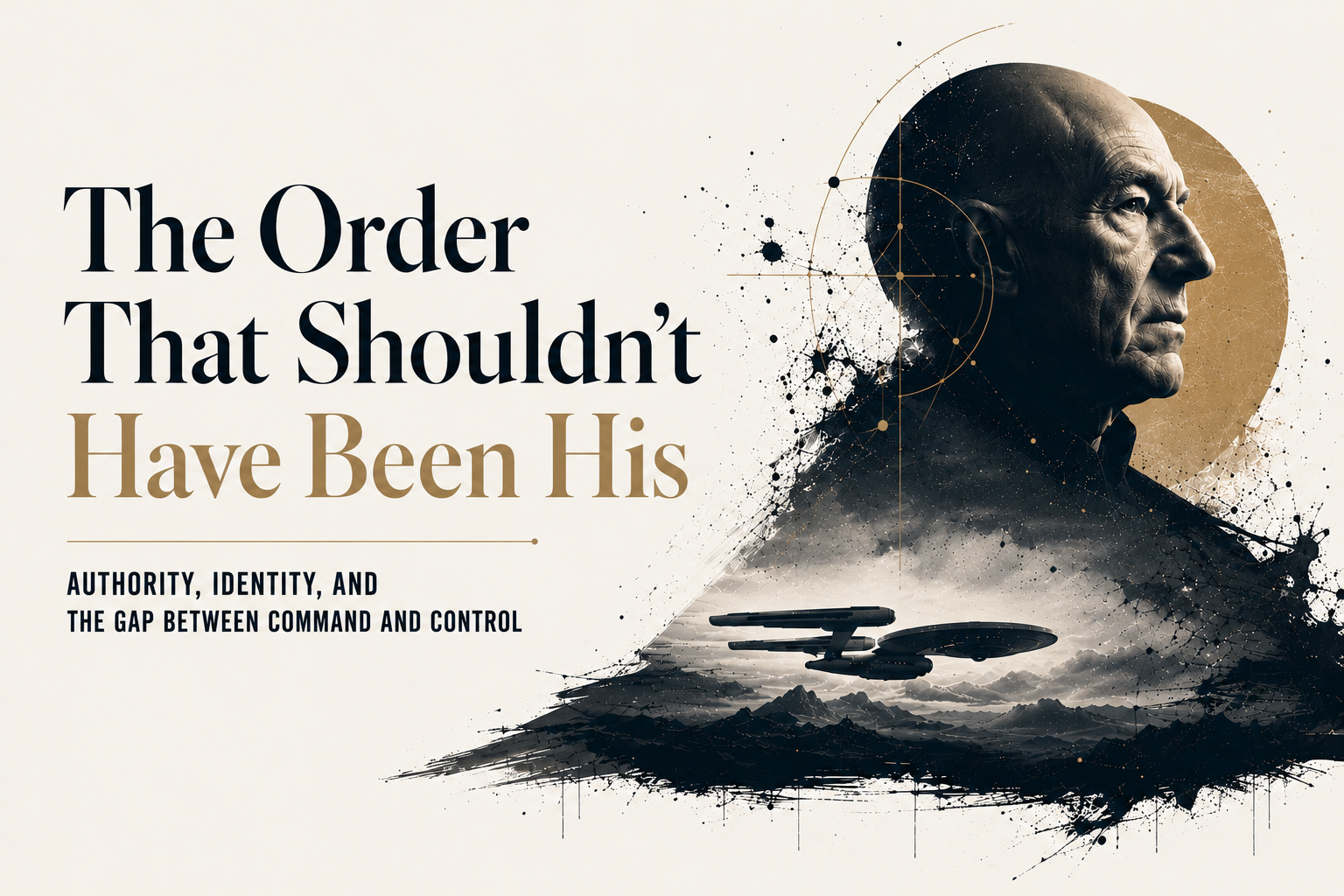
The Order That Shouldn’t Have Been His
Authority, Identity, and the Gap Between Command and Control
I found it deeply unsettling that Jean-Luc Picard ordered the self-destruct aboard the Stargazer in the opening episode of Star Trek: Picard Season 2.
Not because the decision itself was wrong.
Because it should not have been his order to give.
The Stargazer had a captain.
Cristóbal Rios held command authority over that vessel. He carried responsibility for the crew, the mission, and the consequences attached to both. Yet when the moment of irreversible consequence arrived, the series quietly transferred moral and operational authority back to Picard.
Most viewers probably experienced the moment emotionally before they understood it structurally.
Something felt off.
Good institutional storytelling preserves legitimacy under pressure. It understands that authority is not merely symbolic. It is procedural, relational, and earned through role clarity. When systems abandon those distinctions arbitrarily, audiences feel the fracture instinctively.
Even in fiction.
Especially in fiction.
The scene works emotionally because Picard is ultimately a story about Jean-Luc Picard. The franchise bends toward him gravitationally. Patrick Stewart carries decades of symbolic authority, so the narrative naturally re-centers him during the moment of highest consequence.
The problem is that the scene unintentionally exposes something larger about institutions themselves.
Organizations often become so dependent on symbolic figures that everyone else slowly stops behaving like they actually hold authority.
The founder overrides the operator.
The executive starts sitting inside decisions nobody delegated upward.
Eventually the admiral is giving orders on someone else’s bridge.
Procedure remains visible on paper while legitimacy quietly migrates elsewhere.
At first this can feel efficient. Even comforting. Institutions like certainty. People like recognizable moral centers. Mythology creates emotional coherence faster than governance does.
Then eventually the system begins routing authority according to narrative gravity rather than operational accountability.
That is where trust starts eroding.
One of the things Star Trek historically understood better than most science fiction is that command structure matters precisely when pressure arrives. Captains are not merely characters. They are institutional anchors. The chain of command exists to distribute responsibility so that no single individual becomes the entire moral center of the system.
The moment Picard assumes final authority over Rios’s ship, the structure subtly collapses inward around personality.
Ironically, Season 2 is largely about Picard’s inability to relinquish control emotionally. The opening episode accidentally externalizes the same flaw institutionally.
He cannot stop being the captain.
The system cannot stop treating him like one.
That distinction feels increasingly relevant far outside science fiction.
Modern organizations constantly struggle with the gap between symbolic authority and operational authority. Public-facing personas absorb legitimacy while the actual systems beneath them grow increasingly fragile, diffuse, and psychologically disconnected from accountability.
The title remains. The ceremony remains. Everyone still behaves as though the structure underneath it is intact.
Meanwhile the real structure quietly shifts underneath it.
Sometimes audiences notice before institutions do.

Subscribe to Amid the Noise
Amid the Noise is an ongoing body of work on signal, systems, governance, AI, and the structures that shape human judgment under pressure.
Subscribe to receive new essays as they are published.