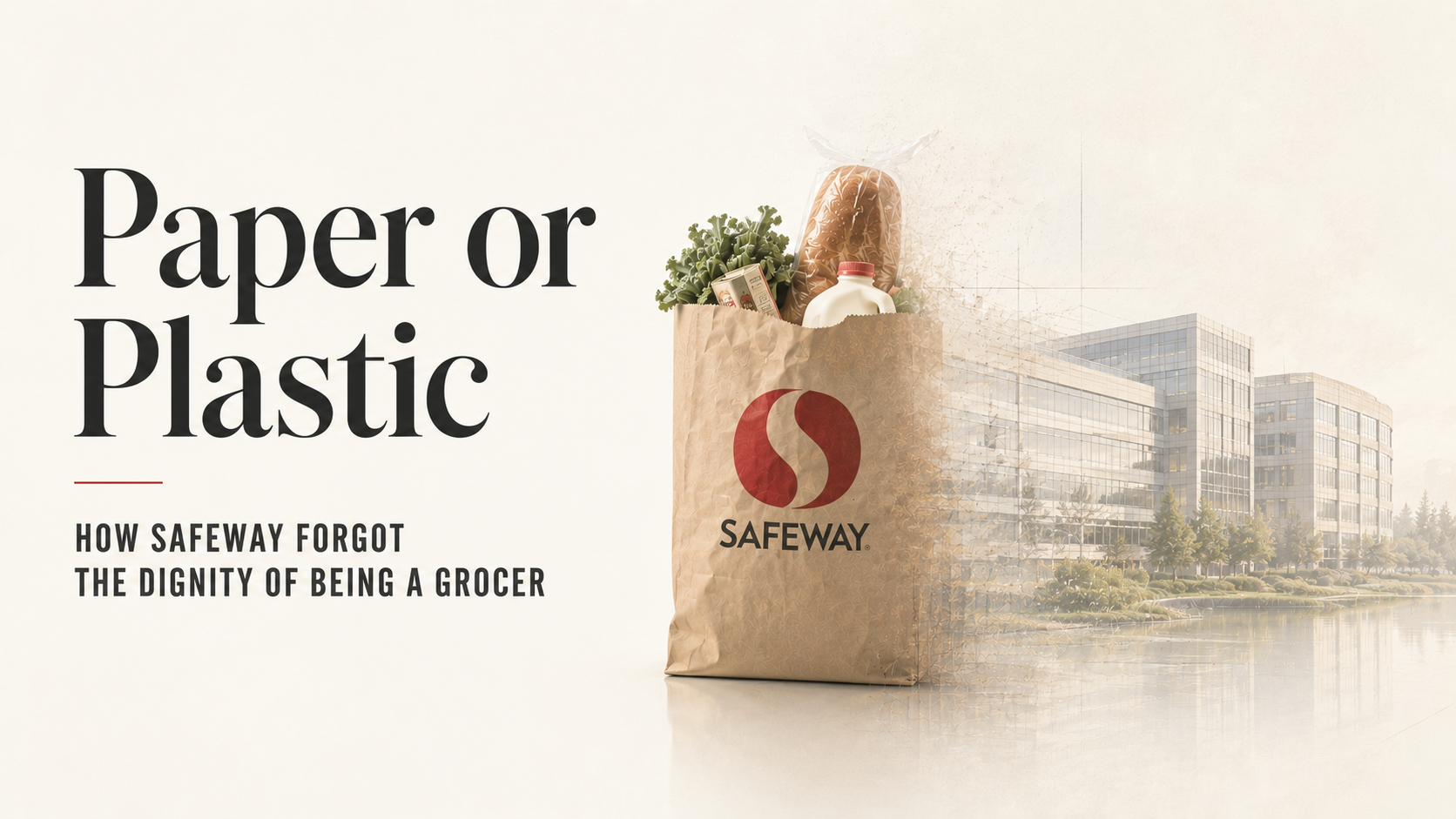
Paper or Plastic
How Safeway forgot the dignity of being a grocer
For most of my life, Safeway felt permanent.
Not glamorous.
Not revolutionary.
Permanent.
The kind of company that disappears into the background of ordinary American life because it is functioning exactly as intended. Grocery stores. Pharmacies. Weekly routines. Birthday cakes. Rotisserie chickens turning beneath heat lamps while someone asks if you want paper or plastic.
I grew up with Safeway stores in Altus, Oklahoma.
Not Silicon Valley.
Not San Francisco.
Altus.
That mattered to me later because it revealed the true scale of what Safeway once was. The company had become ordinary enough to disappear into the fabric of daily life across huge parts of the country. That is usually the clearest sign an institution is working.
One of those stores eventually closed.
The other became a Homeland.
No ceremony. No announcement that a piece of American retail history had quietly shifted shape again. Just another transition in the long process of one institution dissolving into the next.
Years later, I ended up doing a short consulting engagement with Safeway helping redesign parts of the company’s careers experience.
What struck me immediately was the complexity of the workforce itself.
Safeway was not one organization.
It was many.
Store employees. Pharmacists. Distribution teams. Corporate operations. Technology groups. Regional logistics.
A grocery chain at that scale is really a giant human coordination system disguised as retail.
The pharmacy side especially stayed with me. Safeway was struggling to recruit enough pharmacists at the time, which created real operational pressure inside the business. This was not abstract strategy. It was staffing, healthcare access, labor shortages, retention, regional hiring pipelines.
Very human problems.
At the same time, I remember watching company leadership increasingly talk about healthcare, optimization, and transformation in ways that felt strangely detached from the ordinary people already holding the institution together.
One moment especially stayed with me.
During that same general period, Safeway’s CEO testified before Congress and argued that unhealthy people should pay more for healthcare coverage.
I remember being deeply unsettled by it.
Not because businesses should ignore healthcare costs.
Because the statement revealed something larger.
Safeway leadership had become psychologically alienated from the dignity and complexity of ordinary operational life.
That may have been the real beginning of the company’s decline.
The deeper issue was never simply competition or retail pressure or even Theranos.
It was identity drift.
At some point, leadership stopped respecting the business they actually operated.
Being a grocer is not glamorous work. It is logistics. Margins. Supply chains. Staffing. Trust. Repetition. Consistency at enormous scale. The business succeeds when ordinary life functions smoothly enough that customers barely notice the machinery underneath it.
That kind of operational competence used to carry dignity in America.
Then Silicon Valley changed the cultural atmosphere around business itself.
Suddenly every company needed to sound transformative. Visionary. Disruptive. The culture stopped admiring operational excellence and started admiring narrative ambition.
A grocery chain could no longer simply be good at groceries.
It needed to become something larger. Smarter. More optimized. More culturally important.
That is where the costume appeared.
Safeway leadership did not just want to operate supermarkets anymore. They wanted proximity to innovation mythology itself. Health transformation. Predictive wellness. Technology-enabled retail healthcare.
Theranos fit naturally into that fantasy.
Not because the technology worked.
Because the story worked.
The partnership offered symbolic elevation. A way for a traditional grocer to stop feeling traditional.
That kind of ambition becomes dangerous when executives start identifying emotionally with the upgraded narrative instead of the underlying institution. The role becomes performance. The performance slowly becomes identity.
Then the costume starts eating the person inside it.
I keep thinking about Pleasanton.
For years, Safeway’s headquarters represented thousands of stable corporate jobs tied to a very real operational ecosystem. Merchandising. Procurement. Logistics. Human infrastructure connected to feeding millions of people.
Now Workday occupies much of that physical space.
That transition feels symbolic somehow.
One company drifted away from its center while another inherited the remains.
Northern California lost more than a brand during that collapse. It lost layers of stable professional infrastructure that once supported entire careers and communities.
People talk about these transitions like they are inevitable.
Most of the time they are not.
They are leadership decisions accumulating slowly over years.
What happened to Safeway keeps reminding me that institutions often fail once leadership becomes embarrassed by the simplicity of their actual mission.
Airlines stop wanting to transport passengers and start chasing lifestyle branding.
Media companies stop informing audiences and start optimizing emotional addiction.
Technology companies stop building tools and start chasing historical importance.
At some point the institution stops asking: “How do we do this well?”
Instead it starts asking: “How do we become culturally significant?”
That shift sounds ambitious.
Sometimes it is fatal.
Safeway did not need to become revolutionary.
It needed to remain excellent at being a grocer.
That probably sounded too ordinary to the people leading it.
I think that assumption may have destroyed the company.
Paper or plastic.
A simple question from a company that once understood the value of ordinary life better than the executives who eventually inherited it.

Subscribe to Amid the Noise
Amid the Noise is an ongoing body of work on signal, systems, governance, AI, and the structures that shape human judgment under pressure.
Subscribe to receive new essays as they are published.