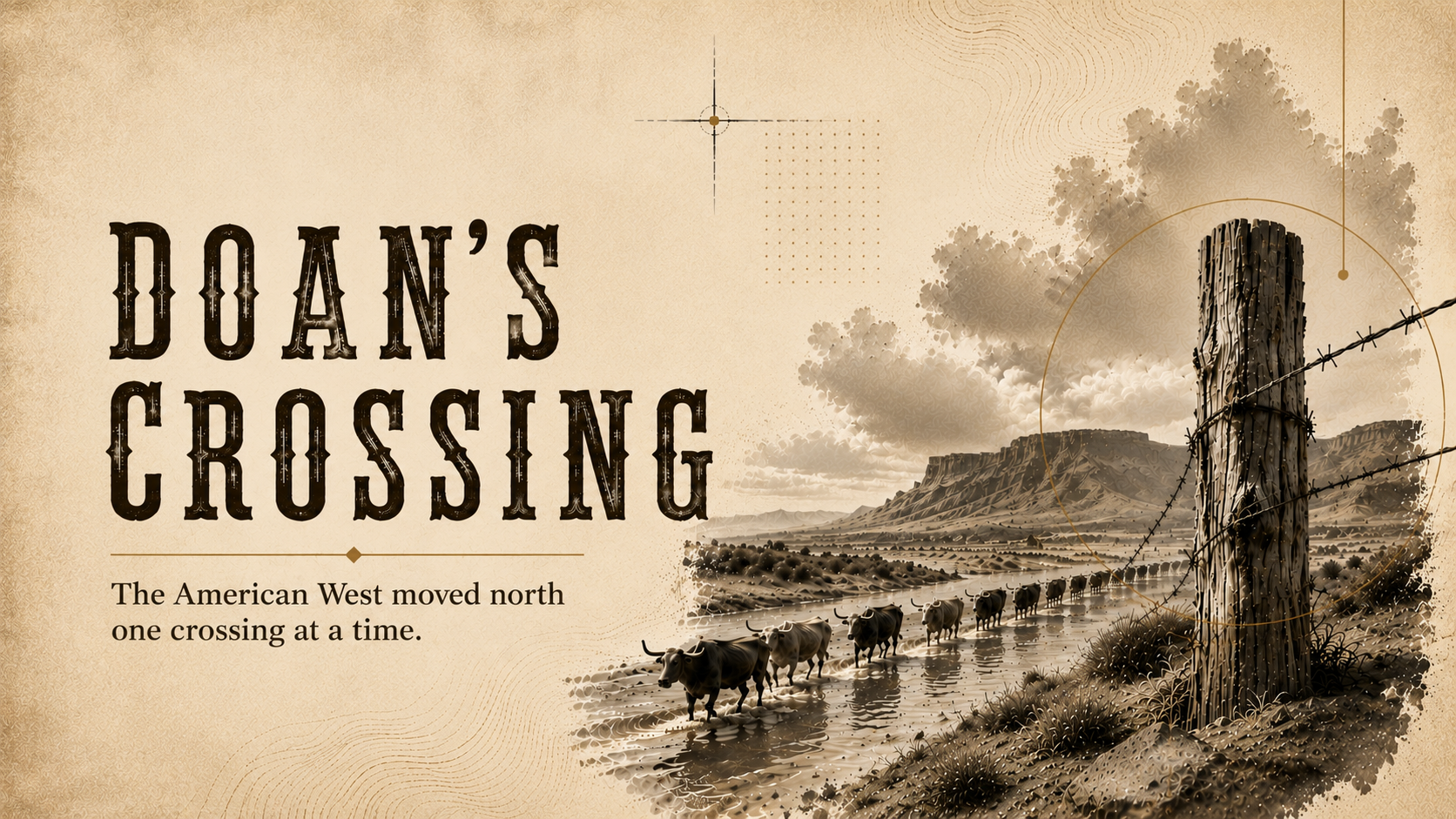
Doan's Crossing
The American West moved north, one crossing at a time.
The Last Crossing Before Territory
Before highways and fiber lines, the frontier moved through fragile crossings held together by trust, rumor, and dust.
The closer you get to southwest Oklahoma and north Texas, the more the land starts feeling less empty and more edited.
Old fence lines appear where no ranch sits anymore. Mesquite grows around foundations that no longer exist. Roads drift into gravel, then dirt, then memory. Entire stretches of land feel strangely paused, as if the machinery of settlement stopped mid-sentence and never restarted.
Growing up there, I heard stories.
Not the polished kind built for tourists or old Western films. These stories arrived sideways. Half-remembered conversations. Rural warnings. Things older people mentioned once, then never explained again.
There were stories about ghost towns hidden beyond restricted land. Places swallowed by weeds and federal reservoir projects. Cemeteries isolated behind gates marked with Army Corps of Engineers signs. Entire communities abandoned so completely that nature itself seemed embarrassed to acknowledge them.
The detail that always stayed with me was the graves.
People said you could climb the fence and find headstones where nearly everyone died within days of each other. Families. Children. Ranch hands. Entire clusters of deaths compressed into the same terrible week.
Anthrax, they said.
I do not know if the stories were true.
Maybe parts were. Maybe several stories fused together over generations into one larger frontier myth. That feels possible. The Plains are full of places where memory and weather erode at roughly the same speed.
Still, the stories endure because they feel emotionally true.
The cattle drives that moved through Texas and Oklahoma were not romantic adventures in the way modern mythology likes to imagine them. They were enormous logistical operations held together by exhaustion, reputation, and luck.
Thousands of cattle moving north through unpredictable terrain.
Water shortages. River crossings. Disease. Bandits. Storms. Stampedes. Territorial tensions. Isolation.
A cattle trail was less a path than a moving economy under constant threat of collapse.
That is what makes places like Doan’s Crossing so fascinating to me now.
Near the Red River, roughly twelve miles north of Vernon, Texas, Doan’s Crossing became one of the final supply points before cattle drives entered Indian Territory along the Great Western Trail. Millions of longhorns passed through there on the way north. Cowboys gathered supplies. Mail changed hands. Information moved faster than certainty.
The crossing mattered because the crossing reduced uncertainty.
That is what infrastructure really is.
Not concrete. Not asphalt. Not fiber.
Infrastructure is the set of systems that lowers the probability of disaster.
A known water source. A trusted ferryman. A general store with flour and cartridges. A place where someone says: “Do not graze east of the river.” “Water’s bad this season.” “Three men died there last month.”
Long before epidemiology stabilized public understanding of disease transmission, frontier communities still understood contaminated ground. Certain lowlands gained reputations. Certain ponds became feared. Certain grazing areas acquired stories that sounded supernatural until science eventually caught up decades later.
The land remembered failure before people understood the mechanism behind it.
That idea keeps following me.
Systems often preserve wisdom long after the original explanation disappears.
Someone teaches a rule. The next generation repeats it. The reason fades. The warning survives.
Do not build there. Do not drink there. Do not cross after heavy rain. Do not stay once the cattle start dying.
The American West was not built all at once.
It moved north a few thousand cattle at a time.
Crossings became towns. Towns became supply chains. Supply chains became rail hubs. Rail hubs became cities.
Others vanished completely because one critical dependency failed at exactly the wrong moment.
Water failed. Disease spread. The railroad bypassed them. Trade routes shifted. The economy moved twenty miles east and never looked back.
The frontier was full of failed nodes.
That may be why these stories still matter.
Modern Americans like to imagine our systems as permanent now. We replaced trails with interstates and river crossings with fiber backbones and distribution centers. The language changed. The dependency did not.
Civilization still moves through fragile crossings.
Ports. Cloud infrastructure. Water systems. Electrical substations. Shipping lanes. Server farms. Semiconductor supply chains.
Most people never think about them until something breaks.
Then suddenly everyone remembers how thin the line actually is between continuity and collapse.
I think that is why the old stories linger in places like western Oklahoma.
The land remembers what happens when a system fails hard enough to erase a town.

Subscribe to Amid the Noise
Amid the Noise is an ongoing body of work on signal, systems, governance, AI, and the structures that shape human judgment under pressure.
Subscribe to receive new essays as they are published.