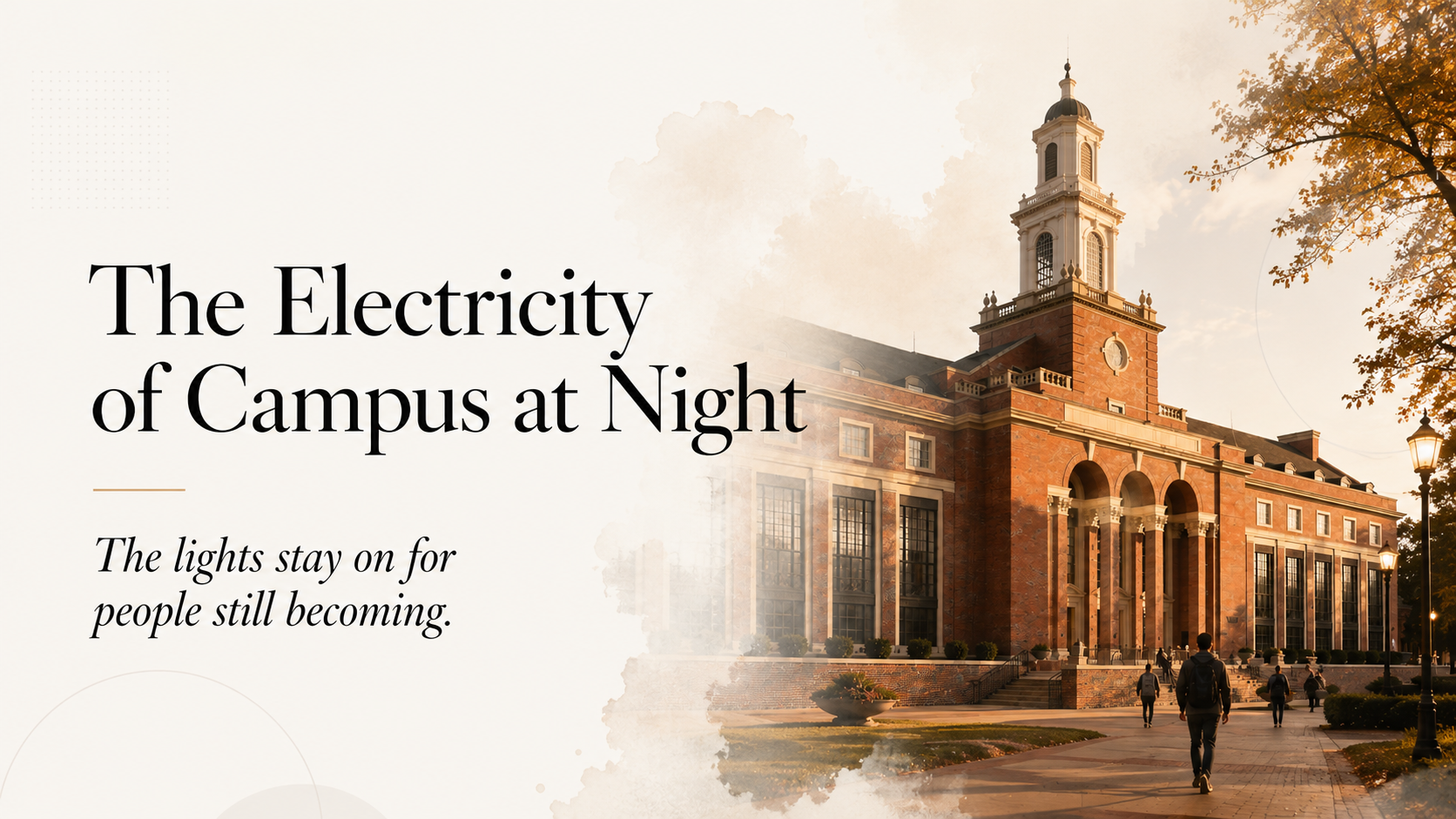
The Electricity of Campus at Night
The lights stay on for people still becoming.
I have always loved university campuses at night.
Not necessarily because of the architecture, although I love that too. The older libraries. The concrete lecture halls. The strange mixture of ambition and exhaustion hanging in the air around engineering buildings at 21h00.
It is the energy I love.
Something feels electrically alive on a campus in a way that is increasingly rare elsewhere.
People are trying.
You see it everywhere once you start noticing it.
Groups huddled around tables studying for an exam that may decide whether an entire semester survives. Someone speed-walking across campus because they are late to a class they cannot afford to miss. A student sitting alone looking completely defeated because a subject has finally pushed back harder than confidence alone can carry them.
I love all of it.
Because underneath those moments is something profoundly hopeful: people publicly attempting to become more than they currently are.
Modern adult life often suppresses visible striving.
Corporate environments reward confidence more than uncertainty. Social media rewards presentation more than growth. Most people learn to conceal confusion quickly because confusion is interpreted as weakness instead of transition.
Campuses still tolerate incompleteness.
That changes the emotional atmosphere of the environment.
On a university campus, people are expected to be unfinished.
Someone learning calculus and someone discovering sculpture for the first time may be sitting twenty feet apart. One student may be failing organic chemistry while another is rewriting a thesis for the third time. None of it feels abnormal because the institution itself is organized around the assumption that growth is occurring.
The chaos feels aligned.
That may be why campuses feel so different from many other curated environments.
Museums preserve meaning. Disneyland orchestrates immersion. Luxury hotels remove friction. Universities do something stranger than all of them: they normalize becoming.
Even frustration feels purposeful there.
The air itself changes because effort becomes socially visible instead of hidden.
I think that is what I respond to most strongly.
Not prestige. Not nostalgia.
Human effort.
A campus is one of the few remaining places where people openly carry books they do not yet understand toward futures they cannot fully see. The environment does not demand that they already be complete before arriving.
It assumes transformation is the point.
That assumption radiates outward into everything else: the lighting, the conversations, the motion, the tension, the libraries still glowing late into the evening.
Anything can still happen there.
You can feel it.

Subscribe to Amid the Noise
Amid the Noise is an ongoing body of work on signal, systems, governance, AI, and the structures that shape human judgment under pressure.
Subscribe to receive new essays as they are published.