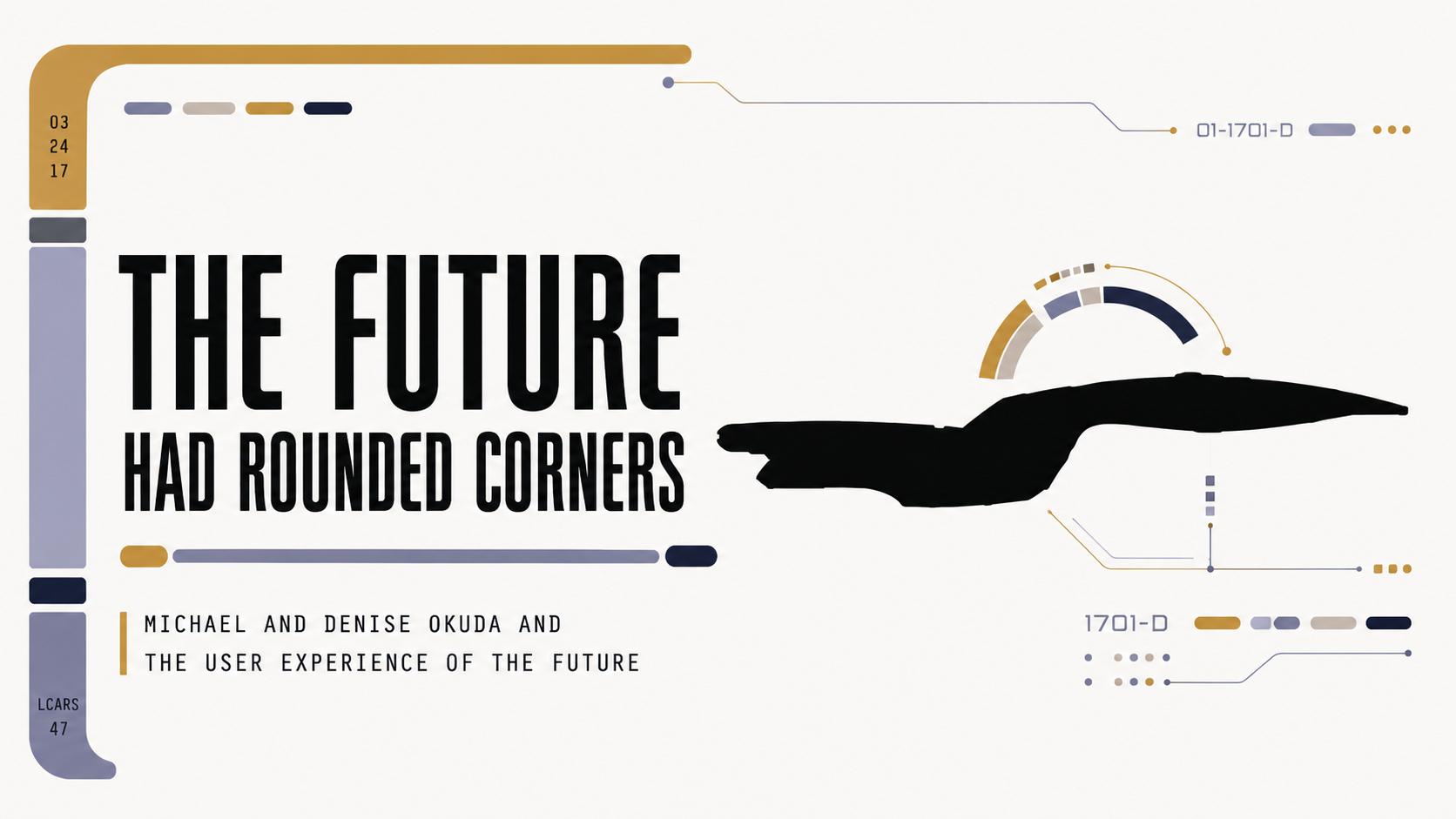
The Future Had Rounded Corners
Michael and Denise Okuda imagined interfaces that felt less like machines and more like trust.
For most of human history, the future looked mechanical.
Blinking lights. Steel walls. Switches. Warnings. Industrial anxiety wrapped in chrome.
Then Star Trek: The Next Generation arrived and quietly changed the visual language of tomorrow.
Not through faster ships.
Not through bigger weapons.
Through interface design.
The future suddenly looked calm.
Soft curves. Muted colors. Spacious layouts. Information organized instead of weaponized. Systems that appeared designed for cognition rather than intimidation. The bridge of the Enterprise-D did not feel like a war room. It felt like a place where highly trained people could think.
Much of that future came from the work of Michael and Denise Okuda.
They did not just create fictional graphics for television. They accidentally authored one of the most influential speculative UX systems ever put on screen.
LCARS.
The Library Computer Access and Retrieval System.
A fake interface with very real consequences.
Most science fiction before LCARS imagined the future as a continuation of military hardware. Interfaces looked like submarines, missile silos, or Cold War command bunkers. The assumption underneath the design was simple: advanced technology becomes more complicated.
LCARS proposed the opposite.
Advanced technology becomes more humane.
That distinction matters more than people realize.
The genius of LCARS was not realism. Realistically, many of its controls made little ergonomic sense. Buttons floated in strange places. Typography occasionally bordered on absurd. The system often prioritized cinematic readability over operational efficiency.
None of that diminished its influence.
Because LCARS solved something deeper than utility.
It solved emotional trust.
The interface implied that the computer was there to assist you, not dominate you. Information density existed without visual panic. Hierarchy was clear without becoming authoritarian. Even the color palette carried psychological intent. Warm peaches, muted blues, lavender tones, restrained contrast. The future was no longer screaming at the user.
It was listening.
That was radical.
Especially in the late 1980s.
Modern UX design still carries the fingerprints of LCARS whether designers acknowledge it or not.
Touch-first thinking before touchscreens existed.
Contextual panels.
Card-based information clusters.
Spatial grouping instead of rigid windowing systems.
Reduced chrome.
Environmental computing.
Interfaces that blend into architecture rather than interrupt it.
Even the idea that a computer interface could reflect institutional values instead of raw engineering traces back to systems like LCARS.
Compare the bridge of the Enterprise-D to contemporary enterprise software from the same era and the contrast becomes almost comical.
One imagined dignity.
The other looked like accounting software bolted to a bunker wall.
What fascinates me most is that LCARS was not really predicting technology.
It was predicting relationships.
The Okudas understood something many modern AI companies still struggle to grasp:
people do not merely use interfaces.
They emotionally negotiate with them.
Every interface communicates a philosophy about human beings.
Some systems assume users are incompetent and dangerous.
Some assume users are revenue streams.
Some assume users are interruptions to the machine.
LCARS assumed users were capable.
That subtle assumption changed everything.
The bridge crew of the Enterprise did not fight the computer. They collaborated with it. The system surfaced information without theatrics. The interface rarely demanded attention for its own sake. It respected operator focus.
Ironically, nearly forty years later, many modern products feel less emotionally evolved than a fictional operating system from syndicated television.
We built devices with extraordinary computational power and then filled them with notification badges, engagement traps, dark patterns, subscription funnels, behavioral manipulation systems, and algorithmic anxiety loops.
LCARS imagined post-scarcity cognition.
We built slot machines with OLED displays.
There is another layer here that matters.
LCARS was not minimalist.
People often misremember it that way because it felt clean.
In reality, it was dense with information. The brilliance came from visual hierarchy and restraint. The interface trusted peripheral cognition. It allowed complexity without collapsing into chaos.
That lesson has aged remarkably well.
Good UX is not the elimination of information.
Good UX is the reduction of cognitive fear.
The difference is enormous.
I suspect this is why LCARS still resonates with designers, engineers, and systems thinkers decades later.
It represented competence without cruelty.
A future where intelligence and elegance coexisted.
A future where the machine did not need to humiliate the human in order to prove its sophistication.
That may ultimately be the quiet legacy of Michael and Denise Okuda.
They did not just design the future.
They designed a future that believed people deserved calm once they arrived there.

Subscribe to Amid the Noise
Amid the Noise is an ongoing body of work on signal, systems, governance, AI, and the structures that shape human judgment under pressure.
Subscribe to receive new essays as they are published.