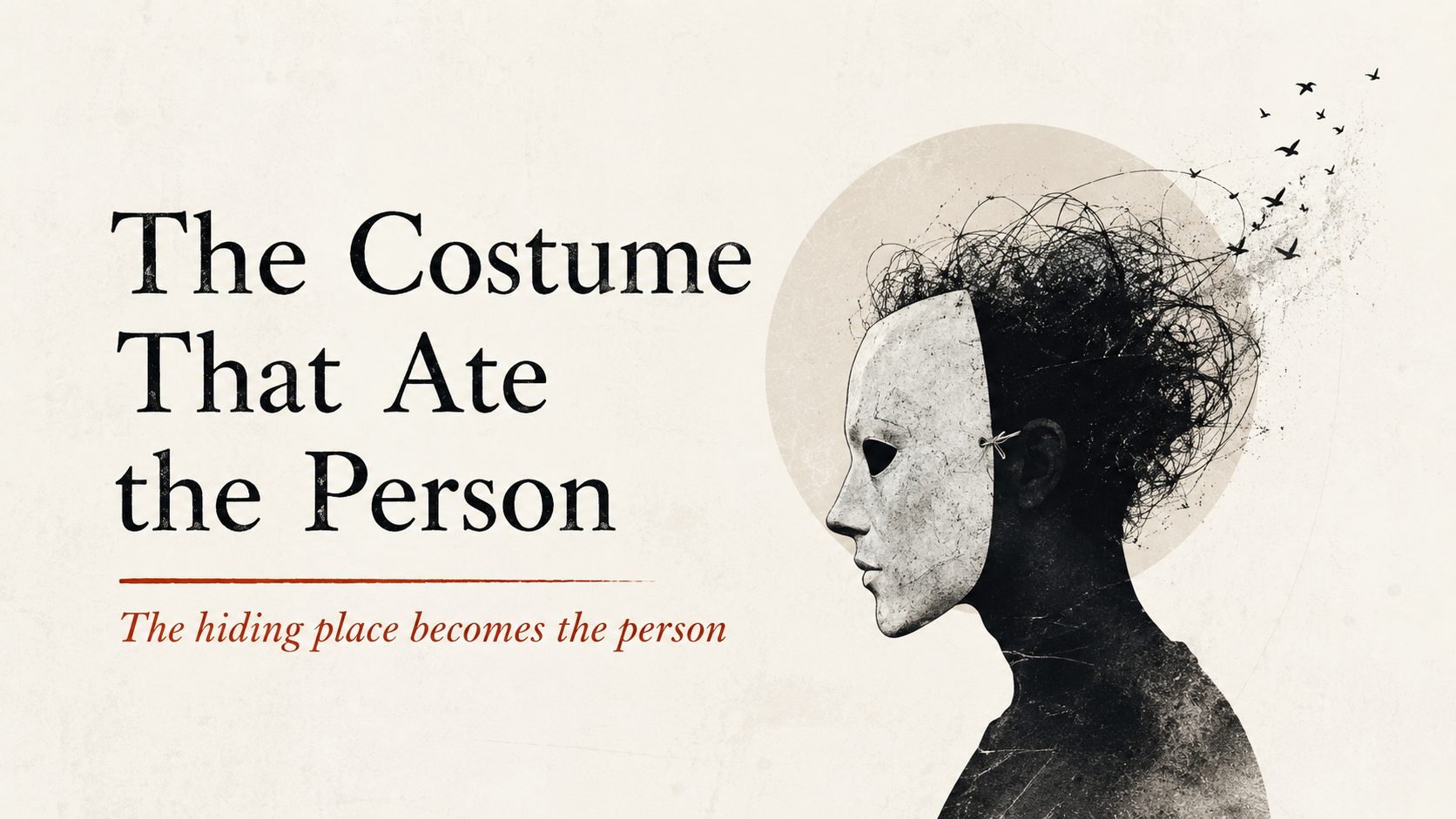
The Costume That Ate the Person
The hiding place becomes the person
Every October, the dead buildings wake up.
Not all of them. Just the ones waiting between identities.
The abandoned pharmacy near the freeway becomes a Spirit Halloween. The old electronics store with the faded yellow sign suddenly fills with fog machines, fluorescent skeletons, fake blood, and animatronic clowns that twitch to life whenever someone walks past. Empty retail shells begin glowing again for ninety days before disappearing back into darkness sometime around November 2nd.
The walls still remember what they used to be.
That part always unsettled me more than the costumes.
Nothing inside those stores is meant to last. The shelves are temporary. The signage is temporary. The workers are temporary. Even the panic feels temporary. Everything exists in a strange suspended state between performance and vacancy, occupying the narrow window after something has failed and before anyone fully admits it is gone.
Spirit Halloween stores only appear in places something else failed first.
The older I get, the harder it becomes not to see the metaphor.
Halloween used to end at midnight.
At some point, it stopped.
Modern life increasingly rewards people who can maintain a performance indefinitely. Not deception exactly. Something quieter and more adaptive than that. A gradual conversion of identity into presentation. The founder becomes the pitch deck. The politician becomes the polling language. The executive becomes the quarterly earnings call. The platform becomes engagement metrics wearing human skin.
Eventually the costume stops feeling like a costume.
It starts handling your conversations for you.
Social media accelerated this process, but it did not invent it. Corporate culture had already normalized professional theater decades earlier. Entire industries run on performed certainty. People rehearse confidence before meetings they privately dread. Startups perform inevitability while hemorrhaging cash. Institutions perform stability while the ceiling quietly leaks somewhere above the conference room tiles.
Somewhere along the way, sincerity became a reputational risk.
The algorithms simply industrialized what was already there.
The modern economy rewards consistency more than honesty. Platforms favor identities that remain legible, optimized, emotionally predictable, and endlessly available. Human beings are messier than that. Real people contradict themselves. They evolve unevenly. They disappear for a while. They become uncertain. They fail publicly. They change their minds halfway through sentences.
Performance scales better.
That may be the most unsettling thing about artificial intelligence. Not that machines can imitate people, but that human beings increasingly organize themselves like machines in order to remain economically visible.
You can already feel it in ordinary conversation.
People speak in branded language now. Trauma becomes identity architecture. Vulnerability becomes content strategy. Every interaction starts carrying a faint undertone of audience awareness, as if an invisible camera has entered the room and nobody wants to acknowledge it directly.
Even authenticity develops a costume.
Especially authenticity.
The frightening thing is not that people are fake. That framing is too simple and usually dishonest in its own way. Most performances begin as adaptation. A person learns how to survive inside a family, workplace, institution, addiction, relationship, or economy. They build a version of themselves capable of enduring the environment around them.
The problem comes later.
Some identities are only meant to carry you through one difficult season.
Then the season changes and the costume survives longer than the person underneath it knows how to.
Recovery taught me that more clearly than anything else ever has.
One of the hardest questions in recovery has nothing to do with substances. It arrives afterward.
Who are you when the performance stops generating protection?
Not the curated self. Not the socially functional self. Not the practiced self designed to reassure employers, partners, audiences, institutions, or strangers. Just the quieter thing underneath all of it. The part that existed before adaptation became continuous.
That question terrifies people for good reason.
A surprising amount of modern life depends on never asking it.
Maybe that is why Halloween still feels strangely honest to me.
For one night, everybody admits the performance exists. The masks become visible instead of implied. The artificial fog fills the room openly. The temporary identities announce themselves without pretending permanence. Even children understand the agreement. You become something else for a little while, then you go home and take it off before morning.
Adults forgot the second part.
Now the costumes follow people into boardrooms, dating profiles, political campaigns, algorithmic feeds, investor decks, performance reviews, and carefully managed personal brands. Entire systems increasingly depend on identities remaining stable long after the human being underneath them has started changing.
The fluorescent lights stay on. The old buildings keep humming. The role survives another season.
Somewhere beneath all of it, the original tenant is still trying to remember what their own voice sounded like before the costume learned how to speak for them.

Subscribe to Amid the Noise
Amid the Noise is an ongoing body of work on signal, systems, governance, AI, and the structures that shape human judgment under pressure.
Subscribe to receive new essays as they are published.