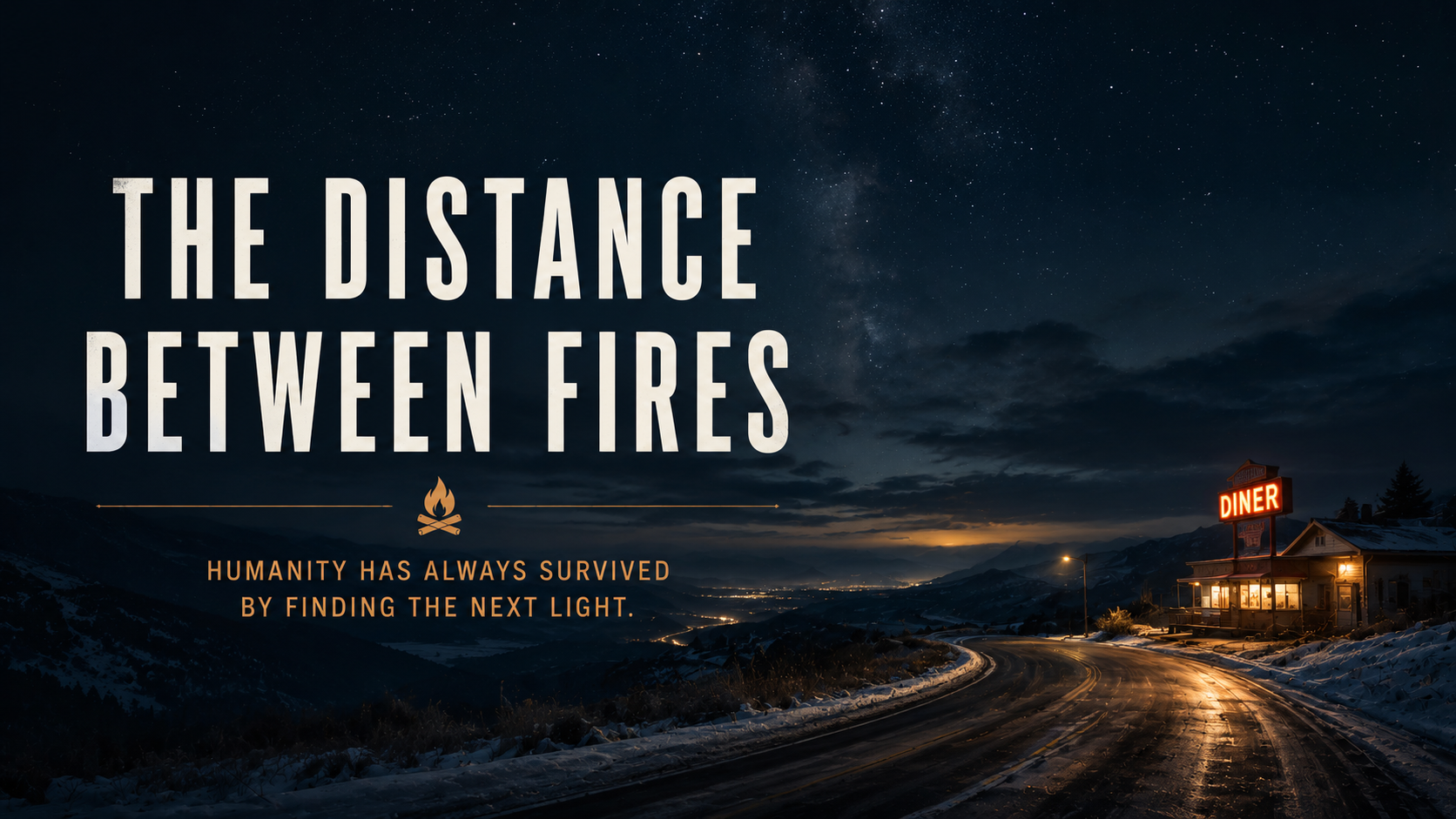
The Distance Between Fires
Humanity has always survived by finding the next light.
Before highways, before electrical grids, before cities became visible from orbit, humanity crossed darkness the same way ships crossed oceans:
by searching for the next fire.
A distant glow on a hillside once meant warmth, direction, food, safety, and other human beings. It meant the night had not swallowed everyone ahead of you. Long before GPS or radio towers, civilization survived through visible reassurance.
One fire.
Then another.
Then another beyond that.
The older I get, the more I suspect modern civilization still operates exactly the same way.
We just changed the shape of the fires.
Tonight they look like:
- a diner sign glowing off an empty highway,
- fluorescent lights inside a twenty-four-hour pharmacy,
- a hospital entrance at 03h00,
- an airport terminal still awake during a snowstorm,
- a gas station somewhere between two rural towns,
- the single apartment window still lit across the courtyard,
- the quiet hum of a convenience store on Christmas Eve.
Most people barely notice these places until they need them.
That is the strange thing about infrastructure. The systems that matter most often disappear into the background right until the moment uncertainty arrives. Then suddenly the smallest signs of continuity become emotionally enormous.
A lit motel vacancy sign can feel like salvation during a storm.
A nurse sitting behind a reception desk at midnight becomes civilization itself.
One open restaurant after a delayed flight starts to feel less like commerce and more like mercy.
We rarely think about how much emotional stability comes from simply knowing someone else remained awake.
That may be one of humanity’s oldest survival mechanisms.
The fire means: someone made it here before you.
Someone stayed.
Someone kept the light alive long enough for another person to find it.
That principle scales upward into almost everything we call civilization. Ports, lighthouses, hospitals, dispatch centers, data centers, air traffic control towers, emergency shelters, and electrical substations all exist for roughly the same reason ancient signal fires existed:
to reduce the psychological distance between uncertainty and safety.
Not every system succeeds at that responsibility. Some fail catastrophically. Some become inaccessible to the people who need them most. Some confuse efficiency with resilience and discover too late that optimized systems often lack emotional durability.
Still, the instinct itself persists.
Humans continue building lights for one another.
That may explain why cities decorate themselves so heavily during winter. Christmas lights have always felt less commercial to me than anthropological. They are reassurance technology. Small declarations against darkness. A species-wide refusal to let the long nights feel uninhabited.
Even now, satellites photograph entire continents glowing against the dark surface of the planet. Networks of illuminated roads connect cities like neural pathways. Aircraft move silently between clusters of light. Ships navigate coastlines using systems descended from ancient beacons and fires.
Civilization still pulses exactly the same way it always has.
One light visible from another.
The hardest years of human life often work this way too.
Most people do not survive grief, addiction, instability, illness, heartbreak, or uncertainty by suddenly solving the future all at once. They survive by reaching the next illuminated place. A conversation. A meeting. A safe apartment. A paycheck. A friend who answers the phone. A porch light left on longer than necessary.
The next fire.
Then the next one after that.
For all our technology, humanity remains surprisingly ancient in this regard. We are still creatures moving carefully through darkness, searching the horizon for proof that someone else made it through the night ahead of us.
And sometimes, without realizing it, we become that light for someone else.

Subscribe to Amid the Noise
Amid the Noise is an ongoing body of work on signal, systems, governance, AI, and the structures that shape human judgment under pressure.
Subscribe to receive new essays as they are published.