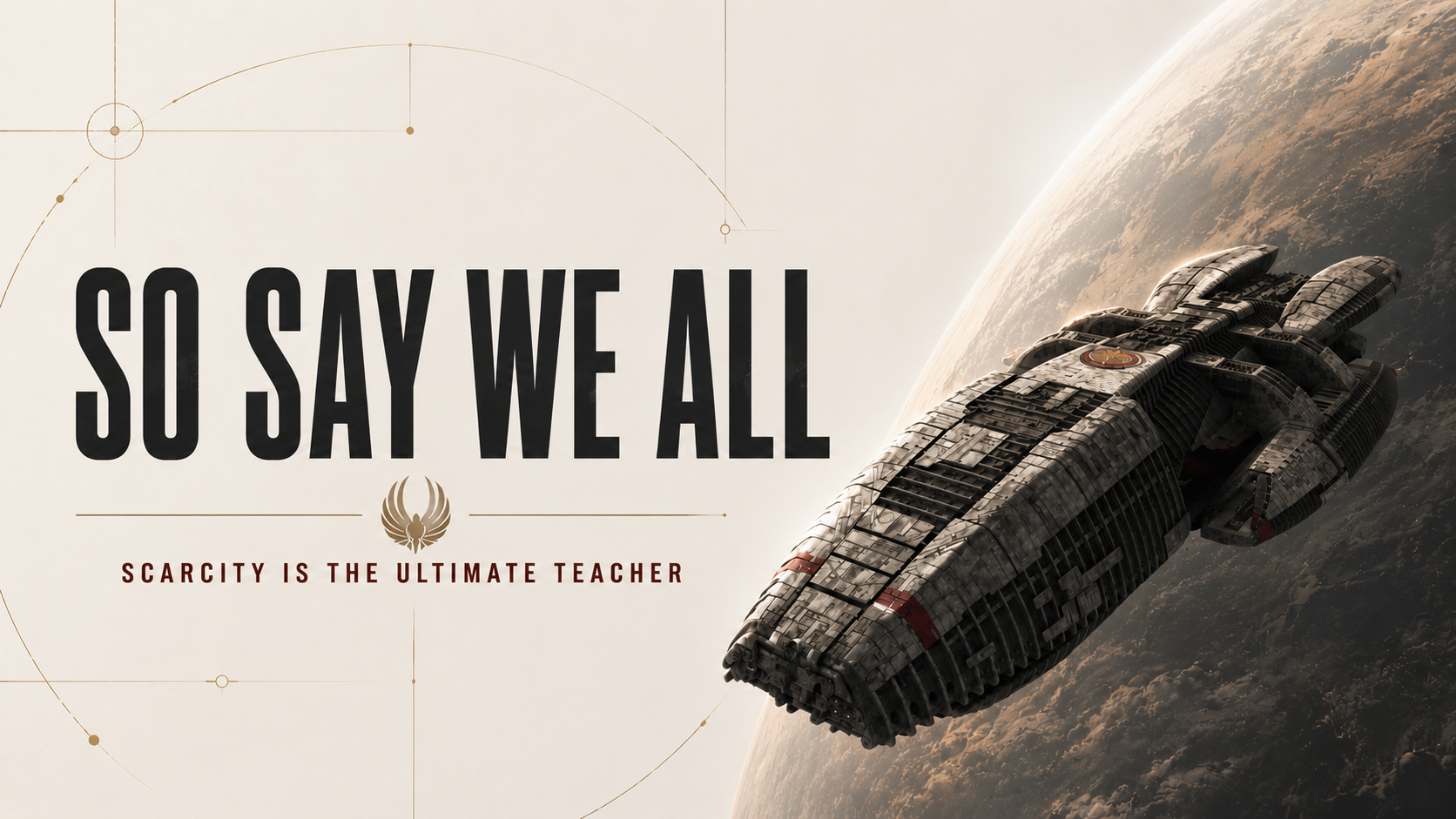
So Say We All
Scarcity is the ultimate teacher.
Most apocalypse stories misunderstand civilization.
They treat survival as a logistics problem.
Food.
Fuel.
Weapons.
Shelter.
But Battlestar Galactica understood something far more unsettling:
Civilization is made of memory.
Not cultural memory. Operational memory.
The mechanic who knows which relay overheats first.
The nurse who can recognize sepsis before the monitors do.
The engineer who remembers the sound a failing pressure seal makes three seconds before rupture.
The teacher who still knows orbital navigation well enough to train someone else.
The Twelve Colonies were not simply attacked.
They were cognitively decapitated.
Billions died in hours. Entire professions likely vanished with them. Somewhere in the destruction, the fleet lost the only surviving expert in a critical subsystem no one else fully understood. Somewhere else, the last specialist in a niche medical field disappeared forever.
That is what makes the series feel humbling.
Not the scale of the destruction.
The arithmetic of what remained.
Fewer than 50,000 people survive. The fleet itself is a patchwork of civilian ships never intended for long-term deep space survival. Medical capacity is catastrophically thin. Manufacturing capability barely exists. Supply chains disappear overnight.
Yet the fleet continues.
Not elegantly.
Not confidently.
Mostly through exhaustion, improvisation, and trust.
That last part matters.
Modern civilization assumes replacement is infinite. If something breaks, another arrives in two days. If someone leaves, another specialist fills the role. We think of systems as durable because they appear large.
But large systems are often shockingly dependent on tiny concentrations of human knowledge.
One database administrator quietly understands an entire county system.
One social worker carries half the institutional memory of an office.
One municipal employee knows why a valve can never be shut off in a certain sequence.
One nurse is effectively holding together an emergency department through experience alone.
Civilization frequently rests on a terrifyingly small number of irreplaceable people.
The fleet in Battlestar Galactica forces that realization into view.
At some point, every object aboard those ships becomes historical.
The cup in your hand is no longer a cup. It is the surviving cup.
Your jacket is no longer clothing. It is a maintenance responsibility.
A flashlight becomes inheritance.
A pressure seal becomes civilization itself.
Even clothing changes meaning under extinction pressure.
That shirt you are wearing may literally be the last shirt you will ever own.
Not metaphorically.
Literally.
That idea rewires everything.
Consumer identity evaporates almost immediately once replacement disappears. Nobody cares about brands when detergent itself becomes finite. The entire logic of abundance collapses into maintenance.
Can this still function?
Can this still be repaired?
Can this person still continue tomorrow?
That may be what the series understood better than almost any science fiction before it.
Humanity survives less through heroism than through stewardship.
The older I get, the less I believe civilization is fundamentally made of buildings, software, or even governments. Those are downstream artifacts. The real infrastructure is relational. It is whether enough people still know how to cooperate once systems become unstable.
That is why the fleet still feels emotionally plausible twenty years later.
It understood a truth modern society rarely wants to confront:
We are simultaneously racing toward two completely different futures.
One future looks like post-scarcity.
Near-zero marginal intelligence.
AI systems capable of replacing entire categories of labor.
Autonomous manufacturing.
Energy abundance.
Synthetic medicine.
A world where material production becomes astonishingly cheap.
The other future looks uncomfortably like the fleet.
Institutional exhaustion.
Climate displacement.
Fragile supply chains.
Knowledge concentration.
Permanent staffing shortages.
Overextended systems quietly operating at failure thresholds.
Both futures already exist.
That is the contradiction sitting underneath modern life.
We can generate photorealistic video instantly while hospitals remain critically understaffed. We can launch reusable rockets while cities struggle to maintain drinking water infrastructure. We can automate creativity while social trust collapses.
Abundance and fragility are arriving together.
That may be the real warning hidden inside Battlestar Galactica.
Not that civilization disappears.
That it survives unevenly.
And that survival itself eventually becomes a form of maintenance.
So say we all.

Subscribe to Amid the Noise
Amid the Noise is an ongoing body of work on signal, systems, governance, AI, and the structures that shape human judgment under pressure.
Subscribe to receive new essays as they are published.