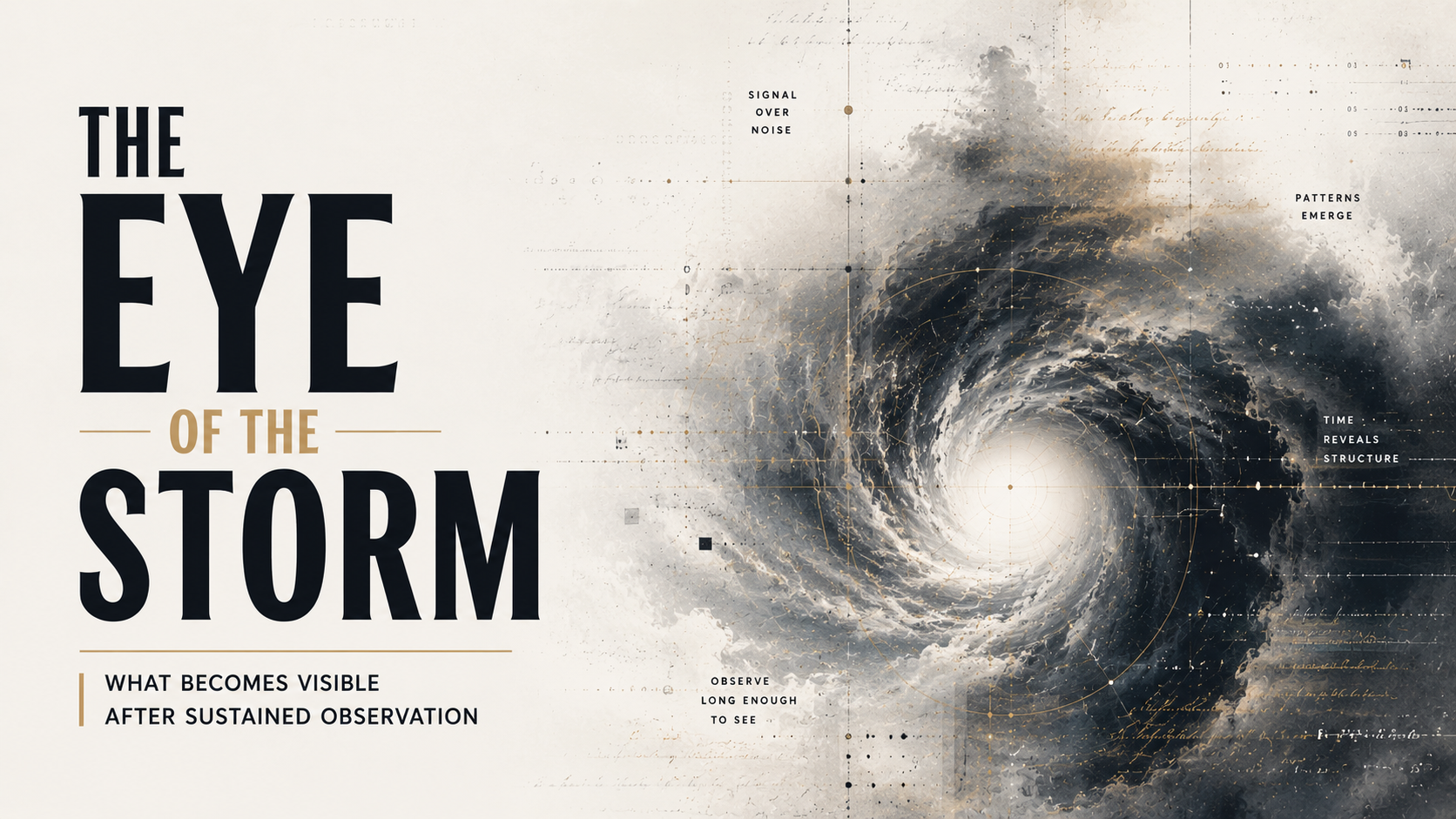
The Eye of the Storm
What becomes visible after sustained observation
This marks my 200th post on Amid the Noise.
Somewhere along the way, the archive stopped feeling chronological.
It started feeling geological.
Layered pressure. Repeated patterns. Signal buried beneath noise long enough to become visible only in accumulation.
At first the posts felt disconnected to me.
Artificial intelligence. Election systems. Recovery. Enterprise software. Russia. Science fiction. Grocery stores. Music. Design. Institutional trust. Civic infrastructure. Identity. Power. Collapse.
At the time, each piece felt local to the moment that produced it.
Now I am not so sure.
Somewhere after the first hundred posts, the writing stopped behaving episodically and started behaving longitudinally.
The same questions kept returning through different surfaces.
What happens when institutions lose coherence?
What happens when symbolic authority overtakes operational reality?
How do systems drift away from the people they were designed to serve?
What survives collapse?
What remains of identity after scale changes?
I do not think I understood I was asking the same questions repeatedly.
The archive understood before I did.
That realization has been unsettling in ways I did not expect.
I used to think my interests were fragmented.
Too broad. Too inconsistent. Too scattered across unrelated domains.
Technology. Governance. Storytelling. Recovery. Retail. Science fiction. Data systems. Human behavior.
Now I think I was circling the same underlying structures the entire time.
The topics changed.
The inquiry did not.
Looking back, I realize how often I found myself near moments where systems were changing shape.
The early web. Post-9/11 America. Enterprise transformation. Platform economies. AI systems. Civic distrust. Institutional drift.
At the time, those experiences rarely felt historic.
They felt procedural.
Meetings. Flights. Deadlines. Projects. Conversations. Ordinary days inside environments that only later revealed themselves as transitional.
I think that is true for most people living through structural change.
History rarely announces itself while it is happening.
It just slowly alters the emotional weather around daily life until eventually the atmosphere feels different and nobody remembers exactly when it changed.
The archive helped me notice something else too.
I have spent much of my life simultaneously inside systems and observing them.
Sometimes that duality felt useful.
Sometimes isolating.
You can feel strangely invisible when your life is distributed across many rooms, industries, institutions, and transitions without ever fully belonging to only one of them.
For a long time, I underestimated how deeply lived my life actually was because I kept comparing it against simpler narratives of success.
Titles. Money. Visibility. Status.
Those things measure scale.
They do not necessarily measure depth.
The older I get, the more I think depth accumulates differently.
Through repetition. Through proximity. Through sustained attention. Through surviving enough versions of yourself to begin recognizing the continuity between them.
That continuity is what surprised me most.
Not achievement.
Coherence.
The archive revealed recurring themes I could not fully see while I was living inside them: signal versus narrative, authority versus legitimacy, systems under pressure, adaptation without self-erasure, the dignity of ordinary life, the danger of institutions becoming psychologically detached from the humans inside them.
Different essays.
Different decades.
The same underlying questions.
That realization has also carried an existential edge I was not prepared for.
Once you begin seeing continuity across a life, time starts feeling sharper.
You realize how much mattered. How much was survived. How much was wasted. How much still remains possible.
That can create a strange form of panic.
Not the fear that life meant nothing.
Almost the opposite.
The fear that life is meaningful enough for the remaining years to matter intensely.
Still, I think this archive ultimately revealed something hopeful.
A life can feel fragmented while it is being lived and deeply coherent once enough distance accumulates around it.
Maybe that is true of people generally.
Maybe coherence is not something we invent afterward.
Maybe it is something that only becomes visible once enough time, pressure, and observation gather around a life long enough for the hidden structure to emerge.
The eye of the storm is not the absence of turbulence.
It is the place where visibility finally becomes possible.

Subscribe to Amid the Noise
Amid the Noise is an ongoing body of work on signal, systems, governance, AI, and the structures that shape human judgment under pressure.
Subscribe to receive new essays as they are published.