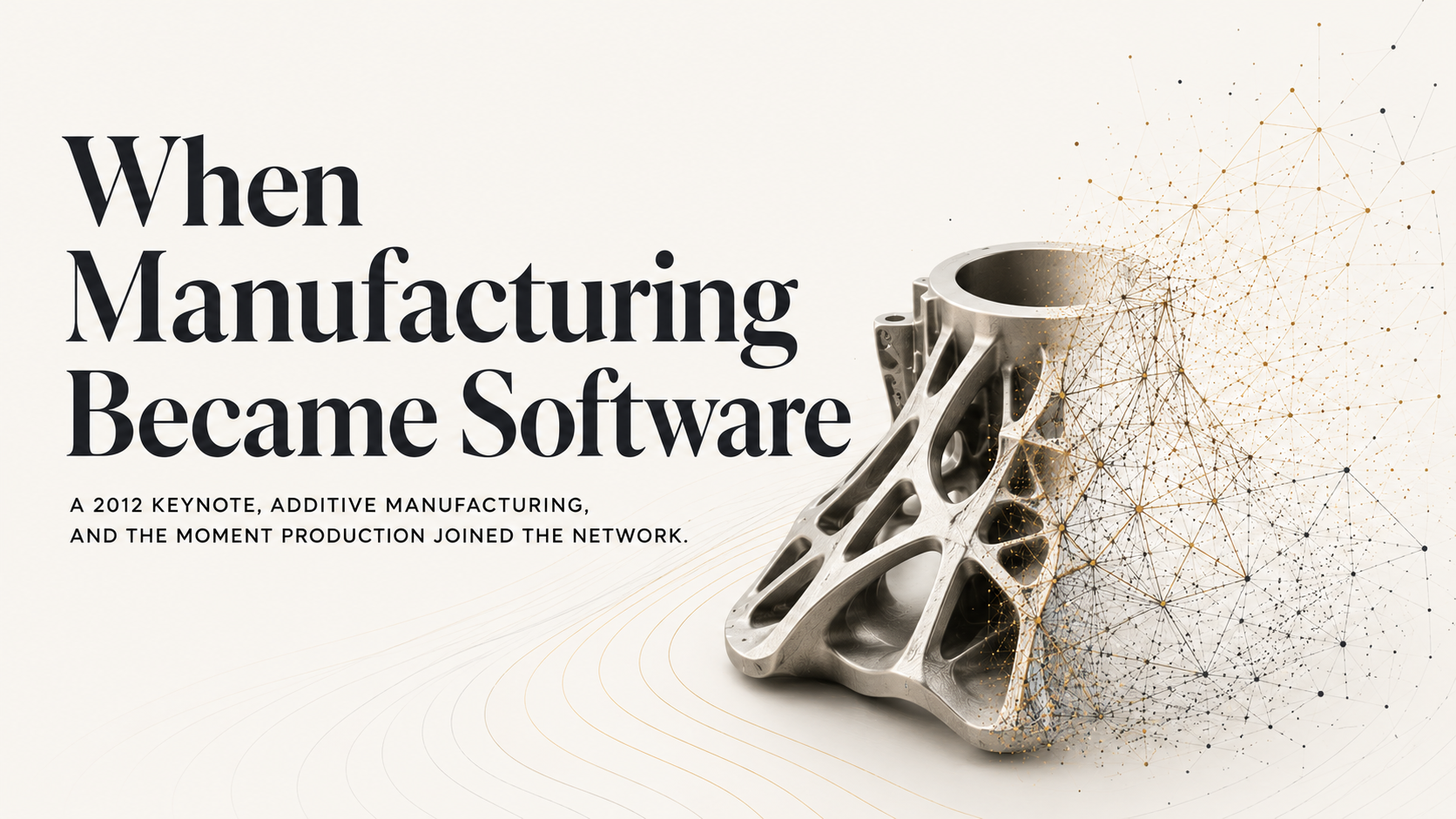
When Manufacturing Became Software
A 2012 keynote, additive manufacturing, and the moment production joined the network.
Fifteen years ago, in 2012, I stood inside the Mandalay Bay Events Center in Las Vegas delivering a keynote on behalf of Autodesk leadership about 3D printing and what many people at the time believed would become the next industrial revolution.
The room held more than seven thousand people. Engineers, architects, designers, futurists, executives, manufacturers. The atmosphere felt enormous in the way technology conferences often do when an industry senses that something fundamental is beginning to shift beneath it.
At the time, the public conversation around 3D printing focused mostly on novelty.
News stories showed plastic figurines, replacement knobs, coffee mugs, and the idea that every family might someday own a printer sitting beside the microwave. The technology was framed as consumer disruption first and industrial transformation second.
That future mostly never arrived.
The more important change happened somewhere quieter.
Inside Autodesk, the signals looked very different. Cloud licensing, rendering systems, simulation workflows, and consumable compute credits increasingly intersected with additive manufacturing pipelines. The conversation inside the industry had already moved beyond hobbyist experimentation.
Around the same period, Autodesk acquired platforms centered around sharing and modifying printable objects. That detail mattered more than most people realized at the time.
Once a physical object can be downloaded, modified, reposted, customized, and fabricated locally, manufacturing starts inheriting some of the behaviors of software.
That changes the equation.
For most of industrial history, production was constrained first by tooling. Engineers designed around molds, machining paths, assembly limitations, material waste, and factory requirements. Manufacturing rewarded repetition and punished variation.
Additive manufacturing altered part of that relationship.
Now geometry could be optimized computationally before it was ever produced physically.
Aerospace companies began printing components that traditional manufacturing methods struggled to create efficiently. Hospitals explored patient-specific devices and implants. Engineers reduced weight, consolidated assemblies, and optimized airflow or thermal performance through geometries that would have been difficult or impossible only a few years earlier.
The printer itself was never the real story.
The story was that physical production had started behaving differently.
Manufacturing was becoming computational.
Looking back nearly fifteen years later, I think many of us were directionally correct even if some of the language surrounding the technology now feels trapped inside the optimism of that era. The desktop printer was never going to replace factories the way some headlines predicted.
Instead, the deeper transformation unfolded more gradually and far more structurally.
Design became increasingly software-defined.
Production became network-aware.
Supply chains became information systems.
Physical objects started inheriting some of the characteristics of digital media. They could be versioned, modified, distributed, iterated, and reproduced with a fluidity that industrial systems historically never possessed.
That transition is still unfolding now.
Artificial intelligence is accelerating generative design. Robotics continue reshaping fabrication. Distributed manufacturing is becoming strategically important again as nations rethink supply-chain resilience. The boundary between simulation and production continues to narrow.
The future turned out to be less about everyone owning a printer.
It was about manufacturing joining the network.

Subscribe to Amid the Noise
Amid the Noise is an ongoing body of work on signal, systems, governance, AI, and the structures that shape human judgment under pressure.
Subscribe to receive new essays as they are published.