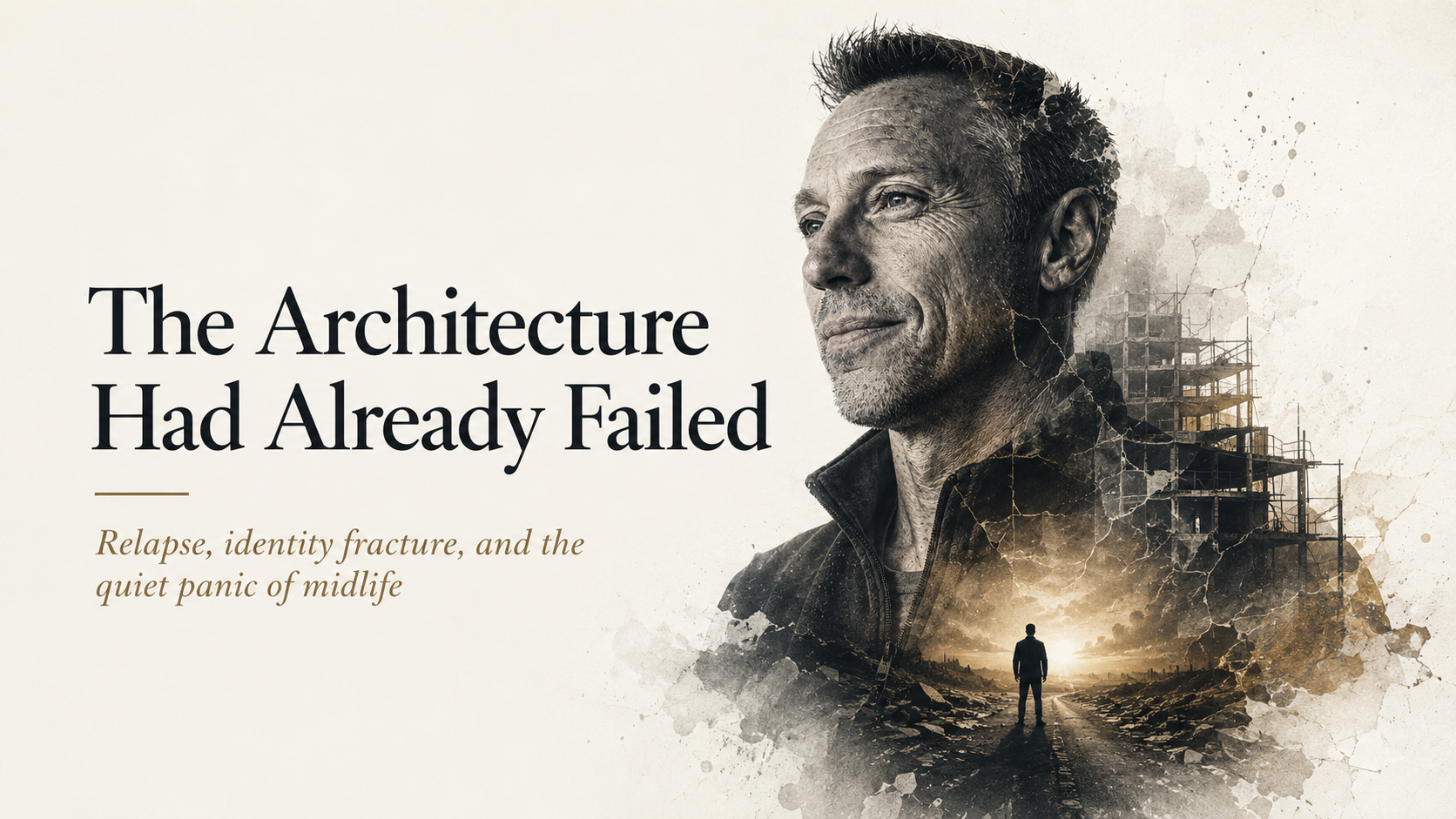
The Architecture had Already Failed
Relapse, identity fracture, and the quiet panic of midlife
I have spent a lot of time trying to understand what actually triggered my relapse.
For a while I framed it narrowly. Stress. Isolation. The wrong people at the wrong moment. Old habits resurfacing under pressure. All of those things were true, but none of them felt complete.
The deeper truth took longer to recognize.
I think part of what happened was a midlife crisis.
Not in the cinematic sense. Not sports cars or impulsive reinvention or suddenly deciding to become twenty-five again. Something quieter than that. More destabilizing too.
I think I reached a point where the architecture of my life no longer matched the person standing inside it.
That realization can arrive slowly enough that you almost miss it happening.
Your parents age. Then one dies.
Industries change.
Entire categories of expertise begin shifting underneath your feet. Technologies that once felt exciting start carrying undertones of replacement instead of possibility. The world begins rewarding different kinds of energy than the ones you spent decades developing.
You keep functioning while privately becoming harder to recognize to yourself.
I do not think enough people talk honestly about what that feels like for high-functioning adults.
Especially men.
A certain generation of men learned to survive through competence. Keep moving. Keep producing. Keep solving problems. Stay useful. Stay needed. Do not become emotionally expensive. Do not slow down long enough to examine whether the structure itself still makes sense.
That strategy can carry a person surprisingly far.
Until it cannot.
My relapse did not feel like rebellion. It did not even feel reckless in the way people often imagine addiction. Looking back, it felt closer to rupture. Like old survival circuitry reactivating during a period of identity instability.
That distinction matters to me.
I first used methamphetamine in 2002. Then I spent years building a career, leading teams, mentoring people, designing systems, traveling internationally, solving difficult problems, and functioning at a level most people around me would have described as successful.
That history complicates the simplistic story people prefer about addiction.
People like narratives with clean lines. Before and after. Stability and collapse. Responsible adult and addict. Real life rarely behaves that neatly.
Sometimes a person remains highly functional for years while carrying unresolved fault lines underneath everything they build.
Then enough pressure accumulates at once.
Grief. Isolation. Aging. Financial instability. Loneliness. Loss of continuity. Fear about relevance. Fear about the future. Relationships that amplify instability instead of grounding it.
Eventually something gives way.
The drugs were destructive. I do not romanticize that. They narrowed my world. Distorted my judgment. Damaged relationships. Eroded stability. Nearly destroyed parts of my life I worked decades to build.
Still, I no longer believe the relapse itself was the original failure.
I think the failure happened earlier.
The structure had already become unsustainable long before the drugs returned.
That realization changed how I think about recovery.
Recovery is often framed as subtraction. Remove the substance. Remove the behavior. Remove the chaos.
Part of recovery is subtraction.
Another part is reconstruction.
You have to build a future that no longer depends on the survival strategies that quietly stopped working years ago. You have to learn the difference between competence and wholeness. You have to separate your identity from constant productivity long enough to figure out who remains underneath it.
That process is slower than detox.
Less dramatic too.
There are no cinematic montages for rebuilding continuity with yourself.
Mostly it looks ordinary.
Sleeping normal hours. Answering messages. Making coffee. Going for walks. Learning how to tolerate stillness without immediately reaching for stimulation or escape. Allowing grief to exist without trying to outrun it. Accepting that aging is not failure. Accepting that usefulness is not the same thing as worth.
None of this fits neatly inside the cultural mythology of a midlife crisis.
Maybe that is part of the problem.
We treat existential instability in adulthood as comedy until it becomes catastrophe. Then we treat the catastrophe as moral weakness instead of asking what collapsed underneath it.
I am not interested in excusing my choices.
I am interested in understanding them accurately.
Those are not the same thing.
The older I get, the more I suspect many people are carrying versions of this quietly. Entire lives constructed around motion, competence, distraction, or usefulness because stopping long enough to confront the deeper fracture feels unbearable.
Eventually the fracture introduces itself anyway.
Mine did.
The surprising part is that recovery did not return me to the person I was before.
It forced me to stop pretending that version of me was sustainable forever.

Subscribe to Amid the Noise
Amid the Noise is an ongoing body of work on signal, systems, governance, AI, and the structures that shape human judgment under pressure.
Subscribe to receive new essays as they are published.