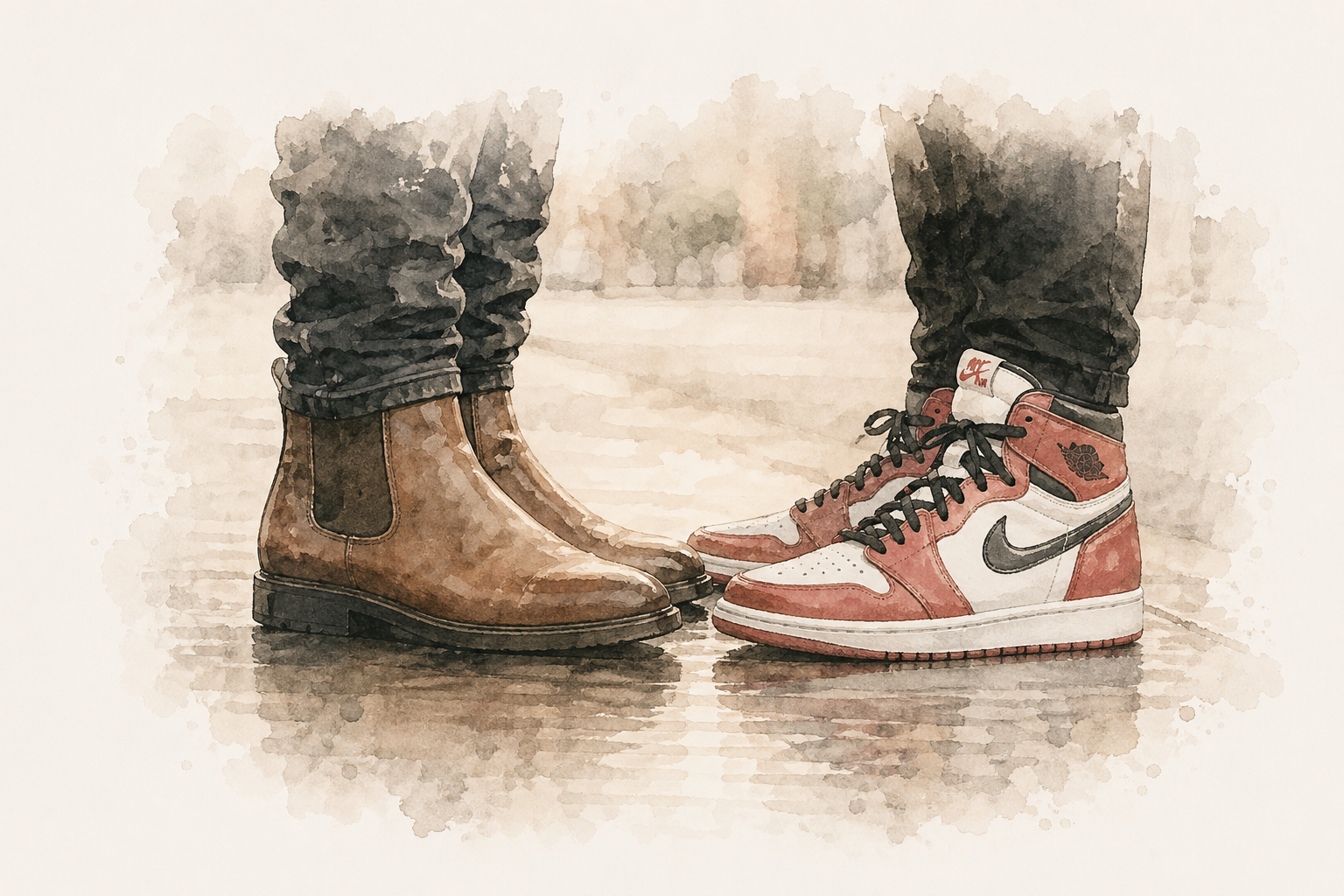
The Air Jordan Paradox
Signal, story, and what we carry
It always begins with the shoes.
Not the smile, not the shoulders, not the voice.
The shoes. Air Jordans. Air Force Ones. Sometimes so white they look like they’ve been baptized, sometimes scuffed to hell and back, like they’ve survived a night downtown and lived to tell it.
I used to think I was being shallow—until I realized I was just being honest. Every time I see someone in a pair of Jordans, I already know the story. Not the one they tell, but the one their feet reveal.
It’s always the same: men who grow up believing that what you wear on your feet defines who you are in the world. The sneaker as a passport. The sneaker as a prayer. The sneaker as proof that you once had nothing, and now at least you have something fresh.
The first time I dated someone with a collection, I thought it was charming. By the third, it became a pattern. By the fifth, it turned into a diagnosis. There’s a connection nobody talks about—Jordans and recovery. The men who line their closets with them like trophies, seeing each pair as a milestone on their long journey out of scarcity. They speak about their shoes with reverence, using language most people reserve for their gods.
And in a way, they’re right. The sneaker is like theology. It’s the religion of resilience.
Meanwhile, I’m the type who wears Chelsea boots. Sleek, quiet, with nothing to prove. The leather improves with age, and the shine depends on maintenance, not luck. Chelsea boots are what you wear when you’ve made peace with your own reflection.
Jordans say, “Look at me.”
Chelsea boots say, I’ve already been seen.
I guess this is where I start to sound elitist. That’s fair. But class isn’t just about money—it’s rhythm, posture, and the difference between just surviving and actually learning how to live.
See, Jordans are loud because their owners grew up unheard. Every colorway is a comeback. Every crease is a confession. I don’t blame them. I just can’t date it anymore.
Because dating men in Jordans always means eventually hearing about the hustle that never pays off, the ex who took the dog, the probation officer who didn’t understand, the job that doesn’t match their “energy.” There’s always a story of redemption that never quite succeeds.
I’m exhausted.
I want to date someone who has already redeemed themselves. Someone who doesn’t need to prove themselves every morning. Someone whose stability doesn’t fade by midnight.
Of course, there’s a risk in my own preferences. The Chelsea boot crowd can be just as lost—only they’re more polished about it. We drink espresso instead of relapsing. We curate our pain instead of confessing it. We own fewer shoes but embrace more silence.
Maybe that’s the true paradox: we’re all going through recovery, just at different costs.
When Baldwin wrote about Harlem, he wasn’t just describing a neighborhood; he was illustrating a state of becoming. He understood that what people wear, desire, and claim are all variations of the same longing—to be respected, to be recognized, to be enough.
I think about that whenever I see those pristine sneakers on men who still act like the world owes them warmth. They’ve learned to clean their soles but not their souls.
Meanwhile, I’ve been walking around pretending that my boots make me immune to the mess—that if I dress the part, I’ll stay above it.
It’s just delusion, only better stitched.
I once dated a man who had twelve pairs of Jordans—each representing a month he had been sober. He told me the collection kept him accountable. I said I understood. But the truth was, I didn’t. I couldn’t. My milestones were quieter—a day without reaching for the past. A night without reaching for him.
We broke up sometime between his eighth relapse and my fourth forgiveness.
When he left, he forgot a pair of metallic silver mids. I donated them to Goodwill the next morning, and I swear I felt lighter. Like maybe I was finally walking in my own shoes again.
So now, when I see the Air Jordan crowd, I smile, nod, and look away. They’re still learning what their feet are saying. I’ve already learned to listen.
Maybe someday I’ll meet someone whose shoes aren’t tied to a sermon. Someone whose stride matches mine—steady, deliberate, unafraid to be boring.
Until then, I’ll keep polishing the leather, not because I care how it looks, but because I value what it symbolizes. Maintenance. Continuity. The quiet discipline of someone who’s no longer running.
Because, let’s be honest, I’ve dated too many men who believe ascension begins at the ankle.

Subscribe to Amid the Noise
Amid the Noise is an ongoing body of work on signal, systems, governance, AI, and the structures that shape human judgment under pressure.
Subscribe to receive new essays as they are published.