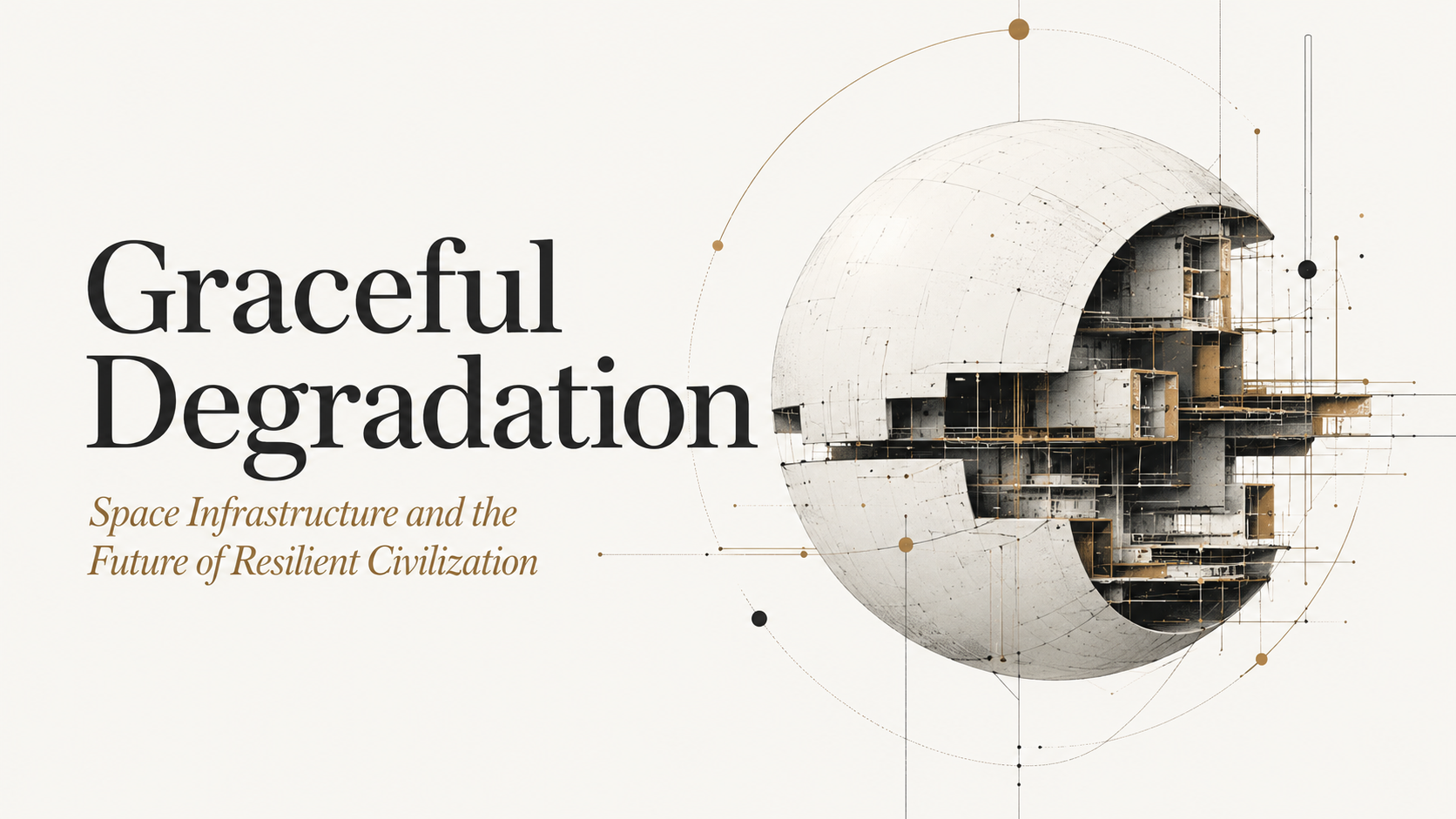
Graceful Degradation
Space infrastructure may teach Earth how to survive instability without collapsing all at once.
Most modern infrastructure was designed around continuity.
Power grids assumed stable climate conditions. Supply chains assumed geopolitical predictability. Communications systems assumed uninterrupted coordination. Cloud architecture assumed someone else would always remain online somewhere else.
The twentieth century rewarded concentration because concentration improved efficiency.
Larger systems generated:
- cheaper energy,
- faster logistics,
- greater scale,
- tighter coordination,
- lower operational cost.
That model worked extraordinarily well.
Until instability itself became infrastructural.
Wildfires now threaten transmission corridors. Cyberattacks target concentrated systems. Heat events strain regional grids. Supply chain disruptions ripple globally within hours. Geomagnetic storms remain capable of damaging infrastructure most people never think about until it disappears.
The issue is not simply technological fragility.
It is architectural dependency.
Modern civilization increasingly relies upon systems optimized to function beautifully under ideal conditions, but which struggle to degrade gracefully once stress compounds across tightly coupled networks.
Space infrastructure cannot afford that assumption.
A lunar habitat cannot simply “go offline” while waiting for repair crews. An orbital system cannot assume neighboring regions remain unaffected. A deep-space mission cannot depend upon uninterrupted rescue capacity.
Off-world infrastructure therefore evolves differently.
Not toward perfection.
Toward survivability.
Compartmentalization. Redundancy. Localized continuity. Autonomous fallback systems. Layered resilience.
Graceful degradation.
Apollo 13 survived not because failure was prevented, but because the spacecraft degraded slowly enough for adaptation to remain possible. Systems were shut down selectively. Resources were rerouted. Survival emerged through containment rather than uninterrupted functionality.
That distinction matters.
The future grid may increasingly resemble that philosophy: not singular, not centralized, not dependent upon uninterrupted continuity everywhere simultaneously.
More modular. More distributed. More capable of remaining partially operational under stress.
The interesting possibility is that humanity’s return to space may accidentally teach Earth how to survive its own complexity.
Not because civilization is collapsing.
Because civilization is becoming too interconnected to assume uninterrupted stability forever.
That realization changes infrastructure design profoundly.
The future may belong not to the systems that operate most efficiently during perfect conditions, but to the systems capable of remaining functional during imperfect ones.
I explore this idea in far greater depth in a new white paper:
Graceful Degradation
Space infrastructure and the future of resilient civilization.
The paper examines:
- distributed resilience,
- infrastructure fragility,
- Apollo 13 and compartmentalized failure,
- the Texas grid collapse,
- microgrids and layered continuity,
- Artemis as infrastructural groundwork,
- orbital systems governance,
- and why space infrastructure may increasingly resemble civic infrastructure.

Subscribe to Amid the Noise
Amid the Noise is an ongoing body of work on signal, systems, governance, AI, and the structures that shape human judgment under pressure.
Subscribe to receive new essays as they are published.