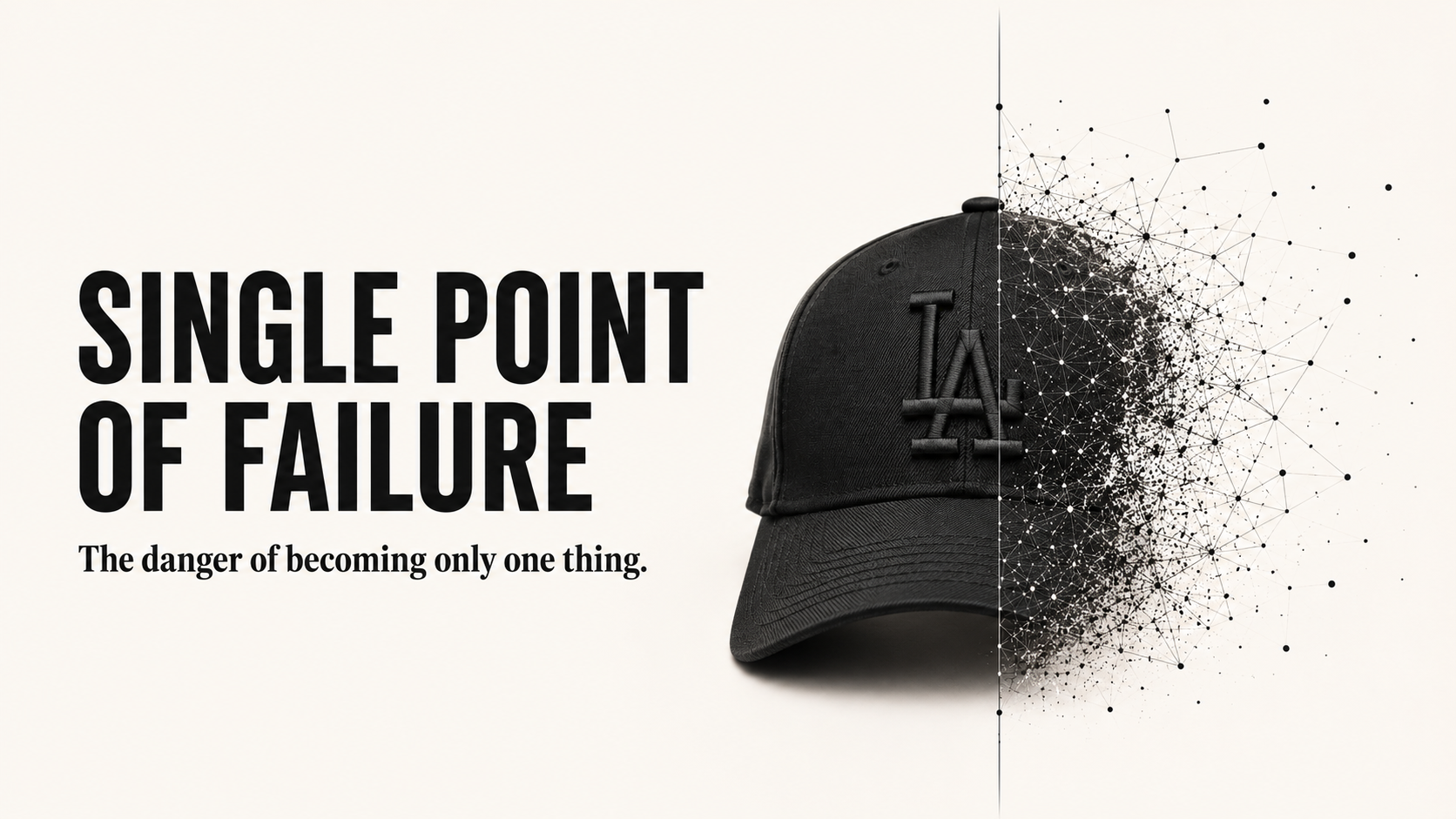
Single Point of Failure
The danger of becoming only one thing.
I have a habit whenever I begin imagining myself in a new city.
I buy something local.
Usually a hat.
Not as cosplay. Not as performance. More as a way of lightly entering the atmosphere of a place without pretending I was born there. A small signal of participation. The civic equivalent of learning which streets hold heat after sunset or how the air changes before rain.
Lately, I have been eyeing a blackout Los Angeles Dodgers cap from ’47 Brand. Triple black. Quiet. No oversized logos. No bright royal blue demanding attention from across the room.
Just enough signal for someone to recognize it if they know what they are looking at.
The hat itself is almost irrelevant.
What interests me is why people do this at all.
Human beings seem wired to absorb fragments of local identity. Sports teams. Transit systems. Regional foods. Area codes. Favorite intersections. We collect these things because they help orient us socially. They create forms of belonging that do not require total assimilation.
At least, ideally.
I have known people who disappeared entirely into institutions.
Former executives who could no longer introduce themselves without mentioning the company they worked for fifteen years ago. Politicians who stayed in office long after they appeared physically exhausted by the role itself. Founders who treated retirement like a form of death. Couples who dissolved so completely into “we” that neither person seemed to exist independently anymore.
The pattern always fascinates me because it feels less like ambition and more like structural dependency.
The title becomes the person.
Senator. Founder. Director. Pastor. Influencer. Husband. Addict.
Remove the role and the architecture collapses.
In systems design, we have a phrase for this: single point of failure.
A system becomes fragile when too much responsibility, authority, or meaning concentrates in one location. If that node fails, the entire structure destabilizes.
Humans are not immune to this.
People who centralize identity too heavily around one domain often become psychologically brittle. Layoffs become existential crises. Retirement becomes erasure. Divorce becomes annihilation. Public irrelevance begins to feel indistinguishable from personal disappearance.
I suspect this is part of why some public figures never leave office willingly. Eventually the institution stops being a career and starts becoming ontology. The role no longer explains what they do. It explains what they are.
That strikes me as profoundly dangerous.
Not because titles are bad. Titles matter. Careers matter. Relationships matter. Communities matter too. There is nothing wrong with wearing a Dodgers cap because you are beginning to emotionally map yourself into Los Angeles.
The danger begins when one identity consumes all the others.
Healthy systems distribute load.
Healthy people distribute meaning.
The writer should also have friendships outside writing. The executive should know who they are without a boardroom. The recovering addict should become more than recovery alone. The politician should remain recognizable after the motorcade disappears.
No single role should possess enough power to erase the rest of the self.
This may be why I resist over-identifying with any one category, even the flattering ones.
I care deeply about design, systems thinking, civic infrastructure, and the strange future emerging between humans and machines. Those things matter to me enormously.
They are not the entirety of me.
Neither are the cities I love.
Los Angeles will not become my personality any more than San Francisco did. A blackout Dodgers cap does not mean surrendering identity. If anything, it represents the opposite. A small local signal integrated into a much larger architecture of self.
Participation without disappearance.
Belonging without erasure.
That feels healthier to me than becoming only one thing.

Subscribe to Amid the Noise
Amid the Noise is an ongoing body of work on signal, systems, governance, AI, and the structures that shape human judgment under pressure.
Subscribe to receive new essays as they are published.