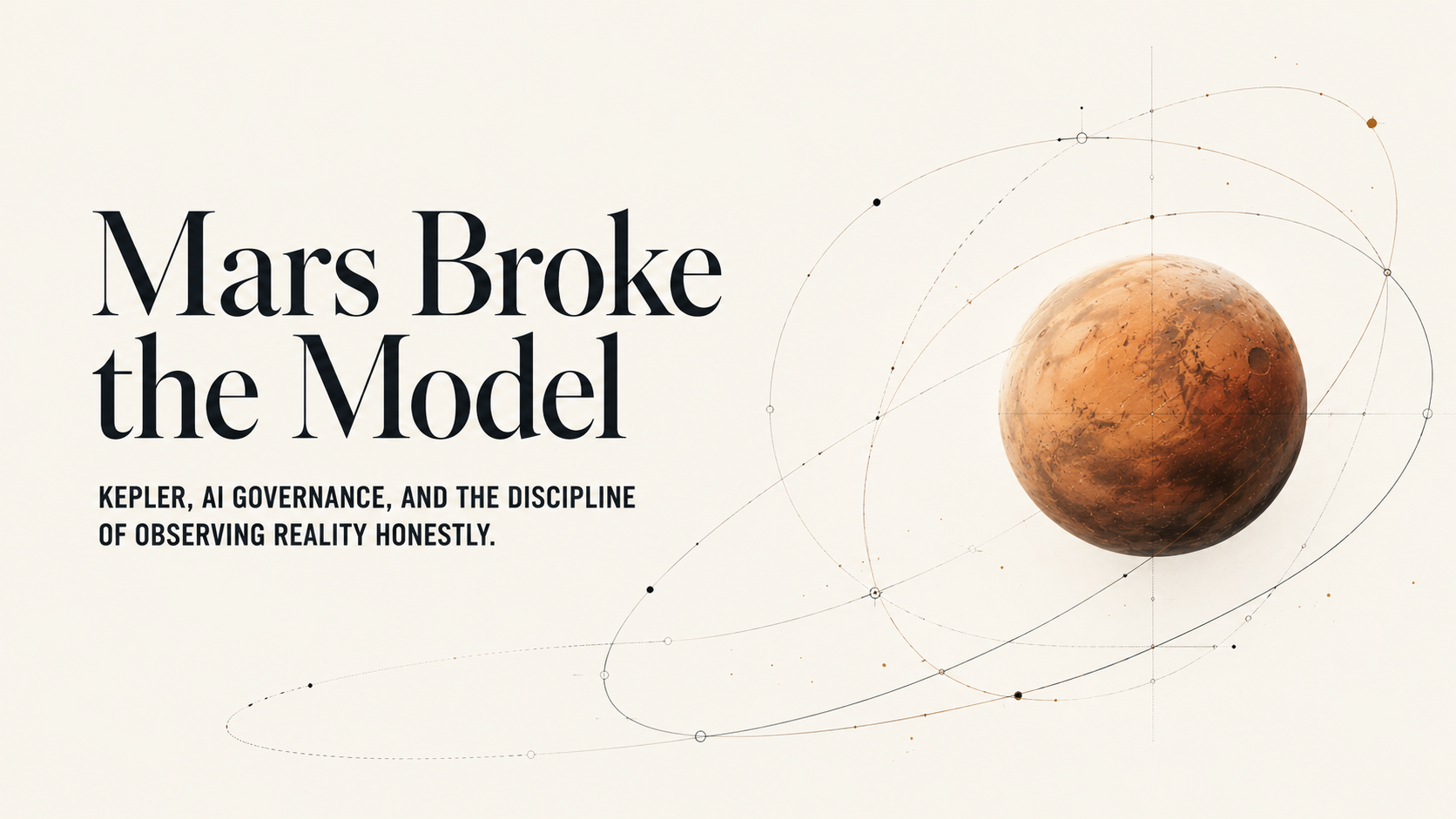
Mars Broke the Model
Kepler, AI governance, and the discipline of observing reality honestly.
Johannes Kepler inherited a beautiful theory.
The planets, according to centuries of accepted wisdom, moved in perfect circles. Circular motion reflected divine harmony. The model was elegant, symmetrical, and intellectually satisfying in the way institutional assumptions often are.
Then Mars refused to cooperate.
Its orbit drifted in ways the mathematics could not fully explain. Small inconsistencies kept appearing in the data. Tiny deviations. Persistent irregularities. The kind organizations are often tempted to smooth over in order to preserve confidence in the larger system.
Kepler did something extraordinarily difficult.
He allowed observation to overrule elegance.
That decision changed human history.
Instead of forcing reality to fit inherited theory, Kepler reshaped the theory until it matched observed behavior honestly. The result was not perfection but ellipses: a model stranger, less symmetrical, and far more accurate than the one it replaced.
The older I get, the more I suspect this discipline matters far beyond astronomy.
Especially in artificial intelligence.
Modern AI governance often suffers from the same temptation that confronted Kepler centuries ago: the desire to preserve beautiful models even after reality begins exposing their weaknesses.
Organizations love circles.
Clean diagrams. Neat ethical frameworks. Simple oversight models. Predictable taxonomies. Confident positioning language.
Reality behaves elliptically.
Human beings do not interact with systems consistently. Incentives distort behavior. Users adapt faster than policy evolves. Edge cases become central cases without warning. Deployment environments produce emergent consequences that looked invisible during conceptual design.
Then the orbit starts drifting.
A moderation system behaves unpredictably at scale. An AI assistant amplifies confidence without accuracy. Users discover adversarial prompting techniques. Governance frameworks collapse under operational pressure. A “human in the loop” exists only performatively because the human lacks authority or context.
At first, institutions often treat these moments as anomalies.
Temporary deviations. Implementation failures. Public relations problems. Outliers.
Kepler understood something dangerous: anomalies are sometimes evidence that the model itself is incomplete.
That mindset requires enormous humility.
Especially because elegant systems create emotional attachment. People build careers around them. Companies build valuations around them. Governments build policies around them. Once enough institutional momentum accumulates, correcting the model can feel psychologically threatening even when the evidence becomes undeniable.
This is not unique to AI.
Civilizations do this constantly.
Financial systems ignore warning signals because markets “should” self-correct. Infrastructure systems assume stability until collapse exposes neglected complexity. Political systems preserve narratives long after citizens stop believing them. Organizations mistake internal coherence for external truth.
Eventually reality intervenes.
The orbit refuses the theory.
What makes Kepler remarkable is not merely mathematical brilliance. Many brilliant people existed during his time. His deeper contribution was methodological integrity. He remained loyal to observed behavior even when observation destabilized accepted wisdom.
That is much harder than it sounds.
Most institutions reward confidence more than revision.
Most systems reward legibility more than uncertainty.
AI governance increasingly faces this exact tension.
There is enormous pressure right now to create stable narratives around systems that remain fundamentally probabilistic, adaptive, and only partially understood. Companies want reassurance. Regulators want definitional clarity. Investors want predictability. Users want confidence.
Meanwhile the systems themselves continue behaving elliptically.
That does not mean governance is impossible.
It means governance must remain observational rather than ideological.
The strongest governance structures are not the ones that assume perfection. They are the ones capable of noticing drift early and adapting honestly.
That distinction matters enormously.
A brittle system treats anomalies as threats to legitimacy. A resilient system treats anomalies as information.
Kepler chose information.
That choice required abandoning elegance in favor of truth.
I think about that often now.
Partly because artificial intelligence increasingly resembles orbital mechanics in one important way: the systems are too complex to govern through intuition alone. We need observation, iteration, correction, and humility before reality itself.
Most dangerous systems do not fail because people lack intelligence.
They fail because institutions become emotionally committed to incomplete models.
Mars mattered because it refused to behave politely enough to preserve the illusion.
Reality usually does eventually.

Subscribe to Amid the Noise
Amid the Noise is an ongoing body of work on signal, systems, governance, AI, and the structures that shape human judgment under pressure.
Subscribe to receive new essays as they are published.