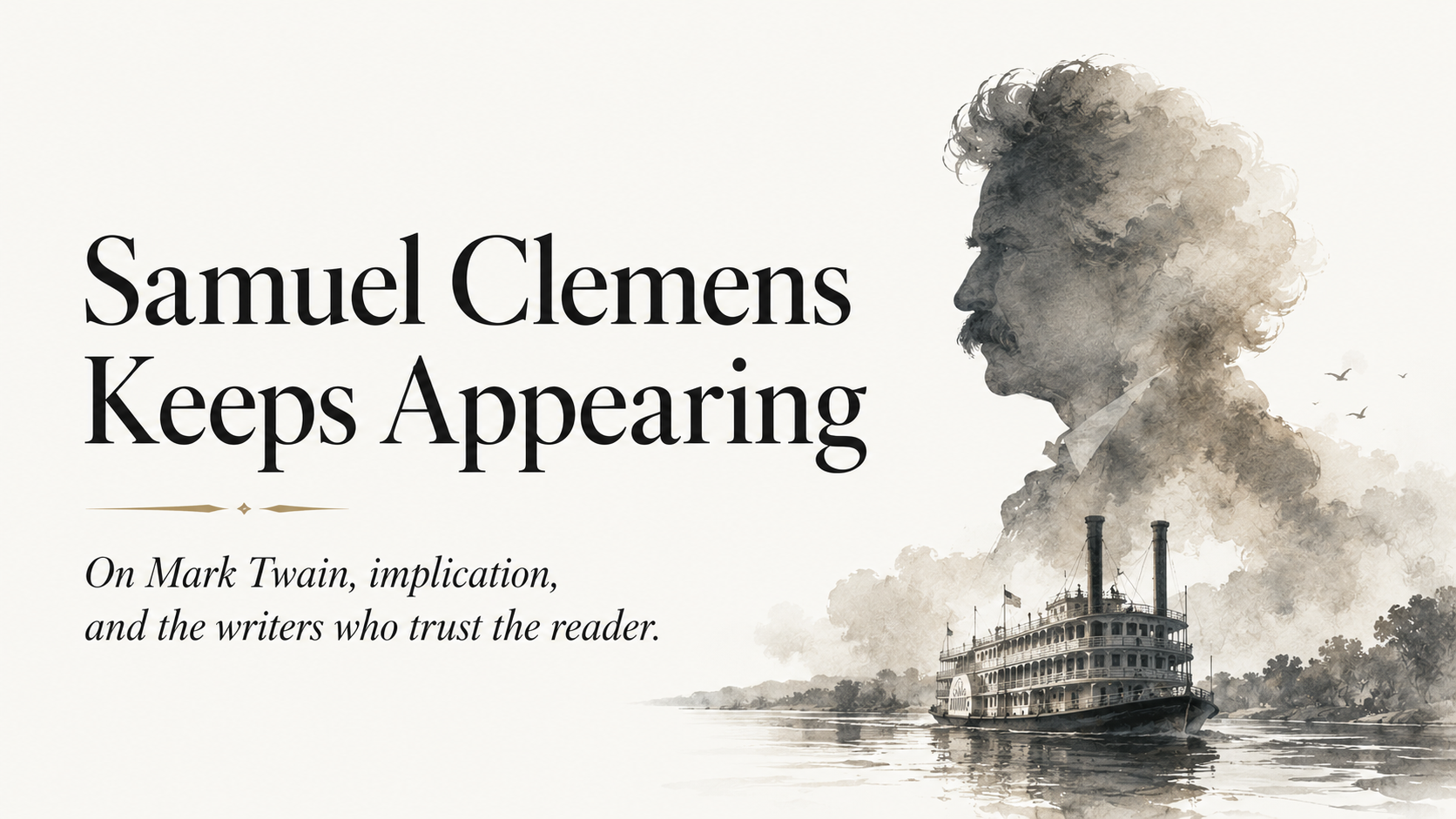
Samuel Clemens Keeps Appearing
On Mark Twain, implication, and the writers who trust the reader.
I spent years encountering Samuel Clemens before I ever really met Mark Twain.
Sometimes he was standing on the deck of a riverboat at Disneyland, narrating an idealized version of America while families floated in careful circles around Frontierland. Sometimes he appeared in the Sierra foothills, hidden among overheated gas stations, old timber towns, and roadside museums where stories still feel slightly exaggerated on purpose. Sometimes he surfaced aboard the Enterprise-D, smiling suspiciously at time travelers while pretending not to notice that everyone around him was lying.
For a long time, I thought those were separate experiences.
I no longer think that.
The older I get, the more I suspect certain writers stop behaving like authors entirely. Their observations detach from the page and begin appearing elsewhere. You recognize their fingerprints inside architecture, attraction design, television dialogue, public mythology, and the cadence of ordinary conversation.
Samuel Clemens feels like that to me.
Not because I worship him.
Because I recognize the method.
Disney understood something important about Mark Twain.
The company did not merely preserve him as a literary figure. It absorbed him into environmental storytelling. The Mark Twain Riverboat is less a ride than a ritualized version of American narration itself: optimism, expansion, nostalgia, performance, spectacle, and selective memory all drifting together in a beautiful controlled loop.
Disneyland’s version of Twain feels polished and theatrical, but still strangely honest in its own way. The attraction quietly acknowledges that America has always preferred stories that float smoothly downstream, even when the actual river underneath them contains debris, contradiction, and history sharp enough to split the hull.
Twain would probably appreciate the irony.
He understood performance better than many modern writers do. He understood that people rarely absorb difficult truths through direct confrontation. They absorb them through participation. Humor lowers the drawbridge first.
The smile arrives before the realization.
Northern California changes Twain again.
Spend enough time in the Sierra Nevada foothills or around Calaveras County and the Disney version begins to evaporate. The stories become drier there. Stranger. Less polished. You start to understand that Twain’s voice was shaped as much by overheard conversation and human absurdity as by literary ambition.
The foothills still contain that energy.
You feel it in old downtowns where every building seems to have survived three economic collapses and at least one suspicious fire. You feel it in antique stores filled with objects nobody can justify throwing away. You feel it in local storytelling traditions where exaggeration is not exactly dishonesty so much as a social art form.
Twain never sounded entirely impressed by civilization. That may be part of why he ages well.
He watched people carefully enough to understand that institutions often become elaborate theater long before they become functional. Politicians, businessmen, newspaper publishers, speculators, social elites, inventors, religious figures, and opportunists all passed through his work carrying their own tiny self-important performances.
He rarely attacked them directly.
He simply illuminated the floorboards until the creaking became impossible not to hear.
That distinction matters.
Modern sarcasm often performs superiority. Twain’s sarcasm usually performs recognition. The reader is invited into the joke because the reader is trusted to notice the contradiction independently.
That creates a very different relationship.
He was not cornering people into agreement. He was giving them enough observational clarity that honest disagreement became difficult to maintain comfortably.
One of the stranger places Twain appears is Star Trek: The Next Generation.
Samuel Clemens enters Time’s Arrow almost like a nineteenth-century systems analyst accidentally wandering into a science fiction plot. Everyone around him is concealing something. The crew is hiding its origins. Alien parasites are hiding in plain sight. Time itself is behaving incorrectly. Clemens notices immediately that the room does not make sense.
Not because he possesses advanced technology.
Because he understands human behavior.
That feels deeply Twainian to me.
Science fiction often assumes intelligence comes from access to superior information. Twain understood that intelligence frequently comes from observing what people avoid saying aloud. He watched posture, status, contradiction, insecurity, ego, and performance. The facts mattered, but the behavioral signal mattered more.
That is probably part of why he keeps resurfacing culturally in places that are ostensibly unrelated to literature.
His writing is not really about riverboats or fence painting or mischievous boys rafting downstream.
It is about social choreography.
I think that is ultimately why I am drawn to him.
Not because I agree with every position he held. Not because I romanticize the era he inhabited. Certainly not because I see him as morally uncomplicated.
I am drawn to the mechanism.
Twain trusted implication more than instruction.
He trusted readers enough to leave conceptual gaps. He allowed observation to carry the argument instead of announcing the thesis immediately. The audience became part of the meaning-making process rather than passive recipients of a conclusion already locked in place.
That feels increasingly rare now.
Modern discourse often arrives pre-interpreted. Every statement includes the explanation, the framing, the disclaimer, the intended emotional response, and the approved conclusion. Nothing is allowed to breathe long enough for the audience to discover anything honestly.
Twain understood something more durable.
People protect themselves from accusation.
They walk willingly into implication.
The older I get, the less interested I am in writers who insist on conclusions.
I trust the ones who leave enough space for the reader to arrive honestly.
Samuel Clemens knew how to do that.
The smile came first.
The realization usually arrived a few seconds later.

Subscribe to Amid the Noise
Amid the Noise is an ongoing body of work on signal, systems, governance, AI, and the structures that shape human judgment under pressure.
Subscribe to receive new essays as they are published.