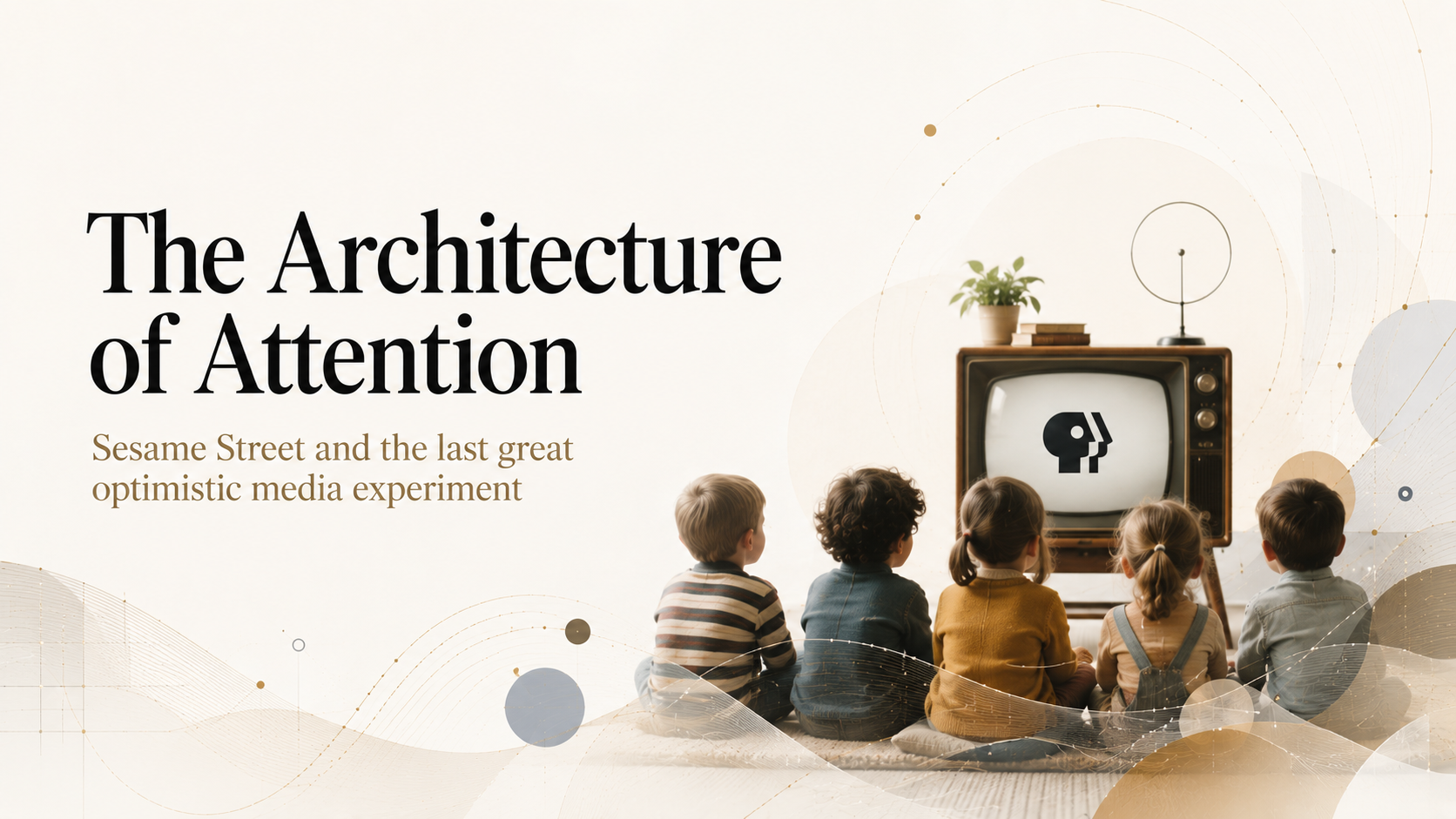
The Architecture of Attention
Sesame Street and the last great optimistic media experiment
One of the most ambitious educational experiments in American history disguised itself as children’s television.
The premise behind Sesame Street was surprisingly radical.
If television advertising could persuade children to memorize jingles, recognize mascots, and emotionally attach themselves to breakfast cereal brands, perhaps those same techniques could teach literacy, numeracy, emotional regulation, and social cooperation instead.
Especially for children growing up without educational advantages.
That was not an accidental side effect of the program. It was the design brief.
The people building Sesame Street understood something many institutions still struggle to acknowledge openly:
Attention is infrastructure.
Children learn partly through repetition, rhythm, emotional attachment, visual contrast, reward anticipation, and narrative continuity. Advertising already understood this by the late 1960s. Commercial television had become extraordinarily effective at capturing and retaining cognitive focus.
Rather than rejecting those techniques, Sesame Street appropriated them.
Fast pacing. Bright colors. Musical repetition. Character familiarity. Short segmented content. Structured reinforcement loops.
Educational television borrowed the grammar of advertising because advertising had already demonstrated that the grammar worked.
That decision reflected a particular moment in American civic imagination.
The late 1960s and early 1970s still carried traces of a belief that media infrastructure could serve public goals instead of purely commercial ones. Public broadcasting, educational programming, and federally supported communications systems emerged from the idea that mass media might reduce inequality rather than merely monetize attention.
The underlying question was profound:
Could educational opportunity be distributed through broadcast infrastructure at national scale?
In many ways, Sesame Street functioned as an attempt to align behavioral science, communications infrastructure, and public funding toward civic uplift.
And remarkably, the experiment largely succeeded.
Research repeatedly demonstrated measurable improvements in early literacy and school readiness among children who watched the program regularly, particularly among underprivileged communities.
That outcome matters historically because it established something society still has not fully reckoned with:
Attention engineering can improve human outcomes when incentives align correctly.
Modern audiences often speak about persuasive design as though manipulation and extraction are inevitable characteristics of behavioral systems. Sesame Street complicates that assumption.
The same underlying mechanics that can drive compulsive scrolling can also teach reading.
The same reinforcement loops that sustain advertising engagement can also encourage emotional development and curiosity.
The same character attachment dynamics that build consumer loyalty can also create trust, comfort, and educational continuity.
The machinery itself is morally flexible.
The incentives surrounding the machinery are not.
That distinction became increasingly important as media ecosystems evolved.
Commercial television optimized heavily around ratings and advertising yield. Digital platforms later optimized around engagement, retention, behavioral prediction, and monetizable attention. Social media transformed many human interactions into measurable performance systems governed by visibility incentives.
The architecture remained persuasive.
The incentives changed.
That may be why Sesame Street feels like a historical anomaly.
Its creators genuinely believed mass media could elevate public capability.
Not simply entertain. Not merely distract. Not primarily extract.
Teach.
Today we ask similar questions about artificial intelligence.
Can adaptive systems personalize education at scale without reducing students into behavioral products? Can conversational systems distribute educational opportunity more evenly without optimizing primarily for retention and dependency? Can attention systems remain aligned with human development once commercial incentives begin competing against public ones?
Those are not entirely new questions.
They are descendants of the same experiment Sesame Street began decades ago.
The real achievement of Sesame Street was not educational television.
It was proving that mass attention systems could be designed around human development instead of extraction.
We once treated that idea as a national priority.

Subscribe to Amid the Noise
Amid the Noise is an ongoing body of work on signal, systems, governance, AI, and the structures that shape human judgment under pressure.
Subscribe to receive new essays as they are published.