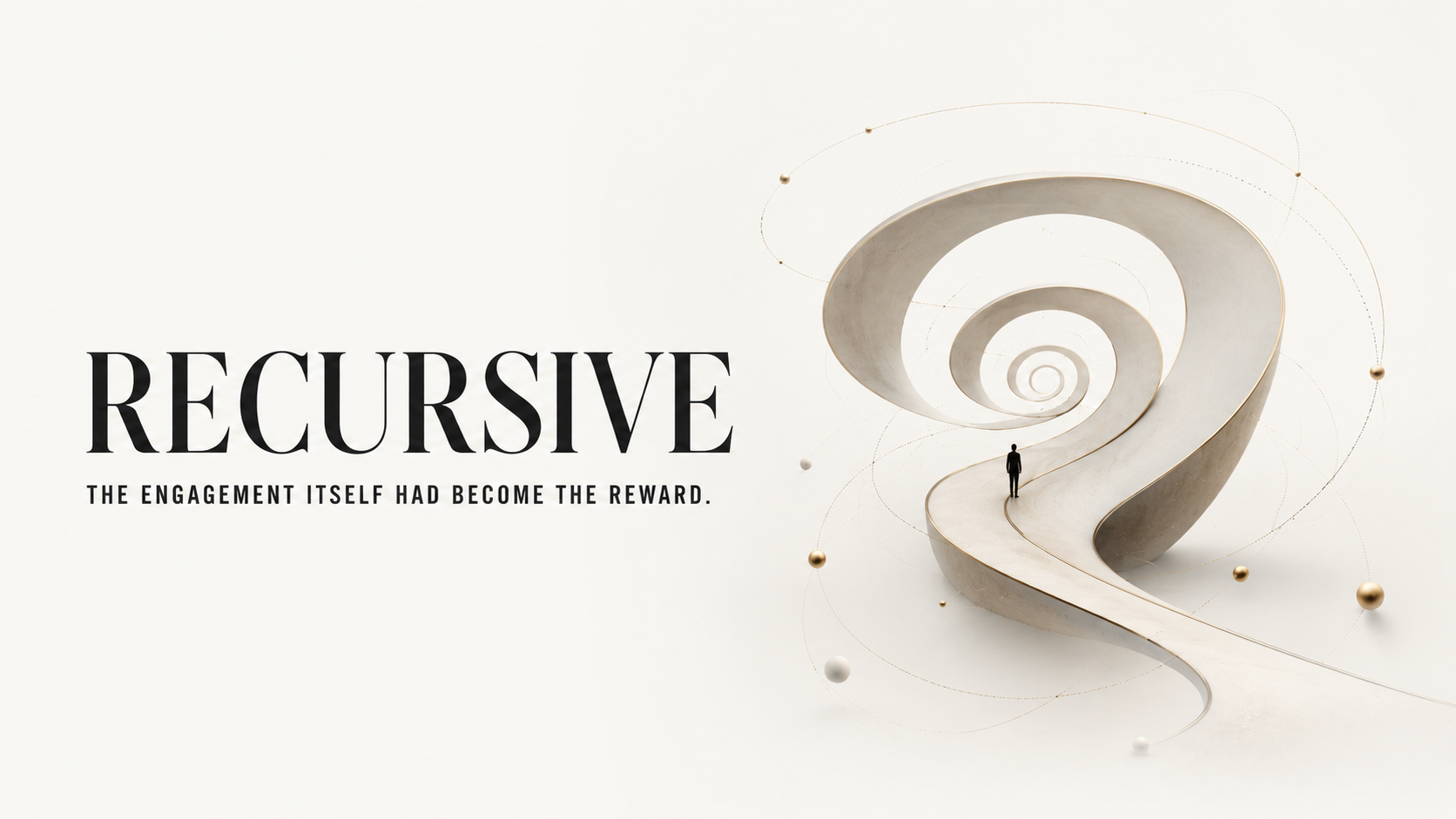
Recursive
The engagement itself had become the reward.
For a long time, I thought I was trying to solve problems.
Then eventually I noticed how often the problem itself changed while the behavior remained exactly the same.
One month it was apartments. Another month it was productivity systems. Then software. Then career strategy. Then furniture. Then cities. Then some entirely new configuration of future optimization that felt urgent enough to justify complete cognitive immersion.
The topic changed easily.
The loop did not.
At first, this looked like intelligence to me.
Curiosity. Thoroughness. Systems-thinking. The ability to anticipate consequences before they arrived.
Sometimes it was those things.
Then one day I noticed something more uncomfortable underneath it.
I was not always searching for answers.
Sometimes I was searching for stimulation structured tightly enough to temporarily feel like control.
That realization reorganized how I understood a lot of my own behavior.
The research itself had become emotionally regulating.
Not the outcome. Not the decision. The engagement.
Open another tab. Refine the model. Compare another possibility. Feel the small neurological satisfaction of movement without exposure.
Repeat.
The strange thing about recursive loops is how productive they feel while remaining almost perfectly stationary.
You can spend entire evenings mentally rearranging your future while your actual life remains untouched nearby.
Not because you are lazy. Not because you lack ambition.
Because uncertainty is physiologically expensive.
The loop offers something cleaner.
Contained stimulation. Temporary order. The comforting illusion that if you think long enough, carefully enough, strategically enough, reality itself might eventually become manageable.
Modern technology quietly accelerates this tendency.
Every platform rewards sustained engagement more than resolution. There is always another recommendation, another comparison, another possibility, another version of yourself waiting just beyond the next click.
Completion is structurally discouraged.
The loop works better unfinished.
What makes this difficult to recognize is that the behavior often disguises itself as responsibility.
You tell yourself you are being careful. Thoughtful. Prepared.
Meanwhile the emotional experience begins drifting further and further away from lived reality and deeper into recursive simulation.
That distinction matters.
There is a form of reflection that helps people enter life more honestly. It helps them leave unstable situations, build structure, survive collapse, make decisions with care.
There is another form that quietly replaces participation itself.
The line between the two can become surprisingly difficult to recognize from inside the loop.
Especially for analytical people. Especially for people who survived instability through anticipation. Especially for people whose intelligence became psychologically intertwined with forecasting.
Real life eventually disrupts every model.
You take the job and discover the culture feels strange. You move to the city and still feel lonely there. You buy the thing and realize the imagined future attached to it never actually arrives.
Reality closes doors that imagination keeps permanently open.
I do not think the answer is to stop thinking deeply. Reflection matters. Curiosity matters. Analysis matters.
Still, there comes a point where additional optimization stops producing clarity and starts functioning as emotional postponement.
That has been difficult for me to admit because so much of modern professional life rewards exactly this cognitive style. Anticipation. Pattern recognition. Comparative evaluation. Scenario modeling.
Those are useful skills.
They just cannot become the entire architecture of a life.
At some point, you have to tolerate the discomfort of incomplete information and enter reality anyway.
Not perfectly prepared. Not fully certain. Not optimized.
Present.

Subscribe to Amid the Noise
Amid the Noise is an ongoing body of work on signal, systems, governance, AI, and the structures that shape human judgment under pressure.
Subscribe to receive new essays as they are published.