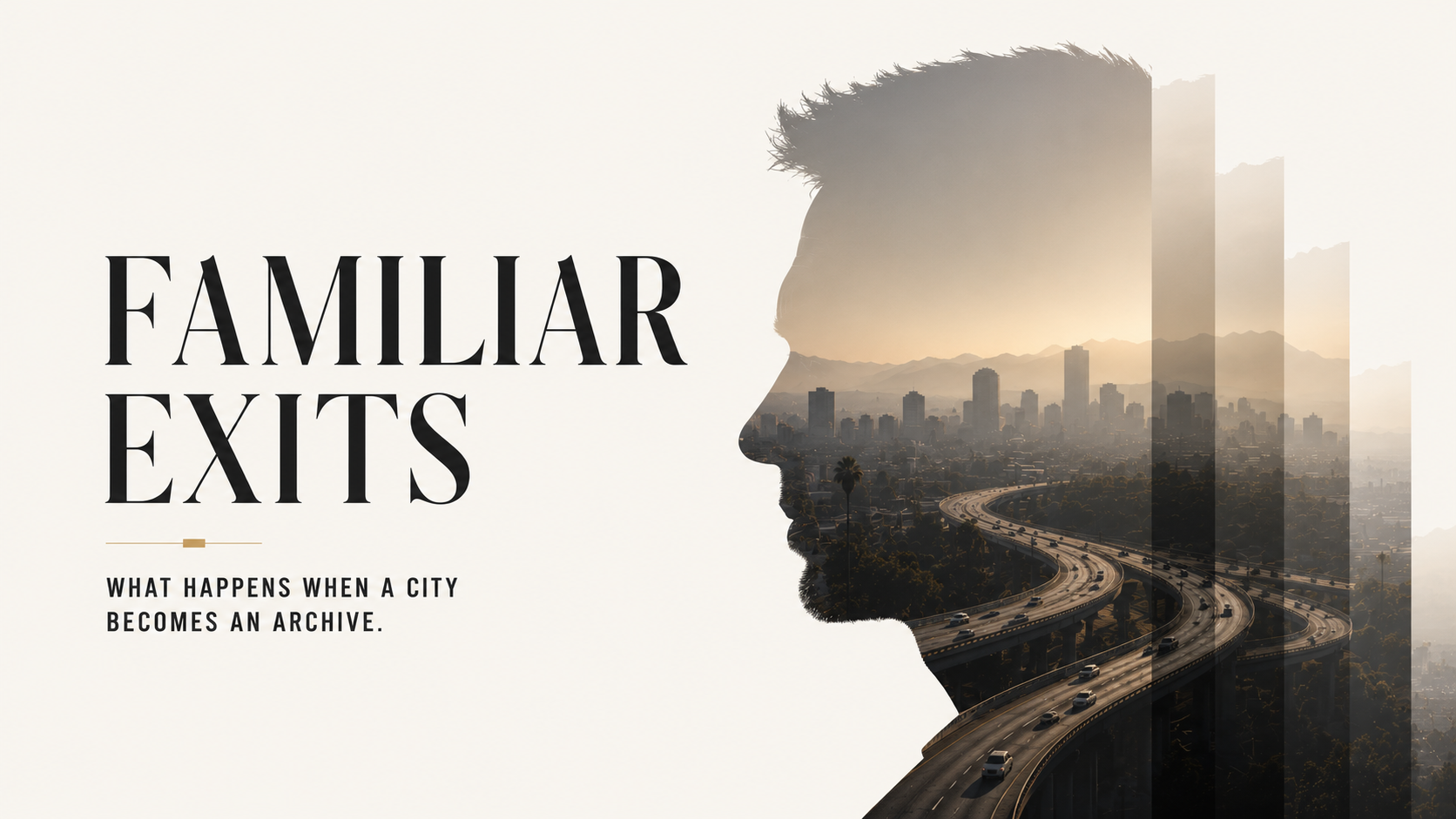
Familiar Exits
What happens when a city becomes an archive.
I used to think I wanted to leave certain cities because I was unhappy there.
That explanation felt simple. Clean. Adult.
Then I started noticing how often memory attached itself to infrastructure.
A freeway exit. A left turn at an intersection. The fluorescent glow of a grocery store at night. A particular gas station seen through rain. A stretch of road your body memorized long before your mind understood what it was surviving.
Some cities stop feeling like places and start feeling like archives.
At first, I thought this was nostalgia. Then I thought it was regret. Eventually I realized it was something quieter and more exhausting than either.
Certain environments become saturated with archived versions of yourself.
You stop moving through neighborhoods and start moving through stored memory.
Here is where you once believed everything was about to work out. Here is where you lost someone. Here is where you were pretending to be fine. Here is where survival narrowed your world into routines small enough to manage. Here is where you became somebody else for a while.
The city remains physically unchanged while your relationship to it fractures into retrievals.
That fragmentation creates a peculiar kind of fatigue.
Not danger, necessarily. Not even sadness all the time.
Recognition.
Too much recognition.
You walk into a coffee shop and immediately remember who you used to text from the parking lot. You pass an apartment complex and feel entire emotional seasons resurfacing without permission. Your body still anticipates turns you have not taken in years.
There is no single traumatic event attached to any of it. The accumulation itself becomes heavy.
I think this is why some people eventually leave places they once loved.
Not because the city betrayed them. Not because another city promises salvation.
Sometimes people simply reach the point where they can no longer hear themselves think over the noise of accumulated memory.
Recovery complicated this realization for me.
People often imagine recovery as resisting temptation. Sometimes it is. Sometimes it is much quieter than that.
Sometimes recovery means becoming tired of encountering archived versions of yourself everywhere you go.
The old routines. The old faces. The old negotiations. The old explanations. The old gravitational pulls.
You begin craving psychological spaciousness more than reinvention.
That distinction matters.
I do not think geography changes people as dramatically as we pretend it does. Human beings have a habit of carrying unresolved parts of themselves directly across state lines. Plenty of people move to new cities only to reconstruct the same emotional architecture somewhere else.
Still, environments shape the emotional texture of daily life.
Some neighborhoods invite you back into the world. Others teach you to move between isolated destinations without ever fully arriving anywhere.
At some point I realized I was not searching for a perfect city.
I was searching for a place where my nervous system did not feel perpetually crowded by memory.
That is a very different desire.
Lately I have started wondering how many adults are quietly carrying entire archives of themselves through familiar environments. How many people are driving home each night through intersections layered with former lives they never fully released.
Maybe this is why certain freeway exits feel emotionally louder than they should.
Not because anything is happening there now.
Because something already did.

Subscribe to Amid the Noise
Amid the Noise is an ongoing body of work on signal, systems, governance, AI, and the structures that shape human judgment under pressure.
Subscribe to receive new essays as they are published.