Quiet Instruments
Some objects stop being technology and become witnesses.
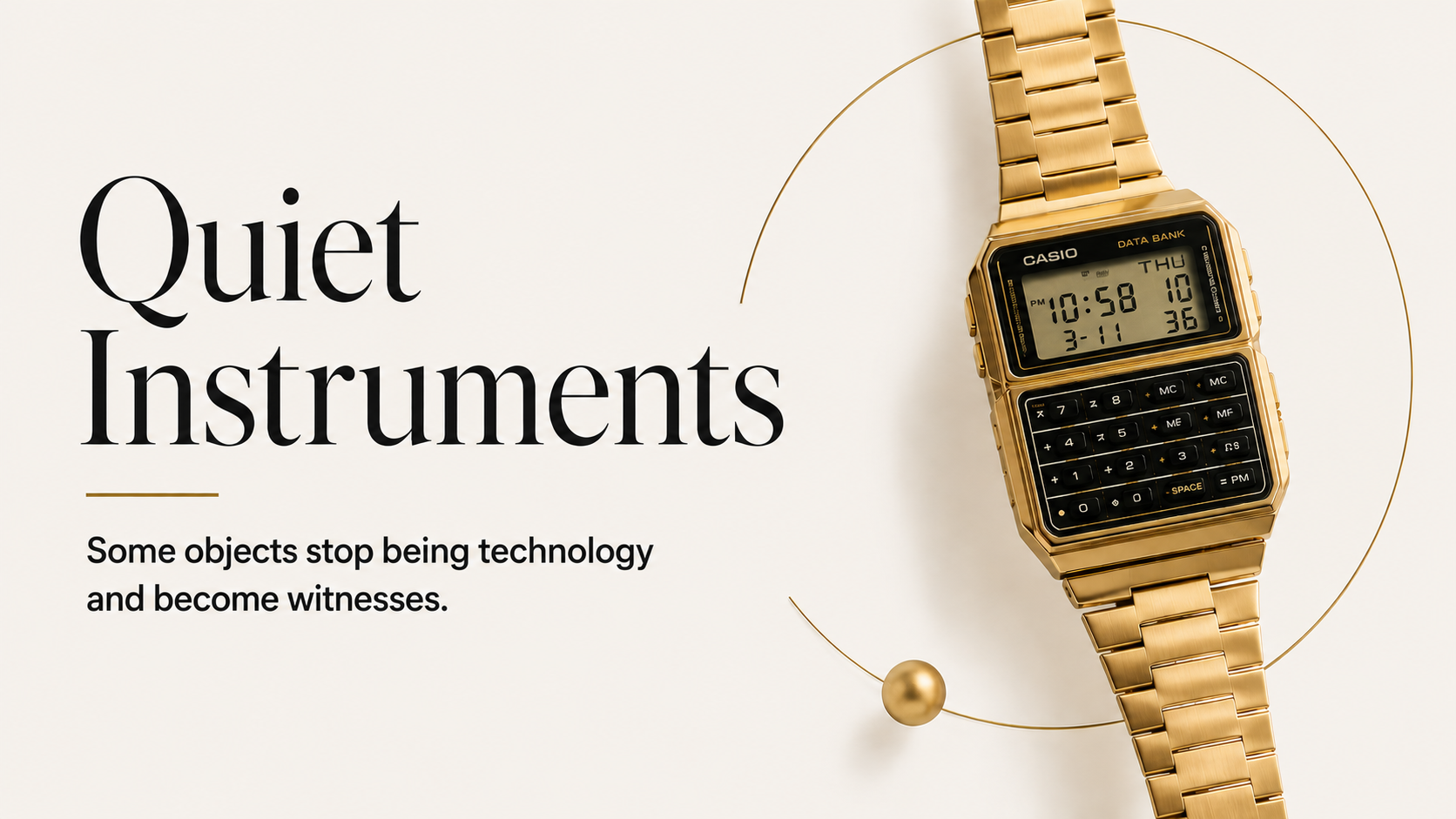
My physician wears a gold Casio calculator watch from the 1980s.
Not ironically.
Not as vintage fashion.
As a tool.
The thing catches light when she moves her hand across the keyboard. Tiny gold buttons. Tiny screen. Tiny keypad. A device that once represented the absolute frontier of wearable technology now sitting quietly in a modern medical office surrounded by cloud infrastructure, machine learning models, and enough processing power to launch Apollo missions several times over before lunch.
I noticed it immediately.
Not because it looked expensive. Quite the opposite. The watch looked durable. Familiar. Settled into.
At some point during the appointment, I realized the watch was no longer really a watch.
It was continuity.
That object has likely been present for years of her life. Maybe decades. Residency. Overnight shifts. Difficult conversations. Long mornings running behind schedule. Small victories nobody else noticed. Moments where she knew exactly what to do and moments where she feared she did not.
The watch remained.
Technology companies spend billions trying to create emotional attachment through novelty. Annual launches. New finishes. New animations. New health metrics. Entire ecosystems optimized around engagement and replacement.
The little Casio offers none of that.
It does not ask for attention.
It does not vibrate with algorithmic urgency.
It does not attempt to emotionally manipulate its owner into reopening an application designed to maximize retention metrics.
It waits quietly until needed.
That restraint feels almost radical now.
In the 1980s, calculator watches represented the future. Miniaturized computation on the human body. A tiny cybernetic artifact from a world that believed technology would help people think more clearly, move more efficiently, and carry useful tools into everyday life.
Somewhere along the way, technology drifted from augmentation toward interruption.
A modern smartwatch can monitor sleep cycles, oxygen saturation, heart rhythm irregularities, stress levels, exercise performance, location history, communication streams, and market activity before breakfast.
Most people are more anxious than ever.
The Casio still knows exactly what it is.
There is something deeply reassuring about that.
Maybe that is part of why the watch affected me so strongly.
I had one of those gold Casio calculator watches as a kid. My father gave it to me sometime around 1985 or 1987. I remember staring at it the way children stare at objects that seem impossibly futuristic. Tiny buttons. Tiny screen. Computation on the wrist.
Back then, the watch represented where technology was going.
Sitting in that medical office decades later, it represented something else entirely.
Experienced professionals often gravitate toward stable tools for reasons that are difficult to explain to people raised inside perpetual upgrade culture. The best tool is not always the newest one. Sometimes the best tool is the one that disappears into muscle memory. The one that asks almost nothing of its owner while reliably remaining available.
Designers understand this instinct immediately.
So do pilots.
So do nurses.
So do recovering addicts with a favorite coffee mug they carried through the hardest year of their life.
Objects accumulate meaning through proximity to transformation.
A worn leather bag. An old keyboard. A fountain pen repaired three times instead of replaced once. A twenty-four-hour sobriety chip with softened edges.
The value eventually stops living inside the object itself.
It migrates into memory.
That is what I kept thinking about while watching her move through the appointment with this tiny gold relic from another technological era resting on her wrist.
The watch no longer symbolizes innovation.
It symbolizes persistence.
Maybe that is why it affected me so strongly.
We live inside systems obsessed with replacement. Faster phones. Faster feeds. Faster cycles of identity construction and abandonment. Entire industries depend on convincing people that familiarity is failure.
Yet some of the most competent people you will ever meet quietly carry the same objects for decades.
Not because they cannot afford better.
Because the object became part of the architecture of their life.
The calculator watch still works.
So does she.

Subscribe to Amid the Noise
Amid the Noise is an ongoing body of work on signal, systems, governance, AI, and the structures that shape human judgment under pressure.
Subscribe to receive new essays as they are published.