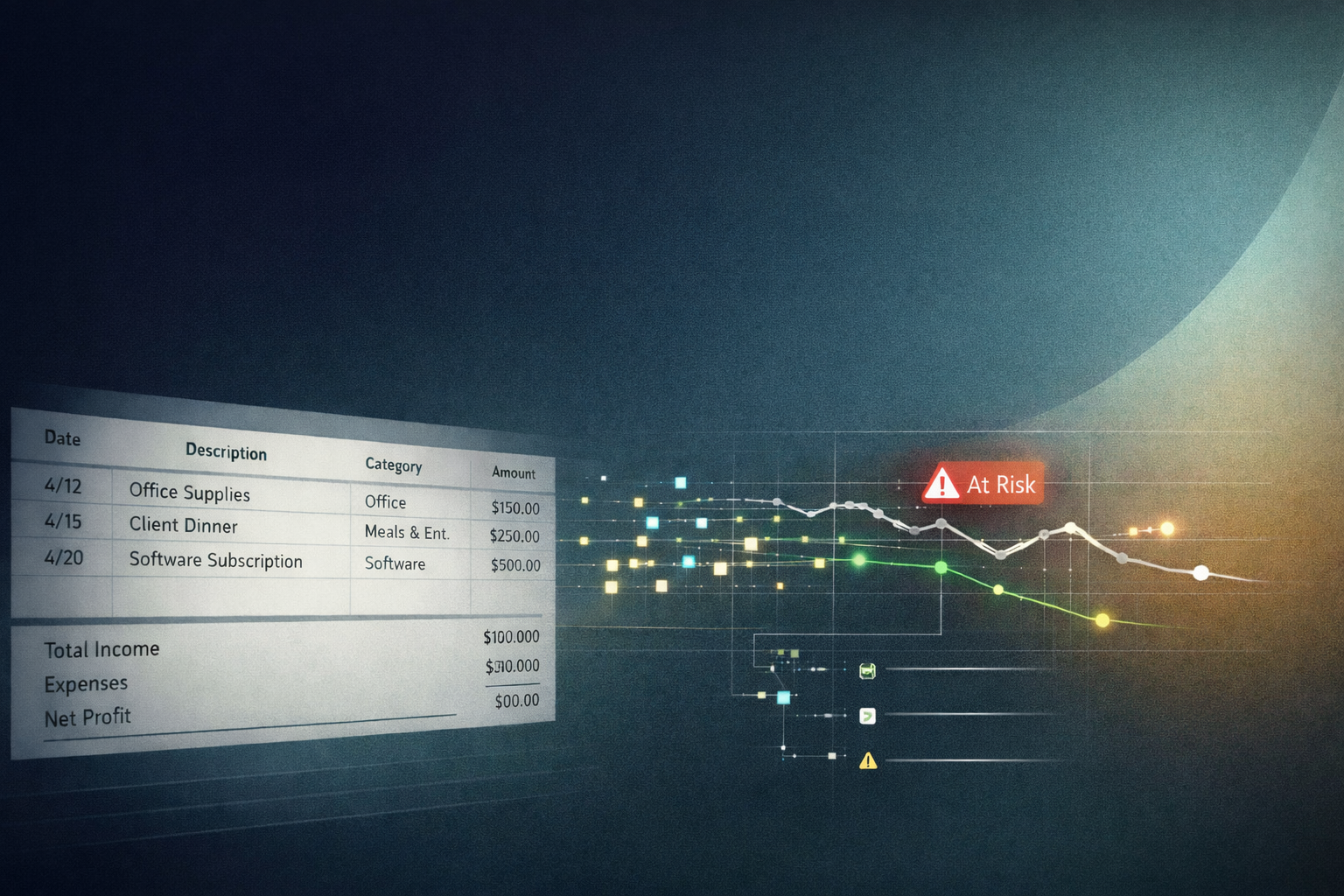
What a Decision System Actually Requires
From records to decisions under uncertainty
Most small business software answers the wrong question.
It answers: What happened?
Small business owners are asking something else entirely: Am I okay?
In practice, that question turns into a constant check on timing and risk, and whether the business holds together over the next few weeks.
That gap is where AI either becomes transformative or irrelevant.
You see this pattern everywhere once you look for it. Small business operators circle the same pressures: cash anxiety, uncertainty about what’s coming next, and the friction of turning financial data into something actionable.
Today, Intuit QuickBooks functions as a highly reliable system of record. It captures transactions, categorizes activity, and produces reports that satisfy compliance, accounting, and tax requirements. It does this well.
QuickBooks has already begun this shift. It projects cash flow, flags anomalies, and surfaces insights through tools like Intuit Assist. The trajectory is clear. The boundary is where those signals become accountable guidance.
It surfaces signals, trends, and reminders. It does not consistently translate those signals into actionable, context-aware decisions.
That is not a feature gap. It is a framing problem.
The Ledger Is Not the Product
The ledger is a memory system.
It tells you where money has been. It does not tell you where you are going, or whether your current trajectory is survivable. For a small business owner managing cash flow, timing, and uncertainty, that distinction is not academic. It is existential.
AI does not need to make bookkeeping faster. It needs to make decision-making clearer.
That requires a shift:
From records to trajectories.
From dashboards to judgments.
From automation to accountability.
From Records to Trajectories
A categorized transaction is a closed loop. It explains the past.
A business runs on open loops.
What matters is not that an expense occurred, but what that expense does to the next six weeks of liquidity. What matters is not that an invoice was sent, but whether it will be paid on time, and what happens if it is not.
A redesigned system would treat every financial input as a forward-moving signal:
- Cash runway under current conditions
- Sensitivity to delayed payments
- Projected constraint points under multiple scenarios
Not a forecast presented as certainty, but a set of bounded trajectories.
The operator does not need a prettier report. They need to see the edge they are walking toward.
From Dashboards to Judgments
Dashboards assume time, literacy, and emotional distance.
Most operators have none of those in the moments that matter.
A decision system moves beyond neutral presentation. It takes a position, with constraints made explicit.
- You can afford this expense
- Delay this payment by ten days
- You are within one late invoice of risk
Each position must be accompanied by reasoning and confidence:
- What inputs were used
- What assumptions were made
- Where uncertainty is highest
This is not automation. It is augmented judgment.
From Automation to Accountability Loops
Automation without visibility creates fragility.
If a system categorizes transactions, schedules payments, or flags anomalies without exposing its reasoning, the user either over-trusts it or ignores it. Both outcomes degrade the system.
Every AI action should carry its own audit trail:
- What was done
- Why it was done
- What alternatives were considered
- What the system might be wrong about
Without this, trust does not scale.
At Intuit’s scale, these constraints are not theoretical. They are the product.
From Categories to Intent
Traditional bookkeeping reduces activity into predefined buckets.
Meals. Software. Travel.
These categories satisfy accounting standards. They do not capture operational intent.
AI can.
- A meal is not always “meals and entertainment.” It may be client acquisition.
- A software subscription is not just an expense. It may be a critical dependency.
Intent sits one layer above classification. It connects financial activity to strategy.
That layer is only partially expressed in current systems. It is where AI begins to earn its place.
Once intent is visible, the system can answer better questions:
- Which expenses drive revenue
- Which costs are structural versus discretionary
- Where the business is actually investing, not just spending
From Tool to Operating System
In its current form, QuickBooks is a tool within a workflow.
In a redesigned form, it becomes the center of gravity.
Payroll, invoicing, and tax preparation become inputs into a larger system whose output is decision support.
The interface shifts from:
Here is your data.
to:
Here is your next move.
The Risk of Getting This Wrong
Financial systems are trust systems.
Overconfident AI introduces real risk:
- False certainty
- Liability exposure
- Erosion of operator judgment
QuickBooks succeeds today because it is conservative. It records reality and limits speculation, which is essential in a domain where guidance can carry legal and financial consequence.
A poorly executed AI layer would damage that trust quickly.
The Synthesis
Do not replace the ledger. Wrap it with reasoning.
- Keep the books precise and auditable
- Build a layer that models trajectories and surfaces decisions
- Make uncertainty explicit
The system becomes two things at once:
A system of record.
A system of bounded judgment.
Most AI integrations add features. That approach is already underway.
The harder move is different.
It accepts that the user is not managing data. They are managing risk, timing, and survival under uncertainty.
Small business owners do not need faster bookkeeping.
They need a system that can stand beside them, look at incomplete information, and say:
Given what we know, here is the move.
Not perfectly.
Not with certainty.
With enough clarity to make a call and move.
That is the redesign.

Subscribe to Amid the Noise
Amid the Noise is an ongoing body of work on signal, systems, governance, AI, and the structures that shape human judgment under pressure.
Subscribe to receive new essays as they are published.