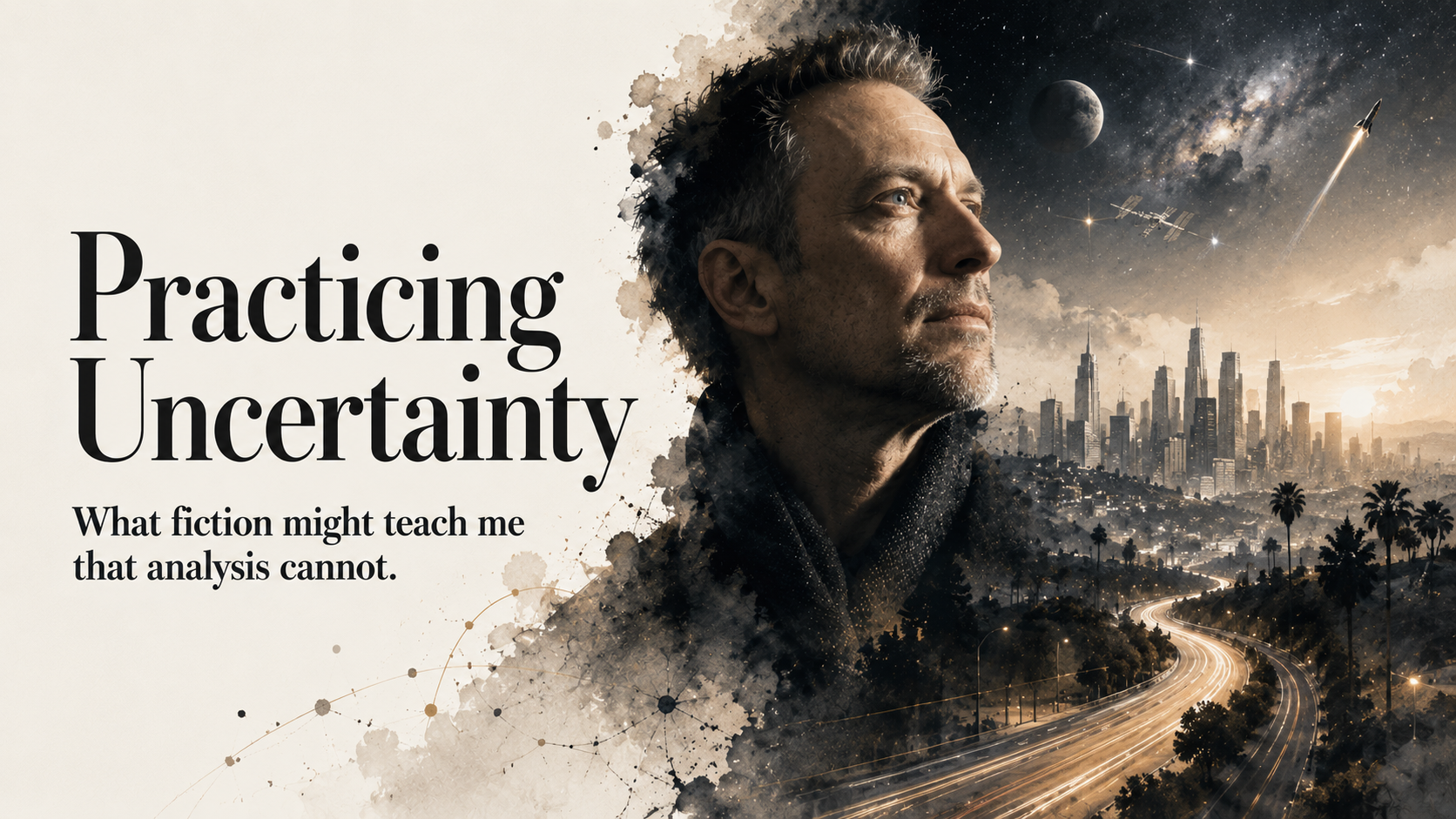
Practicing Uncertainty
What fiction might teach me that analysis cannot.
I have spent most of my life trying to understand the world analytically.
That instinct has served me well.
It helped me navigate systems. Recognize patterns. Anticipate failure. Read rooms. Understand incentives. Build arguments. Protect myself.
Protection, if I am being honest, is probably closer to the center of it than I used to admit.
Recently I noticed something uncomfortable about the way I process emotion.
My first instinct is often defense.
Not reflection. Not curiosity. Not patience.
Defense.
Then the analytical part of my brain arrives almost immediately afterward to construct a framework around the feeling. Evidence appears. Logic appears. Pattern recognition activates. I become very good at explaining why the emotion makes sense.
Sometimes the analysis is even correct.
That does not necessarily make it healthy.
I think there is a difference between understanding a feeling and prosecuting a case for it.
For a very long time, I did not separate those two things.
The older I get, the more I realize how quickly I move toward intellectual stabilization. Ambiguity bothers me. Emotional uncertainty bothers me. I want coherence rapidly. I want the shape of the situation to resolve into something understandable and defensible.
I do not think this came from nowhere.
People who spend enough time navigating unstable systems often become highly adaptive interpreters of behavior. You learn to predict reactions early. You learn to construct explanations quickly. You learn to emotionally brace for impact before impact fully arrives.
That instinct can become deeply ingrained.
It can also quietly narrow perception.
Because not every emotional experience needs to become a verdict immediately.
That realization is part of why I want to experiment with fiction.
Not because I secretly wanted to become a novelist. Not because I am abandoning essays or systems thinking. Not because I suddenly think analysis lacks value.
Quite the opposite.
Analysis remains one of the ways I make sense of the world.
Still, I have started wondering whether analysis has become my only approved method of perception.
Fiction seems to demand something different.
Observation without immediate judgment. Characters without verdicts. Motivations that remain partially unresolved. Contradictions that are allowed to coexist without immediate correction.
Essays let me defend ideas.
Stories may force me to witness people instead.
That difference feels important.
I suspect fiction requires a kind of emotional spaciousness that does not come naturally to me yet. You cannot fully control people once they become characters. They behave inconsistently. They contradict themselves. They reveal motives gradually. They surprise the author.
At least good characters do.
That uncertainty may actually be the point.
I have spent years writing arguments, systems essays, observations about governance, trust, infrastructure, institutions, signal, and technology. Much of that work emerged from a genuine desire to understand the world honestly.
Still, I am beginning to suspect there are forms of truth that become inaccessible once the analytical mind grips too tightly.
Some experiences need atmosphere before explanation. Some truths arrive sideways. Some things become visible only after the instinct to defend loosens slightly.
I think that may be why fiction interests me now.
Not as escape.
As practice.
Practice sitting with uncertainty long enough to observe it before resolving it into meaning.
Practice allowing emotional truth to exist before building architecture around it.
Practice seeing people as environments instead of arguments.
I do not know yet whether I will be good at fiction.
Honestly, that uncertainty is part of why I want to try.
For most of my life, I have trusted analysis to help me survive.
I am beginning to wonder what observation might help me become.

Subscribe to Amid the Noise
Amid the Noise is an ongoing body of work on signal, systems, governance, AI, and the structures that shape human judgment under pressure.
Subscribe to receive new essays as they are published.