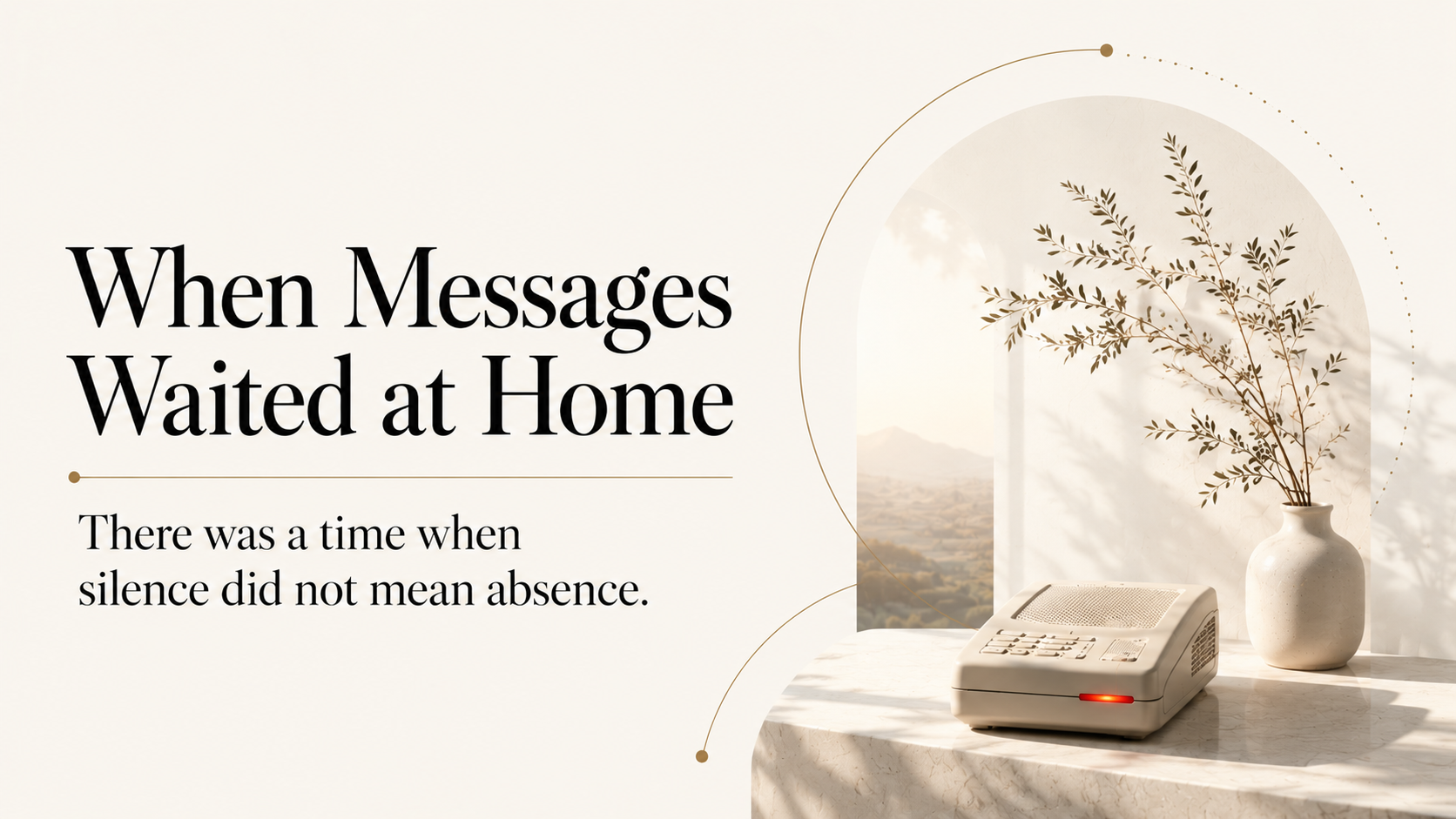
When Messages Waited at Home
There was a time when silence did not mean absence.
I honestly cannot imagine life without a cellphone anymore.
I have carried one almost continuously since 2000. Before that, I had a bag phone in the car beginning sometime around 1992. Cellular connectivity arrived in my life early enough that permanent reachability began to feel normal before adulthood fully settled in.
Still, every now and then, I remember something that feels almost impossible now.
In Rio Rancho, New Mexico, I lived in a house where the garage sat separately from the main structure. To get inside, I had to walk through a small courtyard that opened toward the kitchen. The kitchen itself had massive windows facing outward into the desert light.
Inside sat a beautiful NorTel phone with a long red voicemail indicator.
If someone called while I was gone, that red bar would blink softly through the window when I came home.
That was how I knew the world had tried to reach me.
Not while I was driving.
Not while I was shopping at Furr’s Supermarket or wandering through Target.
Not while I was eating lunch somewhere or standing in line or sitting alone with my own thoughts.
The message waited patiently at home until I returned to it physically.
What strikes me now is how completely normal that felt at the time.
I did not experience anxiety while I was unreachable. Nobody interpreted my absence as hostility. Silence did not automatically imply emergency, avoidance, irresponsibility, or emotional withdrawal.
People simply understood that sometimes you were out in the world living your life.
Communication still had geography then.
Messages existed in places.
Answering machines sat on kitchen counters. Voicemail belonged to the home. Missed calls accumulated quietly in physical locations instead of following you around like a digital weather system attached to your nervous system.
I think we underestimate how psychologically significant that boundary once was.
Modern phones did not merely increase convenience. They dissolved the distinction between presence and availability.
Now a person can be:
- at dinner
- in therapy
- driving
- walking through a grocery store
- sitting beside the ocean
- grieving
- exhausted
- asleep
and still experience low-grade pressure to remain continuously accessible.
The expectation itself became ambient.
That shift happened so gradually most of us barely noticed it.
We surrendered unreachable time in exchange for permanent connectivity, then slowly reorganized society around the assumption that immediate response represents care, competence, professionalism, and emotional investment.
Silence became suspicious.
Delayed response became social friction.
Entire industries emerged around reducing the amount of time humans spend outside communicative reach.
Looking back, the thing that surprises me most is not the technology itself.
It is the emotional spaciousness.
I would leave the house and simply disappear into the day for a while. Not dramatically. Not rebelliously. Just ordinarily.
The world continued functioning.
Then eventually I would return home, walk through the courtyard, glance toward the kitchen window, and see whether the red voicemail light was blinking.
There is something almost sacred about that now.
Not because the past was perfect. Not because technology is evil. I am deeply shaped by modern technology and remain fascinated by what connected systems make possible.
Still, I cannot ignore the possibility that we accidentally traded away a form of cognitive freedom we barely understood while we still possessed it.
A few hours where nobody expected immediate access to your mind.
A few hours where your thoughts belonged entirely to you.
A few hours where messages simply waited at home.

Subscribe to Amid the Noise
Amid the Noise is an ongoing body of work on signal, systems, governance, AI, and the structures that shape human judgment under pressure.
Subscribe to receive new essays as they are published.