Infrastructure Is Not Dependency
Redundancy as independence
Most people think dependence is the problem.
You rely on a train, a bus, a public office, a system. The conclusion follows: if you need something external, you must be less independent.
That sounds right until you notice what actually limits you.
A car tied to another person can disappear in a moment. A ride withheld. A key not handed over. Movement becomes a negotiation.
A train does not negotiate.
It shows up. Or it runs late. Or it breaks. None of that is personal. None of it is conditional on you.
That difference matters more than people admit.
When Movement Stops Asking
There is a version of movement that requires coordination.
You check in. You wait. You adjust to someone else’s timing, someone else’s willingness. Even small decisions carry friction.
Then there is a different version.
You show up. You board. You move. No one mediates the interaction. No one grants or withholds access in the moment.
The difference is easy to miss until you’ve lived both.
In one case, movement can be taken from you.
In the other, it continues whether anyone approves or not.
The Structure Underneath
Independence isn’t isolation. No one actually lives that way.
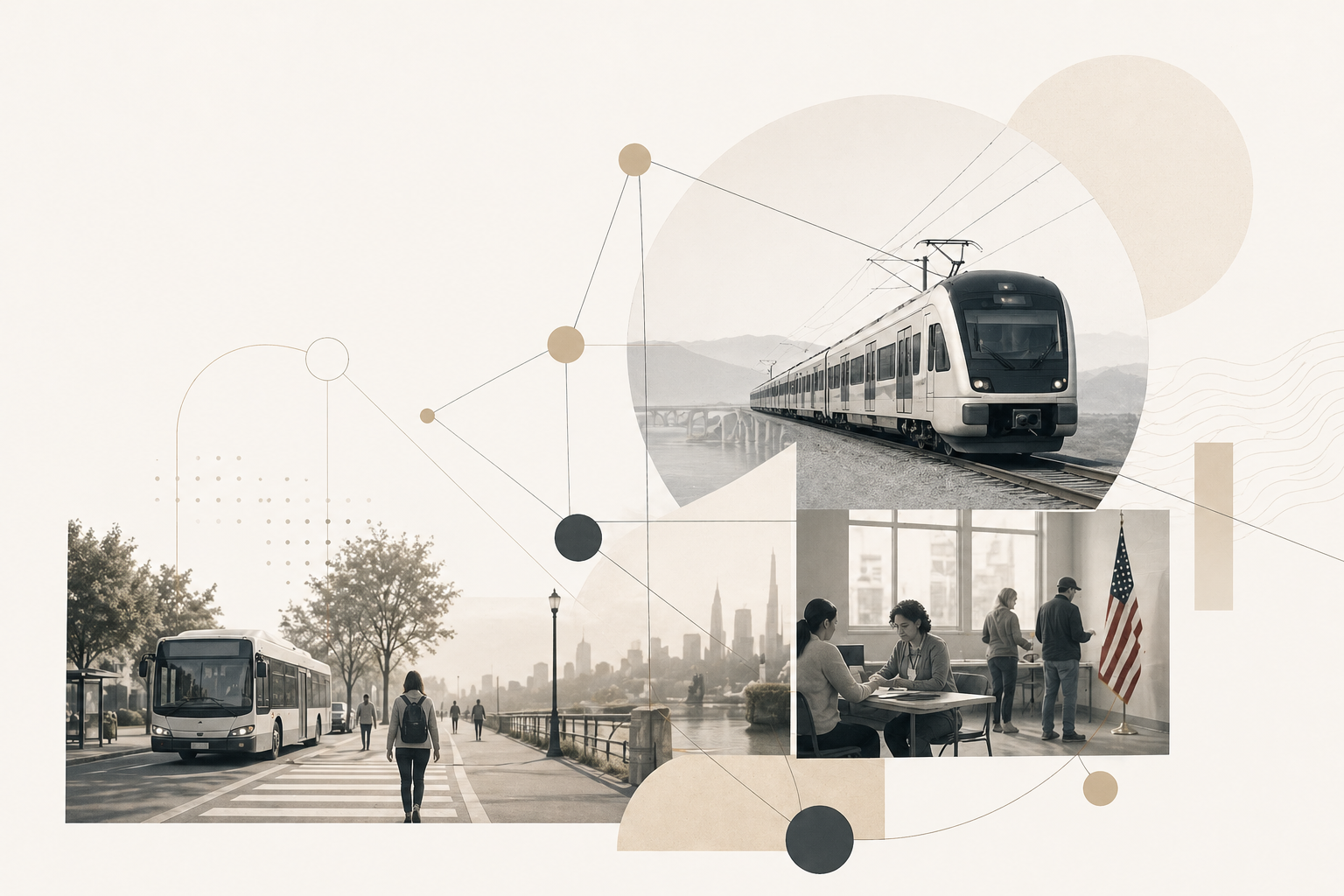
What exists instead is a web of systems that overlap just enough to keep you moving when one of them fails.
Transit. Payment. Identity. Communication. Voting.
They don’t look related. They don’t need to.
What matters is what happens when something goes wrong.
The train is delayed. You take a bus.
Your information doesn’t line up cleanly. You cast a provisional ballot.
You’re in the wrong place. The system reroutes you instead of turning you away.
You’re not perfect. The system expects that.
When it works, it bends around the edge case instead of rejecting it.
That’s not dependence. That’s design.
Where the Language Fails
Calling these systems “dependencies” misses the real question.
The issue isn’t whether you rely on something. Everyone does.
The issue is whether that reliance can be used against you.
A single path can be controlled. It can be closed. It can be withheld.
Multiple paths are harder to manage that way. They dilute control. They give you somewhere else to go.
Redundancy doesn’t weaken independence. It protects it.
The Part Worth Questioning
Some systems do the opposite.
They narrow your options. They require exact inputs. They offer no alternative when something doesn’t line up. Step outside the path and access disappears.
That’s where dependence becomes real. Not because the system exists, but because it removes your ability to move without it.
You can feel the difference quickly.
One kind of system absorbs mistakes.
The other punishes them.
What This Actually Means
Independence isn’t about standing alone.
It’s about never being one decision away from being stuck.
Enough systems in place, working loosely together, make that possible. Not perfect. Not seamless. Just reliable enough that movement doesn’t belong to any one person or gate.
You can feel it in moments like this.
Not in some abstract way. In something simple. You show up, you move, you continue. No one mediates that for you.
That’s the shift.
It isn’t dramatic. It doesn’t announce itself.
It just shows up as a day where you move through the world and nothing asks you to stop.

Subscribe to Amid the Noise
Amid the Noise is an ongoing body of work on signal, systems, governance, AI, and the structures that shape human judgment under pressure.
Subscribe to receive new essays as they are published.