The Poll Site Is a Decision System
Resolve uncertainty without denying participation
A vote center looks simple from the outside. Tables. Ballots. A line that moves or doesn’t.
Step inside and the shape of it changes.
Every interaction is a decision.
I saw this from inside Santa Clara County’s vote centers, watching rules, paper, software, and human judgment collide whenever certainty broke down.
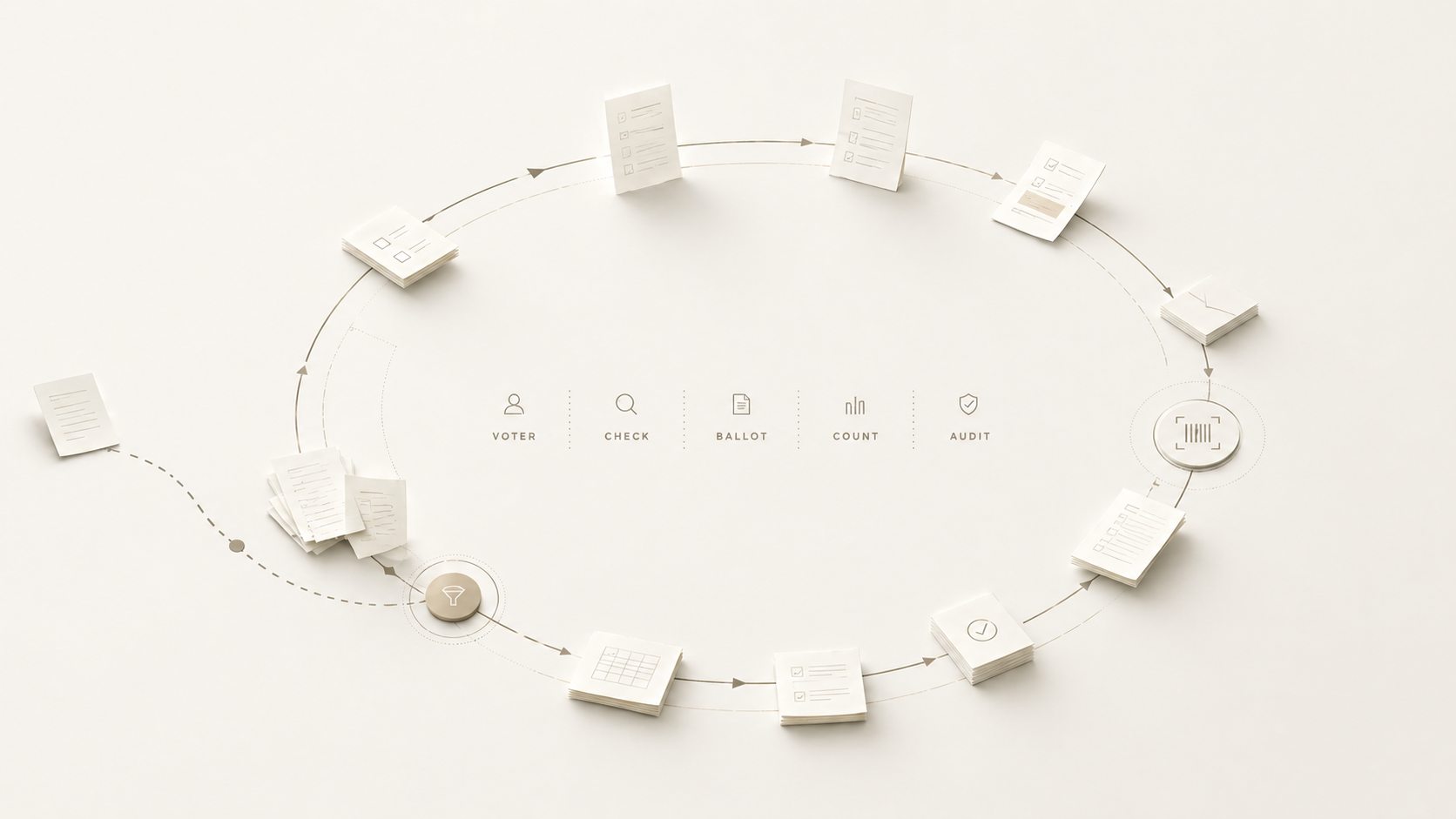
A voter approaches. Their name is checked. The system either finds them or hesitates. A worker makes a call. Standard ballot. Provisional. Escalation. Each path carries a different level of certainty, but all of them move forward.
The system does not stop at uncertainty. It absorbs it.
In Santa Clara County, that design choice is explicit. A voter does not need to prove everything perfectly in the moment. If identity cannot be fully resolved, the system captures the vote provisionally and verifies it later. Participation comes first. Certainty catches up.
Once you notice the pattern, it appears everywhere.
A voter can walk into any vote center in the county. Location no longer determines eligibility. The system pulls the right ballot from data, not geography. The question is no longer “Are you in the right place?” It becomes “Can we generate the right ballot for you from here?”
The voter no longer carries it. The system does.
Identity works the same way. The system treats it as something to resolve, not a fixed gate that either opens or closes. Most voters pass through without friction. Some do not. Out-of-county voters. People whose names have changed but whose records have not. These are ordinary moments where records and reality stop matching cleanly.
When that happens, the voter still moves forward while the uncertainty moves into review.
Ballot casting follows the same pattern. A voter can mark a paper ballot or use a touchscreen device. Different paths, same destination. Every vote ultimately becomes a physical ballot. That ballot is scanned and tabulated, but the paper remains the ground truth.
Multiple ways in. One way to count.
Every official piece of paper is tracked. Ballots. Spoiled ballots. Provisional envelopes. Receipts. Logs. If it enters the system, it must be accounted for when the system closes.
Nothing disappears.
The point is traceability.
Each piece of paper represents a potential decision: a vote cast, a vote voided, a vote deferred, a voter processed.
If something goes missing, the system cannot explain itself.
The accounting has to close.
The result is a physical audit trail alongside the digital one. Two records describing the same event, each capable of challenging the other.
None of this feels dramatic while it’s happening. Mostly it feels procedural. Quiet.
The rules define the boundaries. Workers make judgment calls inside them. The paper records the outcome.
The modern vote center is not a place where eligibility is proven. It is a place where eligibility is resolved, recorded, and made auditable.

Subscribe to Amid the Noise
Amid the Noise is an ongoing body of work on signal, systems, governance, AI, and the structures that shape human judgment under pressure.
Subscribe to receive new essays as they are published.