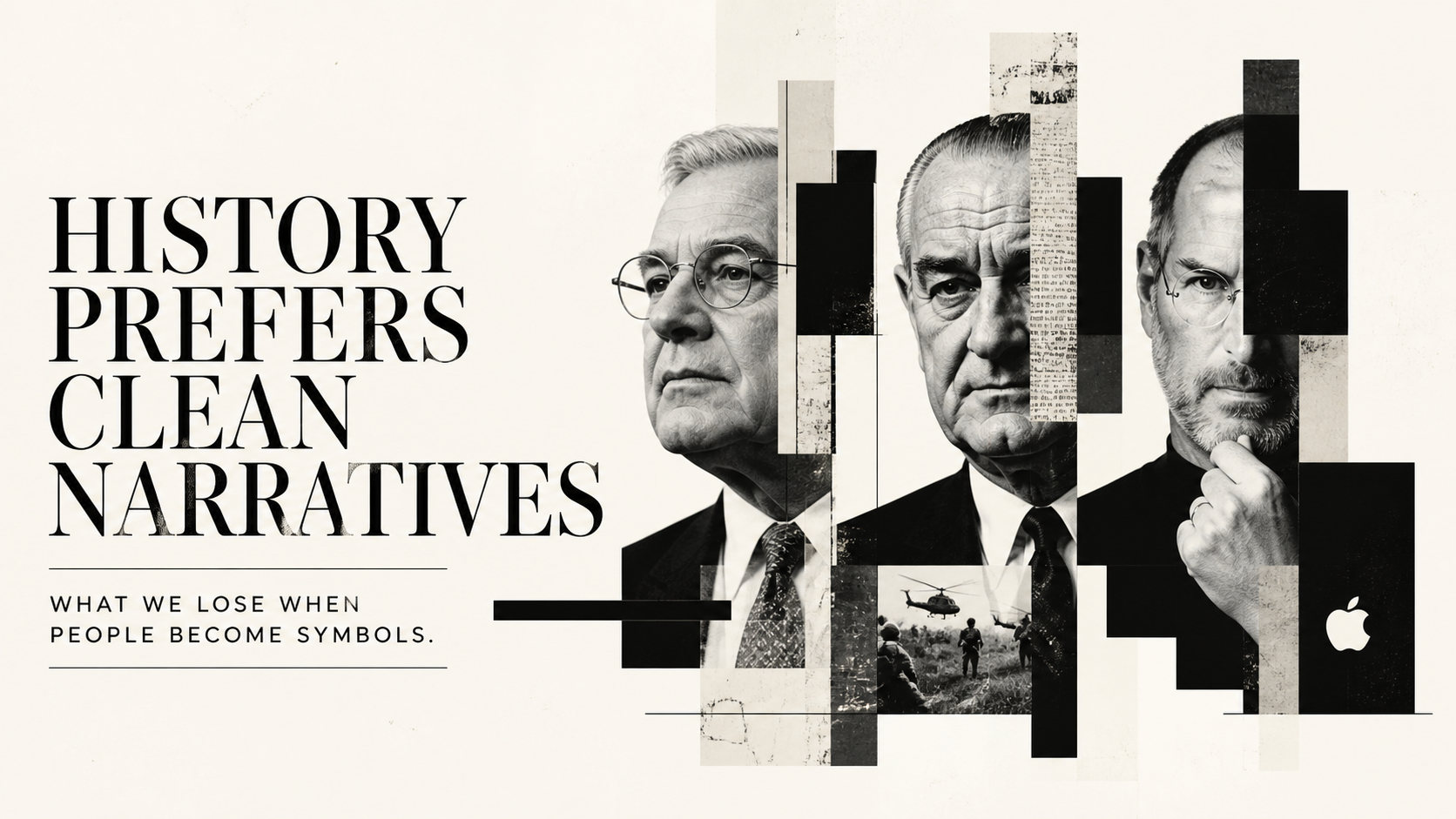
History Prefers Clean Narratives
What we lose when people become symbols.
I was sad to hear that Barney Frank had entered hospice care.
A few minutes later, I found myself reading a deeply angry Substack essay from someone in the LGBTQ community describing him in almost completely opposite terms. Not as a pioneer, but as a selfish political operator. Not as a symbol of liberation, but as a source of pain and exclusion.
The emotional whiplash felt strangely modern.
The older I get, the less interested I become in flattening people into clean categories. History prefers that approach because it is efficient. Human beings rarely cooperate.
Barney Frank becomes “gay rights.”
Lyndon B. Johnson becomes “Vietnam.”
Steve Jobs becomes “Apple.”
Three entire human beings compressed into shorthand.
For most of my life, I thought of Lyndon Johnson as an abrasive Southern politician who escalated one of the most divisive wars in American history. That was the thumbnail version. The simplified one. The version easiest to carry around.
Then I learned more about the actual use of presidential power behind the scenes.
Johnson strong-armed Congress into passing the Civil Rights Act and the Voting Rights Act despite enormous resistance, including from parts of his own region and political coalition. The same man associated with Vietnam was simultaneously one of the most consequential legislative forces for equality in modern American history.
That contradiction complicated the story.
Steve Jobs underwent a similar transformation for me, just in a different direction.
The public mythology around Jobs often presents him as a singular inventor standing alone at the edge of the future. The closer you look, the more complicated the reality becomes. Apple’s breakthroughs often emerged through refinement, integration, timing, taste, and relentless execution rather than spontaneous invention alone. At the same time, countless stories describe Jobs as personally difficult, emotionally volatile, and deeply complicated in his relationships.
None of that erases what he built.
None of what he built erases the rest either.
Barney Frank sits in that same uncomfortable territory for me now.
I still respect the historical significance of what he represented. It mattered that gay Americans saw someone openly occupying space inside the federal government at a time when that visibility carried real social and political risk.
At the same time, reading criticism from within the very community he fought for reminded me how incomplete public memory usually is. Every movement contains internal fractures. Every coalition leaves someone feeling unheard. Every historical figure eventually becomes large enough that other people start projecting their own experiences onto them, both good and bad.
The simplified version survives because simplification is useful.
Symbols are easier to organize around than people.
People are inconsistent. Contradictory. Self-interested. Generous. Petty. Visionary. Cruel. Brave. Afraid.
History does not merely remember. It edits.
Contradiction is usually the first thing removed.
The strange part is that I no longer find this depressing. If anything, it feels clarifying. The older I get, the more suspicious I become of perfectly coherent narratives about public figures. Clean stories often tell us more about the needs of the culture preserving them than the actual people involved.
We do not remember human beings as they were.
We remember versions compressed enough to carry forward.
History prefers clean narratives because people are easier to manage once they have been reduced to symbols.
Human beings, on the other hand, are heavy.

Subscribe to Amid the Noise
Amid the Noise is an ongoing body of work on signal, systems, governance, AI, and the structures that shape human judgment under pressure.
Subscribe to receive new essays as they are published.