Betty White and I
What the ocean revealed beneath the machinery of fame.
For most of my life, I did not think Betty White and I had much in common.
She was a television icon. I grew up in Oklahoma watching the seasons change through spider lilies, lodge halls, library stacks, thunderstorms, and long conversations about the future. Our worlds did not appear adjacent.
I had already been part of the Aquarium’s ocean legacy circle before the name change happened.
That is what caught me off guard.
The announcement did not feel like celebrity branding or institutional theater. It felt strangely personal. Somewhere beneath one of the most recognizable public personas in American culture was a person who cared deeply about the same living systems I did.
The farther I thought about it, the less interesting the fame itself became. What stayed with me was the realization that someone I assumed I had almost nothing in common with had quietly organized part of her life around conservation, stewardship, and awe toward the natural world.
That felt familiar.
The older I get, the less interested I become in fame itself. Celebrity is mostly compression. A human being flattened into a recognizable signal. Public memory tends to reduce people into caricatures of their loudest trait.
Funny. Brilliant. Beautiful. Difficult. Legendary.
The actual person usually disappears somewhere underneath the abstraction.
What struck me about Betty White was the opposite.
The farther I got from the celebrity version of her, the more recognizable the underlying person became.
Someone who cared about sea life. Someone drawn toward conservation. Someone who understood that awe is not childish. It is one of the few emotions capable of making people protective instead of possessive.
The Monterey Bay Aquarium has always felt different to me for that reason.
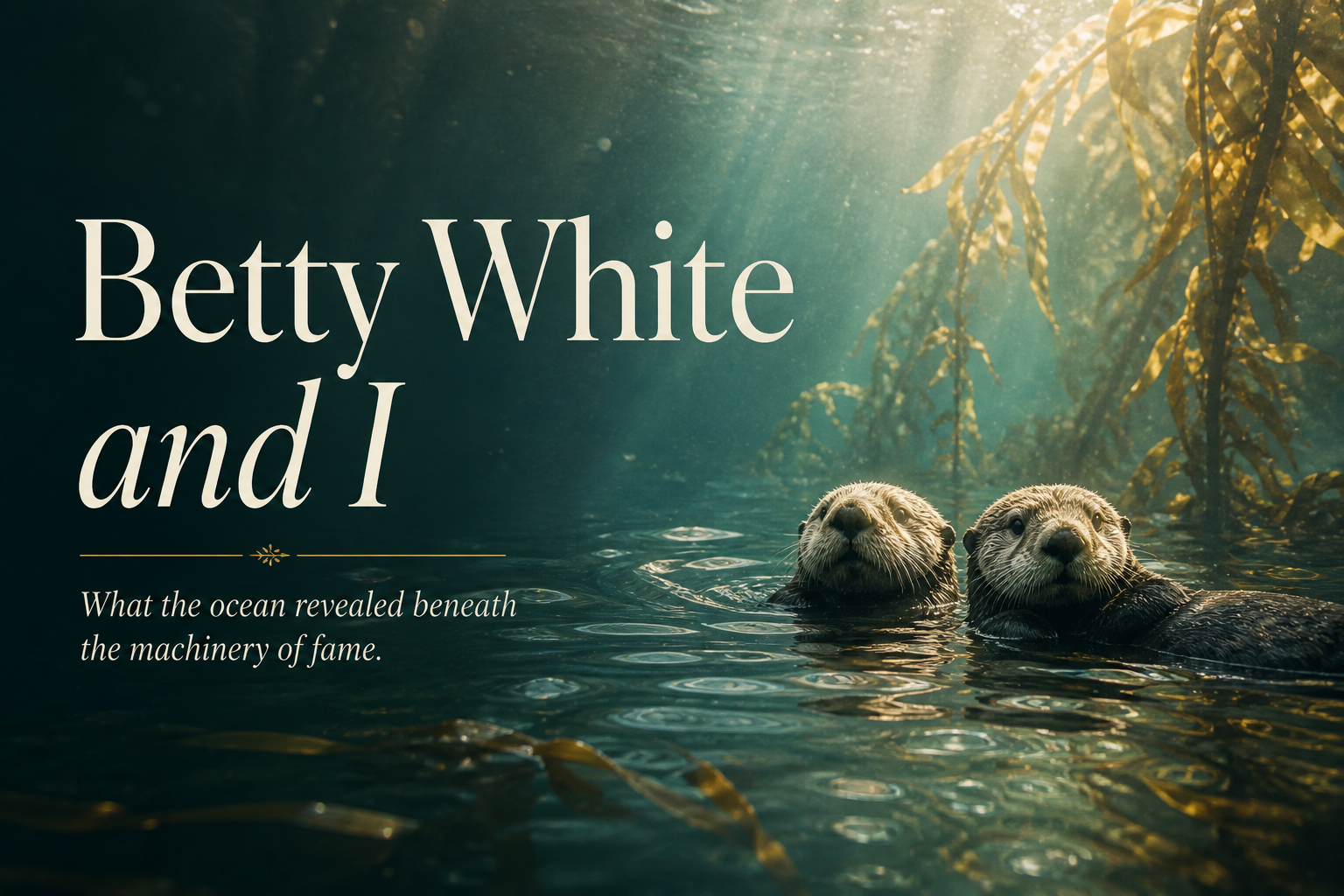
It does not bully people into caring about the ocean. It simply places them close enough to living systems that reverence emerges naturally. You stand in front of a kelp forest or watch sea otters drift together in cold Pacific water and suddenly the world feels interconnected in a way modern life rarely allows.
No screaming. No spectacle. No algorithmic outrage.
Just quiet exposure to something alive.
That is an unusually soft form of persuasion.
It is also incredibly effective.
I think American culture often mistakes softness for fragility because we confuse loudness with strength. Yet most of the things that actually sustain civilization operate through quieter forms of continuity.
Caretaking. Maintenance. Teaching. Stewardship. Conservation.
None of those things dominate headlines. All of them determine whether the future remains livable.
Sea otters are a strangely perfect symbol for this. Their existence is tied directly to the health of kelp forests, which support entire ecosystems along the Pacific coast. When otters disappear, imbalance spreads outward. When they return, systems stabilize around them.
Gentleness turns out to have structural consequences.
That realization changed the way I thought about Betty White.
Not the actress. Not the celebrity. Not the icon.
The person underneath all of it.
The person who looked at the ocean and felt responsibility instead of ownership.
That is the part I feel connected to.
Not because we lived similar lives.
Because beneath wildly different public identities, we arrived at the same conclusion: some parts of this world are worth protecting simply because they are beautiful and alive.
That feels more real to me than fame ever did.

Subscribe to Amid the Noise
Amid the Noise is an ongoing body of work on signal, systems, governance, AI, and the structures that shape human judgment under pressure.
Subscribe to receive new essays as they are published.