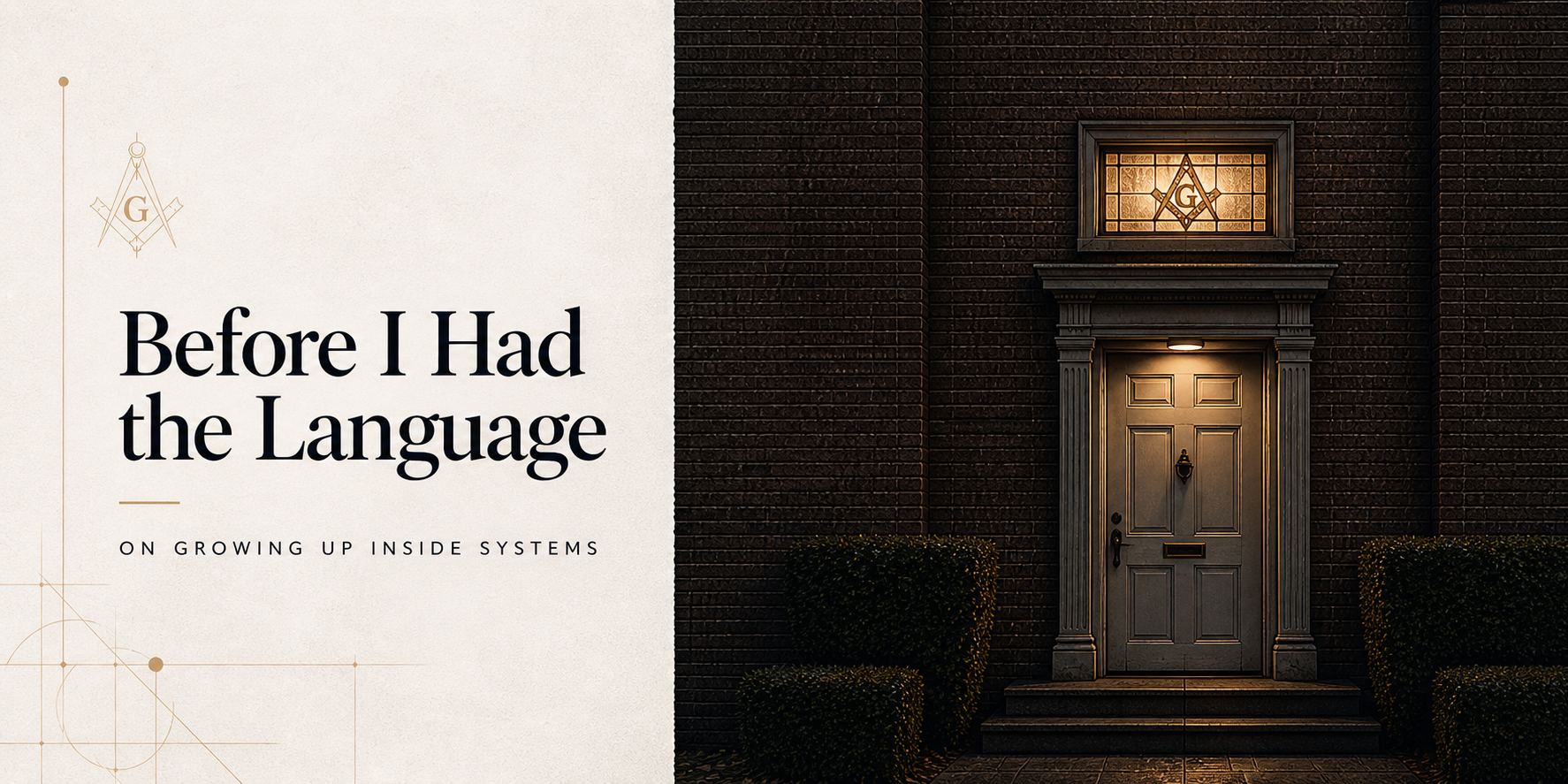
Before I Had the Language
On growing up inside systems
I spent time in Masonic lodges before I was ever allowed to be part of one.
Not as a member. Just a kid waiting while my parents attended Order of the Eastern Star meetings.
I remember the room, and I remember the people.
Everyone was dressed with intent. Jackets, ties, formalwear. Not for show. For position.
They carried themselves differently once the meeting began. More deliberate. More exact.
They weren’t just attending the meeting. They were stepping into roles that were already waiting for them.
Those roles were elected.
And they treated them that way.
The symmetry of the room matched the way people moved within it.
Everything had a place, even if I didn’t know what any of it meant.
My father would answer questions, but only to a point. Enough to suggest that everything in the room had a function. Not enough to explain it.
It never felt like belief.
It felt like structure.
I didn’t have the language for it then, but I was already paying attention to how things were built.
Not what people believed. How belief was organized.
I would later move through the system in the way many do—first through DeMolay International, then into Freemasonry, and eventually into the Scottish Rite.
At the same time, I saw a parallel track unfold around me. My sister’s involvement in International Order of the Rainbow for Girls and Job’s Daughters International. My mother’s deep connection to Rainbow.
The language was the same.
The expectations were not.
Looking back, what stands out is not the content of any one experience. It’s the consistency of the system itself.
Scripted language that removed ambiguity.
Defined positions that clarified where you stood.
Progression that turned participation into identity.
Repetition that made values feel natural, even inevitable.
These were not abstract ideas.
They were embedded in the environment.
What stayed with me wasn’t what people said.
It was the feeling of stepping into something that didn’t depend on me to exist.
The system would still be there tomorrow. With or without me.
I recognize that feeling now working with the Santa Clara County Registrar of Voters.
A system designed to hold. To function. To maintain integrity regardless of who happens to be inside it on any given day.
The structure held.
The people didn’t always.
It wasn’t sudden.
It was drift.
Fewer people in the room.
The same names returning to the same roles.
Decisions shaped as much by familiarity as by principle.
Nothing broke. Nothing failed outright.
The form stayed intact.
But something underneath it started to thin.
That was the first time I understood something I rely on now.
A system can be well designed and still lose its clarity in practice.
Not because the structure is wrong.
Because people don’t always operate within it the way it was intended.
Systems don’t fail all at once.
They drift.
Before I ever designed systems, I was shaped by them.
I didn’t find this work later in life. I grew up inside it.
What I took with me wasn’t doctrine or belief.
It was an awareness that systems are built. That they encode decisions. That they guide behavior long before anyone notices.
Some systems tell you what to think.
The better ones show you how thinking is structured.
And once you see that, you start to recognize it everywhere.

Subscribe to Amid the Noise
Amid the Noise is an ongoing body of work on signal, systems, governance, AI, and the structures that shape human judgment under pressure.
Subscribe to receive new essays as they are published.