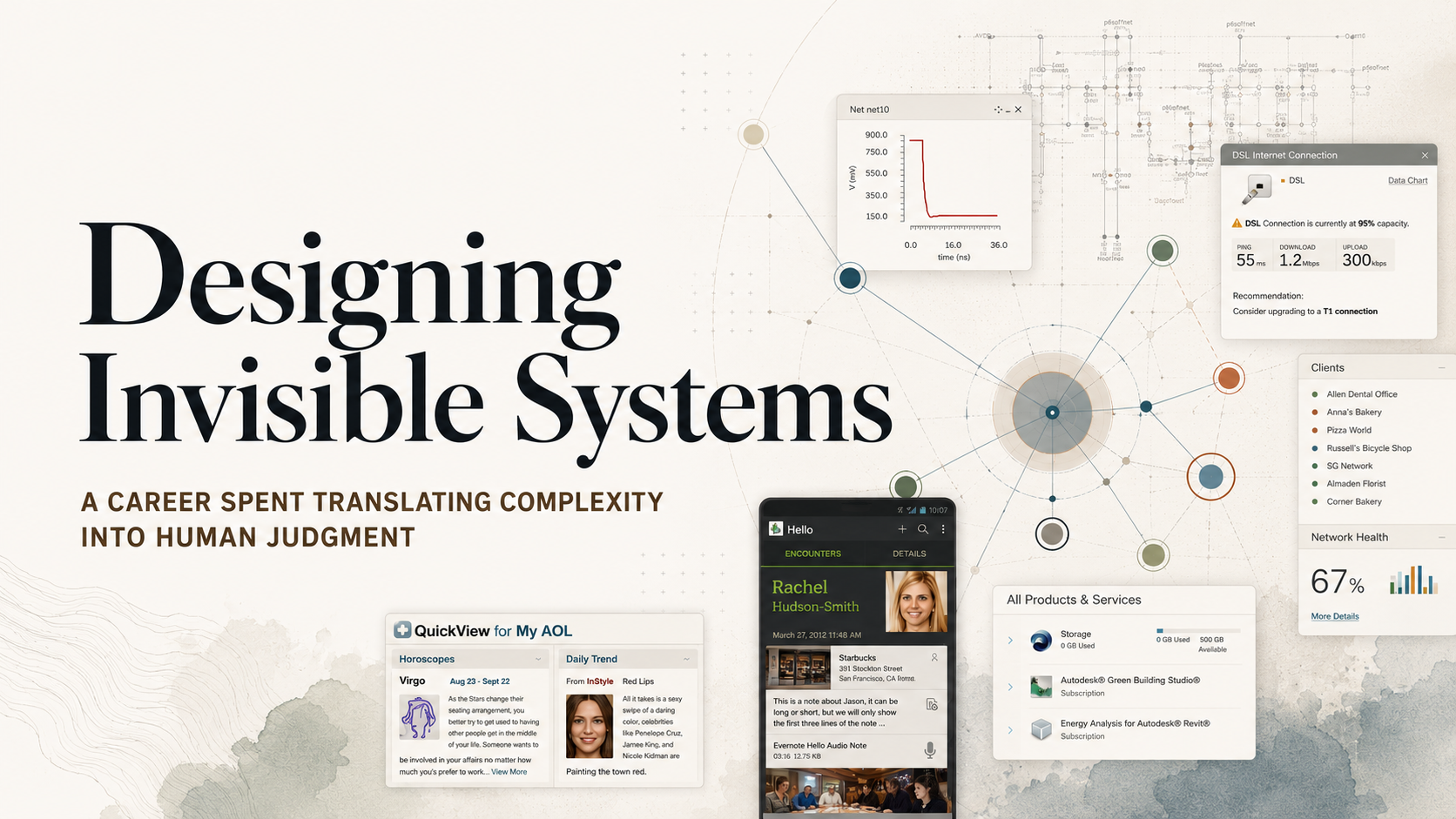
Designing Invisible Systems
A career spent translating complexity into human judgment
Most people experience technology through apps.
I spent most of my career designing the systems behind them.
Networks. Identity systems. Semiconductor tooling. Cloud infrastructure. Ambient memory systems. Enterprise telemetry. Operational dashboards.
Systems so large and interconnected that no single person could fully hold them in their head all at once.
The public rarely sees these environments directly. They appear only as side effects: a recommendation arrives instantly, a subscription activates correctly, a network outage resolves itself, a simulation finishes successfully, a relationship resurfaces at the exact moment memory would have otherwise failed.
The interfaces behind those moments are rarely witnessed. They are often dense, technical, and operationally unforgiving. Yet they quietly shape how modern life functions.
Over time, I realized I was never really designing screens.
I was designing translation layers between humans and invisible systems.
The Systems Beneath the Surface
Every era of computing creates new forms of invisibility.
In the early web, it was information overload. Later it became identity, networks, distributed infrastructure, cloud orchestration, and machine-scale operational complexity. Today it is increasingly probabilistic systems driven by AI, telemetry, and automation.
The problem remains remarkably consistent:
How do humans make decisions inside systems too large, fast, or abstract to fully perceive?
That question quietly connected nearly every environment I worked in, even when the industries appeared completely unrelated.
Designing Human Memory
In the early 2010s, I worked on Evernote Hello.
At first glance, it looked like a contact application. In reality, it was something stranger and far more ambitious: an attempt to build contextual relationship memory into everyday life.
The application treated encounters as meaningful events rather than static records. Who did you meet? Where? Under what circumstances? What was discussed? Who else was present? What business card was exchanged? What photos were taken nearby?
Long before AI assistants normalized ideas like contextual memory and ambient recall, these systems were already exploring the edges of machine-assisted human continuity.

Looking back now, the design challenge was not merely organizational. It was cognitive.
Human beings are terrible at maintaining relational continuity at scale.
Modern life increasingly depended on remembering hundreds of fragmented interactions across conferences, airports, offices, dinners, introductions, and passing conversations. The cognitive load quietly exceeded what human memory evolved to manage comfortably.
We forget names. Context collapses. Time compresses. Relationships drift into fragments.
The interface became an external memory scaffold.
Not artificial intelligence in the modern sense. Something quieter: a system designed to preserve human orientation across increasingly fragmented social environments.
Making Networks Legible
Around the same period, I worked on Cisco OnPlus.
The problem space could not have looked more different. Instead of human relationships, the system visualized small-business network infrastructure: routers, switches, wireless access points, printers, servers, internet health, service degradation, topology relationships, failure states.
Yet underneath, the challenge was surprisingly similar.
Modern networks are invisible until they fail.
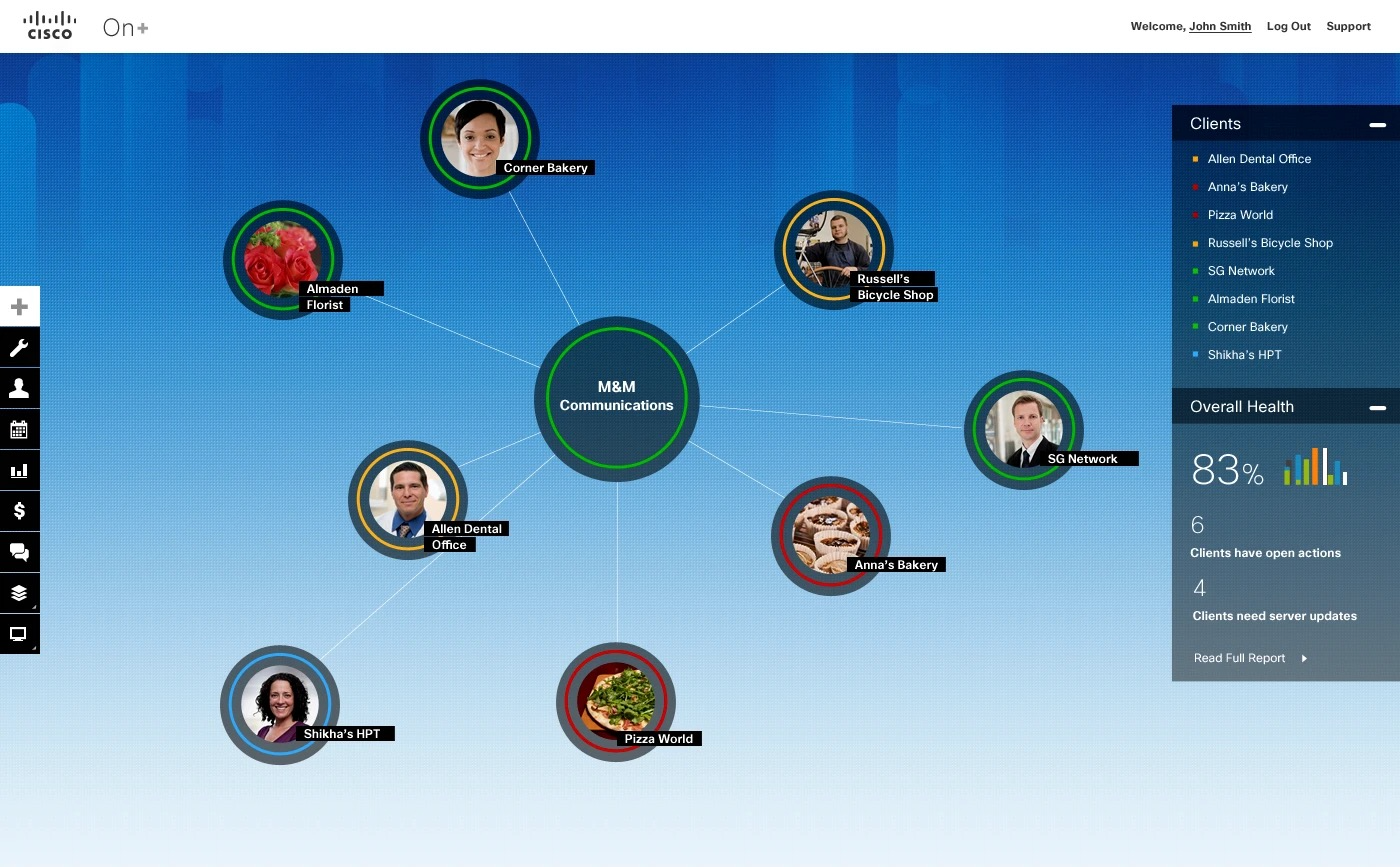
The interface was not simply reporting machine state. It was translating infrastructure into navigable operational understanding. Which systems were connected? Which dependencies mattered? What was degraded? What required intervention? What could safely be ignored?
The topology views mattered because they transformed abstraction into spatial reasoning.
Machines already understood the network.
Humans needed help understanding the consequences.
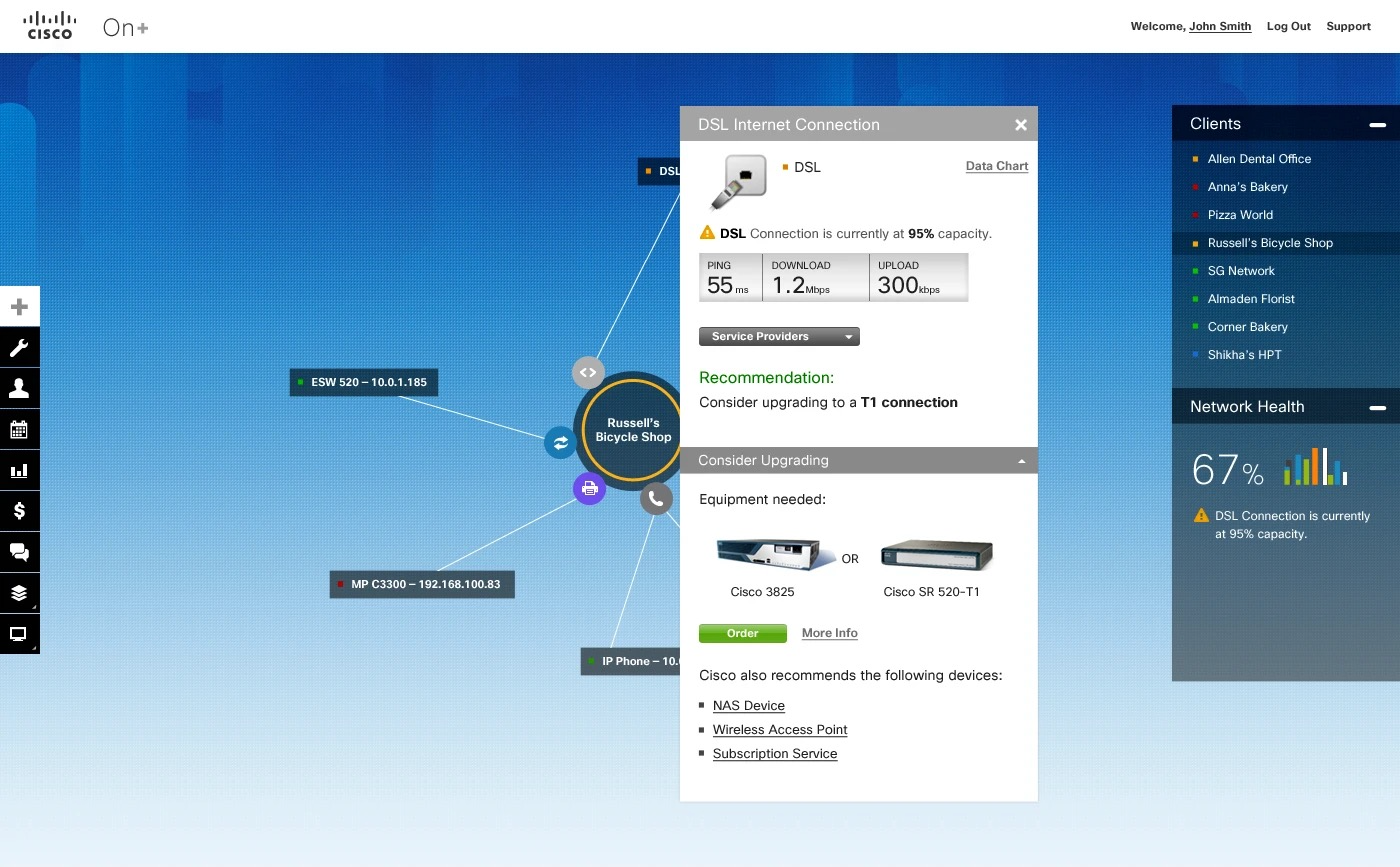
One recommendation screen in particular still stays with me: It was one of the first times I saw infrastructure software behave less like a monitoring tool and more like a system attempting to anticipate human consequences before failure arrived. a DSL line approaching saturation capacity, surfaced alongside upgrade recommendations and operational guidance.
Today, the language surrounding AI systems often focuses on explainability, observability, orchestration, and human oversight.
In many ways, those concerns already existed inside infrastructure tooling long before large language models entered public consciousness.
The systems were simply smaller, more deterministic, and easier to reason about.
When Software Became Service
At Autodesk, another transition was underway.
Software was no longer becoming something people purchased occasionally. It was becoming an ongoing service relationship built around identity, entitlement, storage, synchronization, and persistent cloud access.
The challenge was not merely interface modernization. It was psychological continuity.
People who had spent decades thinking in terms of owned desktop applications suddenly needed to understand accounts, subscriptions, permissions, services, and distributed ecosystems.

Moments like this are historically easy to underestimate while they are happening.
In retrospect, they represent profound shifts in the relationship between humans and technology. Software stopped behaving like a product people owned and started behaving like an environment they continuously inhabited.
The role of interface design expanded with it.
Losing access no longer felt like misplacing software. It felt like being locked out of part of modern working life.
Designing at the Edge of Human Comprehension
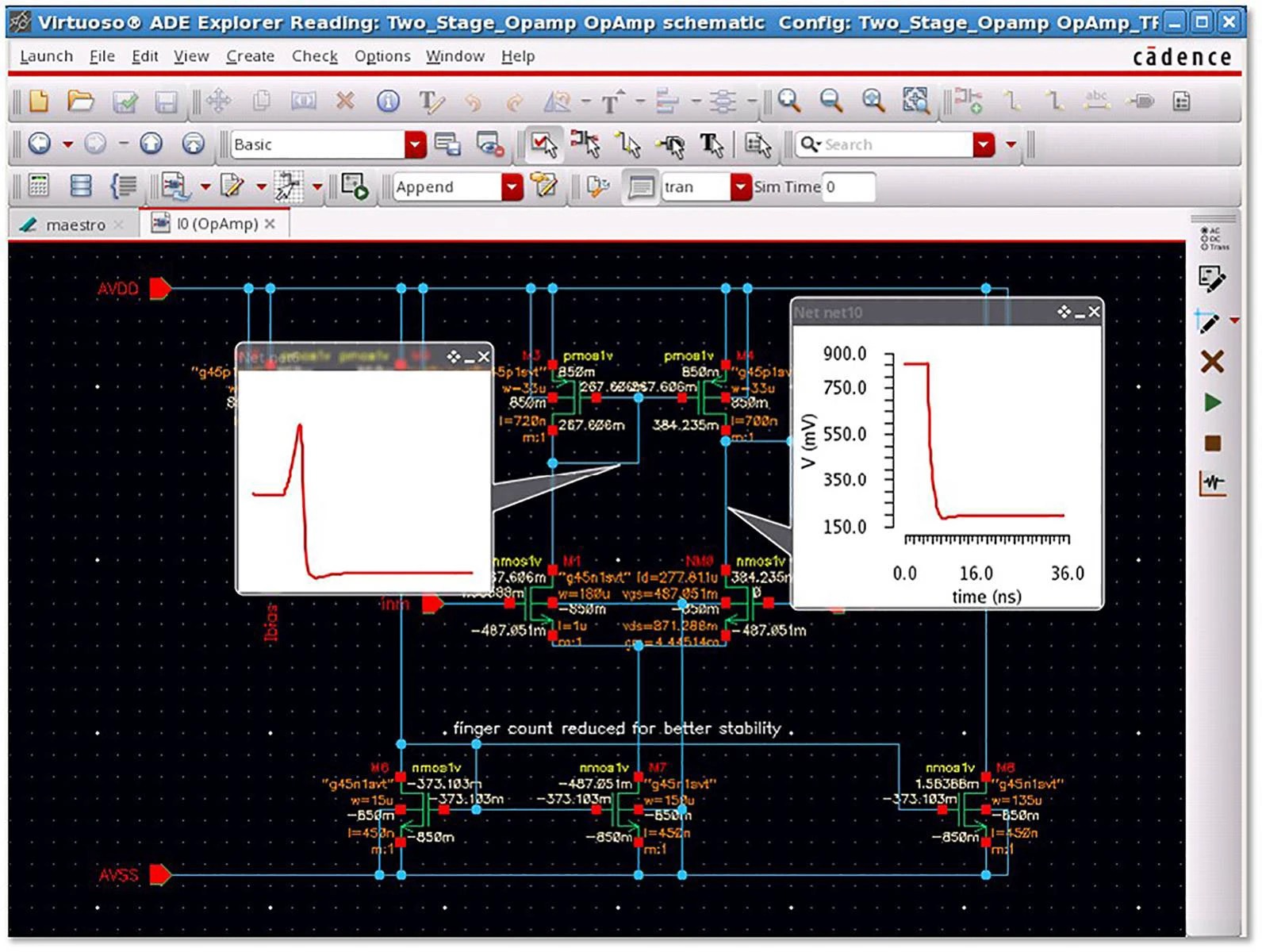
The most demanding environments I worked in were probably semiconductor systems.
Cadence users operated inside worlds defined by simulation, electrical behavior, signal integrity, timing relationships, abstraction layers, and manufacturing precision measured at astonishingly small scales.
These were not interfaces designed for casual discovery.
They were environments built for experts navigating immense technical complexity under significant cognitive load.
The lesson I carried away from those systems never left me:
simplification is not reduction.
Poor simplification hides reality. Good simplification preserves reality while making navigation possible.
That distinction matters deeply today as AI systems increasingly mediate decision-making across medicine, finance, infrastructure, logistics, governance, and security.
The challenge is not removing complexity.
The challenge is helping humans remain oriented within it.
Before AI Had a Face
Looking back across these systems now, a pattern becomes difficult to ignore.
The industries changed: social systems, network infrastructure, enterprise software, cloud services, semiconductor tooling, automation ecosystems.
The underlying cognitive problem did not.
Every system struggled with some version of the same question:
How do humans maintain judgment inside environments too complex to fully inspect?
That question sits at the center of modern AI discourse now, but it did not begin there.
For decades, interface designers have quietly been building cognitive bridges between human reasoning and increasingly invisible machine systems.
Most of those systems never became culturally visible. They existed beneath the surface of ordinary life, quietly coordinating infrastructure, memory, communication, permissions, logistics, and operational awareness.
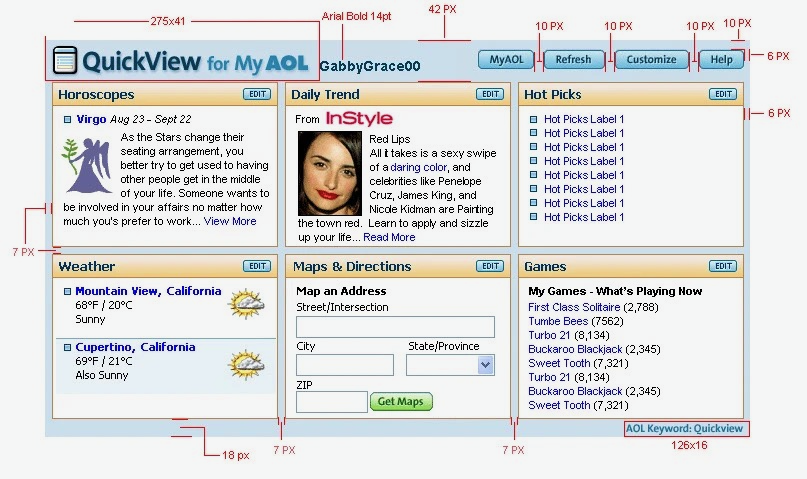
The screenshots from those years are not especially glamorous by modern standards. Some are dense. Some are awkward. Some belong to entirely different eras of computing.
That is precisely why they matter.
They document the gradual evolution of machine-mediated human judgment long before the current AI moment gave the industry language broad enough to describe it.
The Through-Line
For most of my career, I thought I was changing industries.
Now I think I was studying the same problem repeatedly from different angles.
How do humans navigate systems they cannot fully see?
How do we preserve agency inside environments increasingly shaped by invisible computation?
How do we build interfaces that clarify rather than obscure?
The technologies changed constantly.
The responsibility did not.
The work was always the same: helping human beings remain oriented inside systems too complex to fully see.

Subscribe to Amid the Noise
Amid the Noise is an ongoing body of work on signal, systems, governance, AI, and the structures that shape human judgment under pressure.
Subscribe to receive new essays as they are published.